


Nash County was formed in 1777 from Edgecombe County. It was named for American Revolutionary War Brigadier General Francis Nash, who was mortally wounded at the Battle of Germantown that year. In 1855, parts of Nash, Edgecombe, Johnston, and Wayne counties were combined to form Wilson County.
Bailey
There seems to be multiple overlapping and differing historical accounts for this area. First, the history of this community may date back to the 1700s when Drewey Bailey settled in the area. It’s said that the Township of Bailey was formed in 1860 when William Joseph Bailey, whose family came from England in 1565, was given a grant of 640 acres two miles from the present town. During the Civil War, according to local history, this area was called Bailey’s Mustering Ground, the place where soldiers assembled for duty or were discharged, and the area was also used as a hospital.
It’s also said that Bailey Township began in 1900 and the Town of Bailey was incorporated on February 1, 1908 as the town of Baileys. By 1919, Bailey had established itself as a small but promising tobacco market until the depression of the 1920s. President Harry S. Truman made a visit to Bailey when he was in office from 1945-1953.
Or… in 1907, the Town of Bailey was founded by Joseph D. Farmer, a prominent landowner in Bailey Township. That same year, the Norfolk and Southern Railroad laid its first tracks through Bailey’s Township (by prison labor), establishing the Bailey as a railroad depot, opening the sparsely-settled town to the region. Before that time, the Bailey area was known as Eatmon’s Post Office.
Take your pick!

Country Doctor Museum
The Country Doctor Museum (7089 Peele Rd.) is the oldest museum in the United States dedicated to the history of America’s rural health care. It was created in 1967 by a group of women from North Carolina, whose initial interest was to build a lasting memorial for rural physicians. Over the decades, the Museum’s collection grew to over 5,000 medical artifacts and many volumes of historic texts gathered from across the nation. The interpretive range also expanded from rural doctors to include topics such as nursing, pharmaceuticals, and home remedies.
The building itself was originally attached/adjacent to the doctor’s original home. But this portion was saved and relocated in Bailey as a museum. In 2001, the Country Doctor Museum’s board of directors decided to seek new stewardship. With its focus on primary care medicine, the division of Health Sciences at East Carolina University seemed to be an appropriate guardian. After two years of negotiations, the Museum was donated to the Medical Foundation of East Carolina University. Through an agreement with the Foundation, the Museum is managed today as part of East Carolina University’s Laupus Health Sciences Library.
The Museum invites people of all ages to visit and learn about the history of rural health care in the United States. Docents lead tours through three buildings of exhibits and are available to answer questions. Exhibits contain artifacts relevant to the practice of medicine between the late 18th century and the first half of the 20th century.

Rocky Mount
The region around the Tar River was continuously inhabited by various cultures of indigenous people for 12,000 years. It had long been home to the historic Tuscarora people, who spoke an Iroquoian language. English and Scots traders encountered the indigenous people in this area of the falls of the Tar River beginning in the mid-1700s. After English colonists and indigenous allies waged the Tuscarora War in the early 1700s; most survivors migrated to the North. The main party of the Tuscarora settled by 1722 with other Iroquoian peoples of the Five Nations, south of the Great Lakes in what became central and western New York. They became the Sixth Nation of the Iroquois Confederacy.
Incorporated in 1867, the community continued to develop through the 19th century based on agriculture (mostly cotton and tobacco), manufacturing of textiles (made possible by the water power of the falls), and development of rail transportation to link the town to major markets.
A post office was established at the falls of the Tar River on March 22, 1816. At this point, the name “Rocky Mount” officially appears in documented history, referring to the rocky mound at the falls of the Tar River. Rocky Mount Mills, the second cotton mill in the state of North Carolina, was built there soon after in 1818. Its proprietors were two entrepreneurs and Joel Battle, grandson of an original colonial settler here. Battle bought out the other proprietors before turning over the enterprise to his cousin James Smith Battle.
The Battle family was also involved in the construction of the longest continuous railroad in the world up to that time, the Wilmington and Weldon Railroad, which ran about two miles east of the mill. It connected the area to major ports in Virginia to the north and the port of Wilmington, North Carolina, to the south. The tracks first reached Rocky Mount on Christmas Eve in 1839. Subsequently, the railroad stimulated development of the town. In 1871, the county line was moved from the Tar River to its present location in the center of the tracks. The Raleigh-Tarboro stage route also passed just south of Rocky Mount (roughly where I-95 and U.S. 64 run today), and for a time was the logical debarking point for railroad travelers wishing to proceed east or west.
During the Civil War, the surrounding region was raided in 1863 by Union troops under the command of Brigadier General Edward E. Potter. They burned down the mill, which supplied Confederate yarn and cloth. After the war ended, the owners rebuilt the mill. On February 19, 1867, the village outside the mill, which was largely devoted to worker housing, was incorporated as a town.
In the latter half of the 19th century, the tobacco industry became established in the state. Adjacent to the sandy coastal plain, Rocky Mount was well situated to take advantage of the rapidly rising demand for brightleaf tobacco that grew best in the sandy soil. Tobacco also shaped the city’s social life. Warehouses where tobacco was stored and marketed began hosting balls for the community in the 1880s; these became known as “June Germans” for the time of year and style of dance. June Germans eventually transformed into all-night dance parties and attracted musicians and socialites from miles around well into the 1900s. By the end of the 19th century, tobacco had surpassed cotton as the town’s primary agricultural product.
On February 28, 1907, with a population around 7,500, Rocky Mount was officially incorporated as a city. A main railroad line, a well-established cotton mill, and productive farmland for brightleaf tobacco were major contributors to the area’s growth and prosperity over the next decades.
During the first decades of the 21st century, the city has encouraged efforts to revitalize the historic downtown. It has supported projects to renovate buildings such as the train station and Douglas Block, or repurpose them, such as the Imperial Centre for Arts and Sciences. In 2007, Capitol Broadcasting Company bought Rocky Mount Mills. It is adapting it as a mixed-use campus of breweries, restaurants, residential lofts, and event space. Major new community projects include the 143-acre sports complex and 165,000-square-foot downtown event center.
Rocky Mount has twice received the All-America City Award from the National Civic League: in 1969 and 1999. A small tornado touched down in the town of Rocky Mount the day before this bloggers’ visit, as a result of Hurricane Helene, causing only minor damage.
The Imperial Centre for the Arts & Sciences
The Imperial Centre for the Arts & Sciences (270 Gay St.), a version of Medieval Romanesque architecture, houses an arts center and gallery, education center, theater, planetarium, event space, and live animals. More than 90% of the complex’s buildings were originally built between 1903 and 1923.

City Lake Park
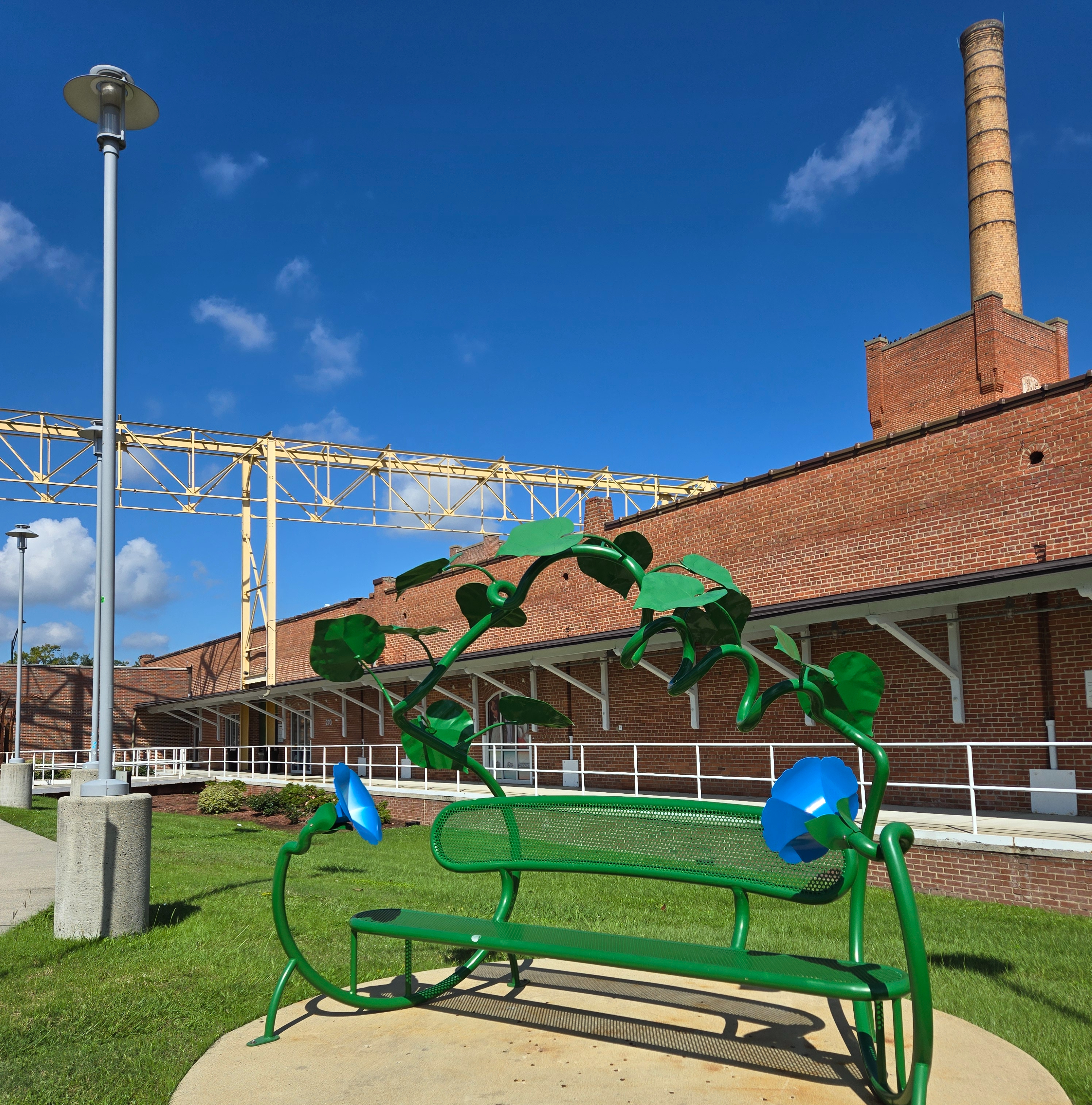
Located on Sunset Ave., City Lake Park offers a quiet retreat. Picnic or peruse around the lake and enjoy various public art pieces, including several metal animal sculptures crafted by nearby Greenville/Pitt County artist Jonathan Bowling.

Nashville
The town of Nashville, NC, was founded in 1780 and features Victorian and Queen Anne style homes. Founded in 1780, the town is named for Francis Nash, an officer of the North Carolina militia who died in the American Revolutionary War. The Nashville Blooming Festival was founded in 1997 and features food, music, vendors, a parade, and a carnival. North Carolina governor Roy Cooper is from Nashville.
Dortches
On July 19, 2023, an EF3 tornado stuck the town of Dortches, destroying many homes and leveling half of a local Pfizer plant. The tornado stayed on the ground for 16.5 miles.
Next stop… Guilford County!
 Portable NC
Thank you mi amiga.
Astrid Mesa Astrid’s Detailed Cleaning 203 Boyce Avenue Jamestown NC 27282 Astridsdetailedcleaning.com Ph: 336-456-4046
LikeLike