
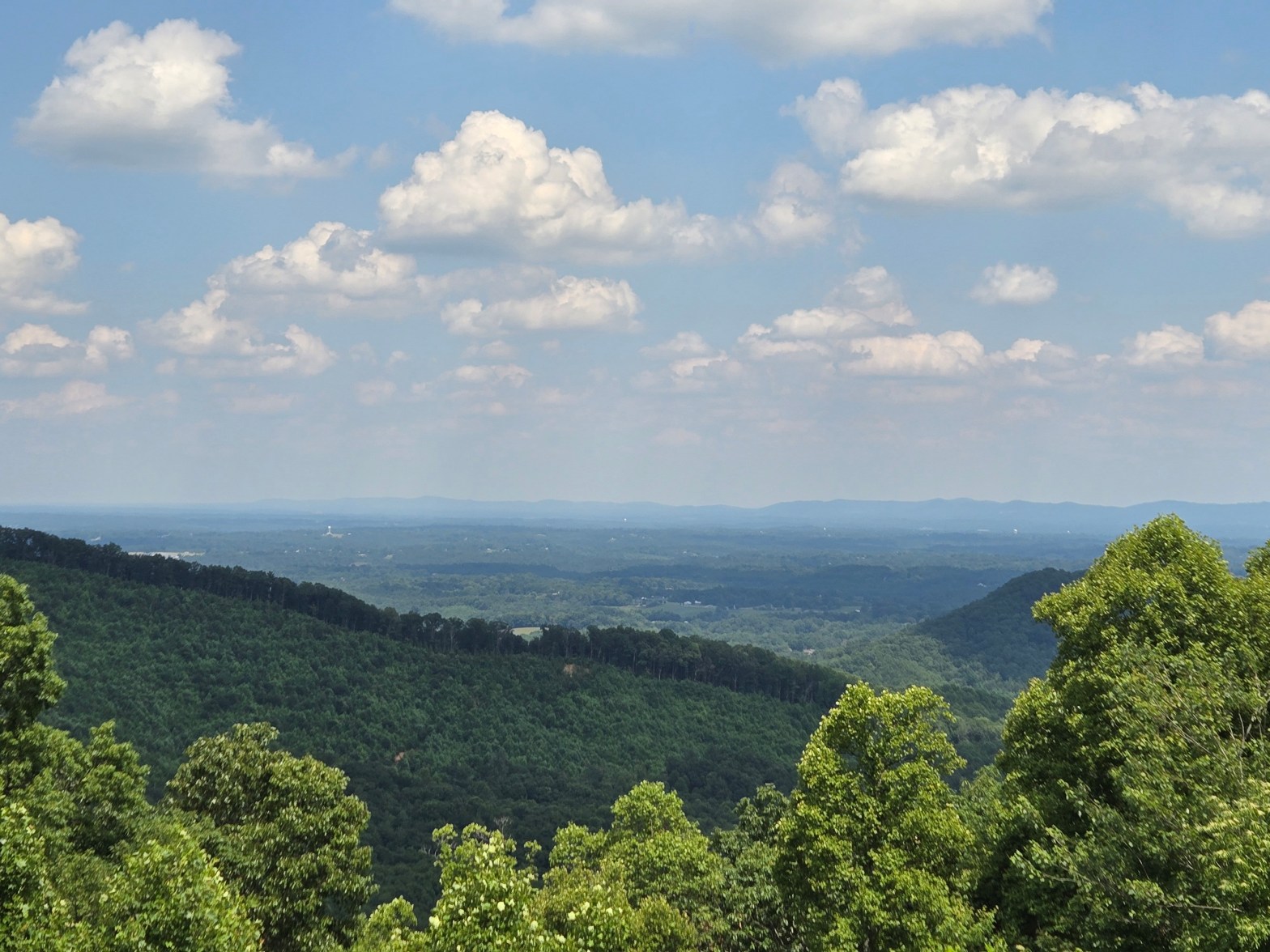
Wilkes is also one of the 27 North Carolina counties which the Blue Ridge Parkway runs through. Here you’ll discover lots of farms and orchards along your drive as well as surprising mountain vistas and bountiful scenic overlooks.
The county was formed from parts of Surry County and was named for the English political radical John Wilkes, who lost his position as Lord Mayor of the City of London due to his support for the colonists during the American Revolution. Over several years Wilkes County was subdivided, or boundary adjustments were made, to form all or part of Ashe County, Caldwell County, Alexander County, and Watauga County.
Wilkes County was once known as the “Moonshine Capital of the World,, and was a leading producer of illegal homemade liquor. From the 1920s to the 1950s, some young Wilkes County males made their living by delivering moonshine to North Carolina’s larger towns and cities. Wilkes County natives also used bootleg liquor as a means for barter beyond the borders of North Carolina. Many Wilkes County distillers ran white liquor as far as Detroit, New Jersey, and South Florida. Since this often involved outrunning local police and federal agents in auto chases, the county became one of the birthplaces of the sport of stock-car racing.
Despite its rural character and relatively small population, Wilkes County has been the birthplace of numerous large industries. Lowe’s, the second-largest chain of home-improvement stores in the nation (after The Home Depot) began in Wilkes County in 1946. And until 2003, Lowe’s had its corporate headquarters in Wilkes County, but the company has since relocated most of its corporate functions to Mooresville, North Carolina, a fast-growing suburb of Charlotte. However, Lowe’s large office in Wilkesboro still houses many corporate departments, and Lowe’s remains the county’s second-largest employer.
Other industries which started in Wilkes County include Lowes Foods (now headquartered in Winston-Salem — and started by the same Lowe’s family as Lowe’s Home Improvement). The Carolina Mirror Company in North Wilkesboro, founded in the 1930s, was for many years the largest mirror factory in America. Today Gardner Glass Products Inc. still produces mirrors in North Wilkesboro. Holly Farms, in Wilkesboro, was the largest poultry producer in the Southeastern United States until it was bought by Tyson Foods in 1989. Wilkes County remains one of the largest producers of poultry in the Eastern United States, and many of the county’s farmers are poultry farmers for Tyson Foods, which is the largest employer in Wilkes. On your travels you may pass by numerous Tyson chicken facilities — with numbered signs at the street. In fact, Wilkesboro’s largest industry is the Tyson Foods poultry processing plant, and it has one of the largest poultry plants east of the Mississippi River.
Wilkes County is part of the Yadkin Valley AVA, an American Viticultural Area. Wines made from grapes grown in Wilkes County may use the appellation Yadkin Valley on their labels. With the decline of tobacco farming, some Wilkes County farmers have switched to wine-making, and have hired experts from Europe and California for assistance. As a result, wine-making has grown in popularity in both Wilkes and surrounding counties. In May of each year, Wilkes county celebrates the new wine industry with the Shine to Wine Festival, held in downtown North Wilkesboro.
Wilkes County is also home to the annual Brushy Mountain Apple Festival, which is held in downtown North Wilkesboro the first weekend in October. The festival, which attracts more than 160,000 visitors each year, is one of the largest single-day arts and crafts fairs in the Southern United States. Carolina in the Fall is another music festival each September in the Historic Downtown Wilkesboro area.
In 1988 legendary, Grammy-winning folk music guitarist Doc Watson and Bill Young started the Doc Watson Festival (later renamed the MerleFest music festival) in Wilkesboro. Held on the campus of Wilkes Community College and named in honor of Doc’s late son Merle Watson, MerleFest has grown into one of the largest folk and bluegrass music festivals in the United States, drawing an average of over 75,000 music fans each year and attracting big name stars, such as James Taylor. The festival has become the main fundraiser for the college, and brings more than $10 million in estimated business and tourist revenues to Wilkes County and surrounding areas each year.
While passing through the county, you may catch one of the 16 quilts considered part of the Wilkes Barn Quilt Trail.
Notable People Connected to Wilkes County
Daniel Boone (1734–1820), explorer and pioneer, lived in Wilkes County for several years and married a Wilkes County native before moving west to Kentucky.
Chang and Eng Bunker (1811–1874), Siamese twins, who were a popular attraction in Asia, Europe, and North America in the nineteenth century, settled in Wilkes County in the 1850s, married two local sisters, and between them fathered 21 children.
Deneen Graham (born 1964), the first black woman to be crowned Miss North Carolina in 1983.
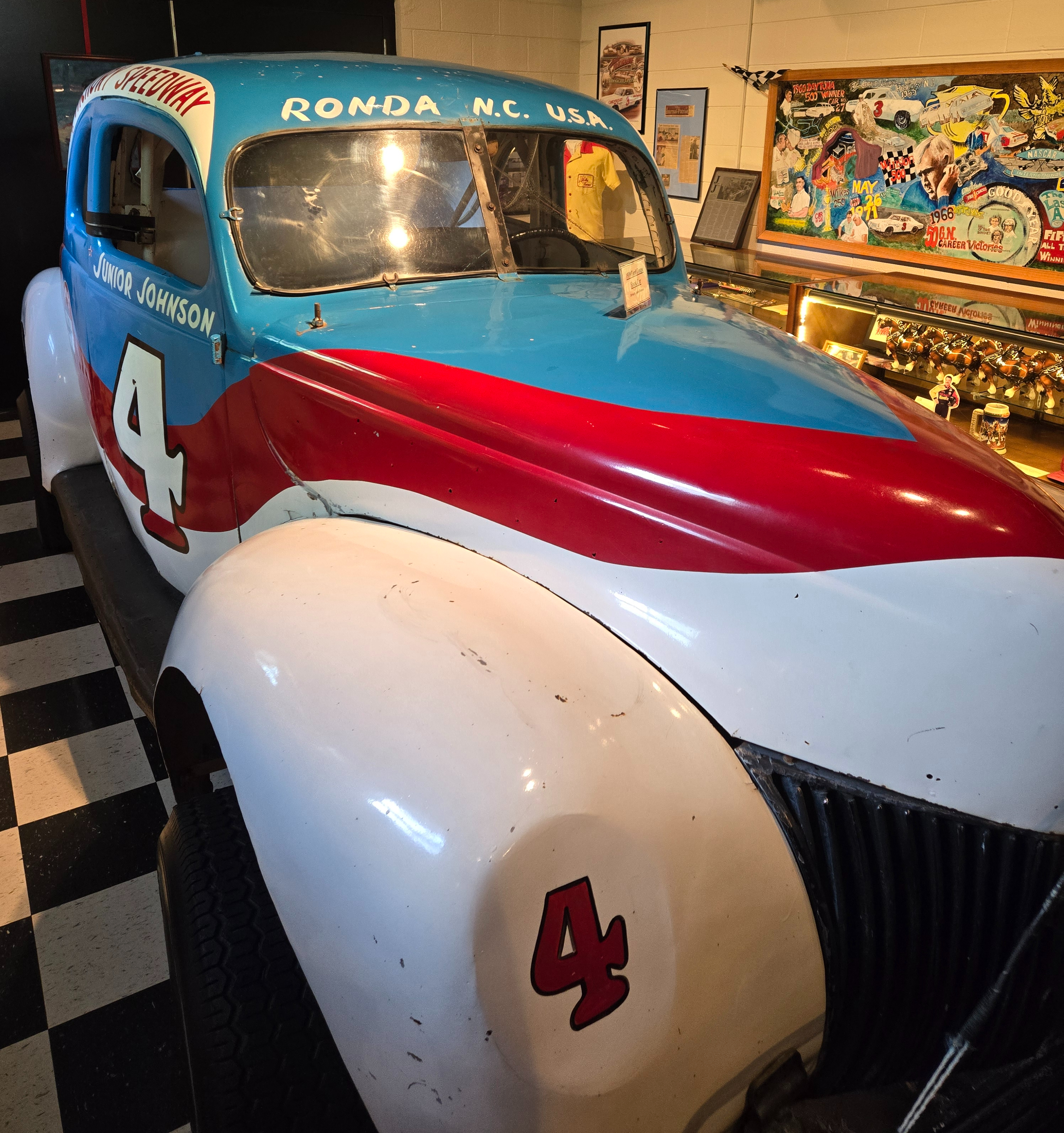
Junior Johnson (1931–2019) became a legend in the 1950s rural South by consistently outrunning law-enforcement officials in auto chases while delivering homemade liquor (moonshine) to his customers. Johnson then became a champion NASCAR racer, winning 50 NASCAR races before his retirement.
Lucius Smith Lowe (1879–1940) is the founder of North Wilkesboro Hardware, which later became the home improvement giant Lowe’s Home Improvement
James Lucius Lowe (1918–1965) is the founder of Lowes Foods and also the son of Lucius Smith Lowe, co-owner of Lowe’s Home Improvement.
Benny Parsons (1941–2007), is a NASCAR racer who won the 1973 NASCAR championship. After his retirement, he became a longtime TV racing analyst.
Morgan Shepherd (born 1941), NASCAR driver for more than 50 years; oldest driver to lead at least one lap in a NASCAR race. He currently owns his own team in the NASCAR Xfinity Series as the Shepherd Racing Ventures team.
Moravian Falls
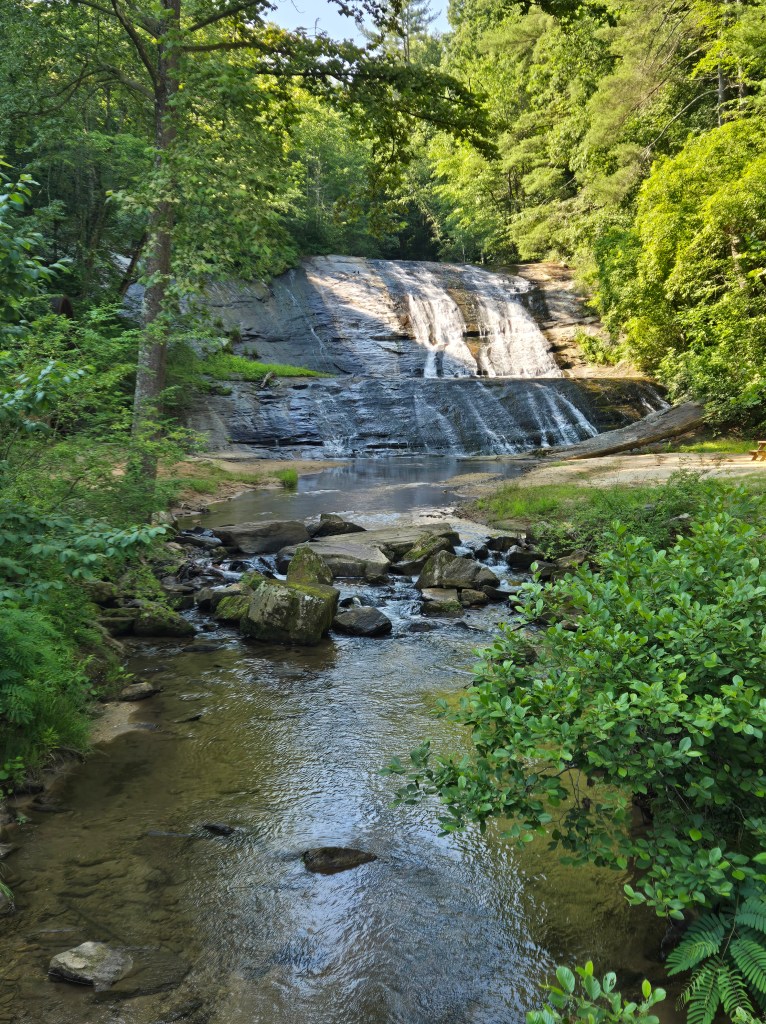
The town of Moravian Falls is located in the heart of Wilkes County, North Carolina, and sits at an elevation of 1,192 feet. Deriving its name from its 35 foot waterfall and the Moravian brothers who settled here in 1753, Moravian Falls could be the perfect setting for your mountain vacation.
In 1752, in the backwoods of North Carolina the Moravians purchased a tract of almost 100,000 acres . The name of the tract became known as Wachovia. In 1766, they establish the town of Salem (meaning “peace”), which is often confused with Salem, Mass.
The Moravians established a rooted community with strong values and stable trade.
The Moravian Falls
The falls are located on the grounds of the Moravian Falls Campground. From US Highway 421, exit onto NC Highway 18 and NC Highway 16. Follow NC 18/16 south to the town of Moravian Falls, bearing right to stay on NC 18. After 0.4 miles, turn left onto Falls Rd. and go 0.5 miles to see a view of the falls on the left. Please do not slow down or block traffic to view them, as traffic may come down the hill at a good speed. There is a small turnoff area across from the falls, and you can pull in there for a quick view. Visitors are required to obey all rules at the campground concerning the Falls and are not allowed to swim near or above the falls.
Ferguson
Whippoorwill Academy & Village
Edith Carter started this Whippoorwill Academy & Village (11928 NC Hwy 268 W Ferguson) with her husband, Hill, to preserve a part of the area’s rich history. Edith, a retired teacher, was driven to educate visitors about the events that have taken place and shaped the Yadkin Valley. The village is open one Saturday a month and during the week for school groups. They offer tours and activities that provide out-of-the-classroom learning opportunities for students of all ages.
Whippoorwill is located on the Ferguson family farm (circa 1700s) and consists of a group of 12 buildings (mostly log cabins). There is a museum dedicated to Tom Dooley (of “Hang Down Your Head, Tom Dooley” fame), who lived in the area before his hanging back in the 1800s. There are also two cabins dedicated to Daniel Boone, who lived in the community back in the 1700s. Two large festivals are held every year: Tom Dooley Day and the Daniel Boone Festival. Whippoorwill Academy and Village also includes a one-room schoolhouse, known as Whippoorwill Academy, built in 1880. North Carolina’s Poet Laureate Larkin Pearson attended this one-room school. In the loft of the Academy is the Tom Dula (Dooley) Museum, which includes paintings, drawings, and other Dula memorabilia, including a lock of Laura Foster’s hair. Visit Daniel Boone’s home (a replica cabin) from when he and his family lived on the Yadkin River region in 1760. The village also has the Smokehouse Art Museum, with regular shows by local artists, a blacksmith shop, weaver’s shop, country store, and the log cabin Chapel of Peace.

W. Kerr Scott Dam and Reservoir
The W. Kerr Scott Dam and Reservoir (499 Reservoir Rd.) is a 1,475-acre artificial lake impounded by a dam located in Wilkes County. Located on the Yadkin River system, the dam is operated and managed by the U.S. Army Corps of Engineers. You can park to walk across the top of the dam or you can drive across as well.

Wilkesboro
Wilkesboro is the county seat of Wilkes County. Located along the south bank of the Yadkin River, it is directly beside the town of North Wilkesboro. Wilkesboro is also the home of the annual MerleFest, Carolina in the Fall, and Brushy Mountain Peach & Heritage festivals.
The town is built atop a low, broad ridge which runs for over a mile along the south bank of the Yadkin River. For many decades a popular historic spot in Wilkesboro was the “Tory Oak”, a large oak tree from which Colonel Benjamin Cleveland, a well-known Wilkes County patriot during the American Revolutionary War, hanged Loyalist militia leaders who supported the British King and opposed American independence from Britain. The oak was located behind the old Wilkes County courthouse, but it succumbed to a storm and is now memorialized with an historic placard and photo, recounting its story.
During the Civil War, many of Wilkesboro’s residents remained loyal to the Union and opposed the Confederacy. In March 1865, General George Stoneman, a Union cavalry leader, led a raid through the town. Shortly after the war ended, Tom Dula (Dooley), a Confederate veteran, was tried and hanged for the murder of his fiancée, Laura Foster. Many people were convinced that one of Dula’s jealous ex-girlfriends murdered Foster, and that Dula was innocent of the crime. Dula’s story was turned into a top-selling ballad in 1958 by The Kingston Trio, the title of which was Tom Dooley. The story was subsequently turned into a 1959 movie starring Michael Landon as Dula, and each summer the Wilkes Playmakers present a popular play based on the story.
Don’t miss the Doc Watson Mural at 101 West Main St.

Barn Quilt Sundial
In downtown Wilkesboro, you’ll find a working sundial, unveiled in December 2012. The quilt square is mounted on the Wilkesboro Police Department building in Downtown Wilkesboro just west of the Wilkes Heritage Museum and is part of the Wilkes County Barn Quilt Trail.
Amateur astronomer Bob Hampton worked out the mathematics and the gnomonic design so that it will be correct for its longitude and latitude. The eight-foot by eight-foot structure features two sets of numbers for telling time, standard time and daylight savings time. It features a gnomon, or pointer, that uses sunlight to tell the time of day and is accurate within five minutes. The exact time for the Sundial only takes place twice a year. Two additional panels beside the dial explain the trigonometry principles involved and how to read the sundial accurately.
Ben Long Fresco Trail
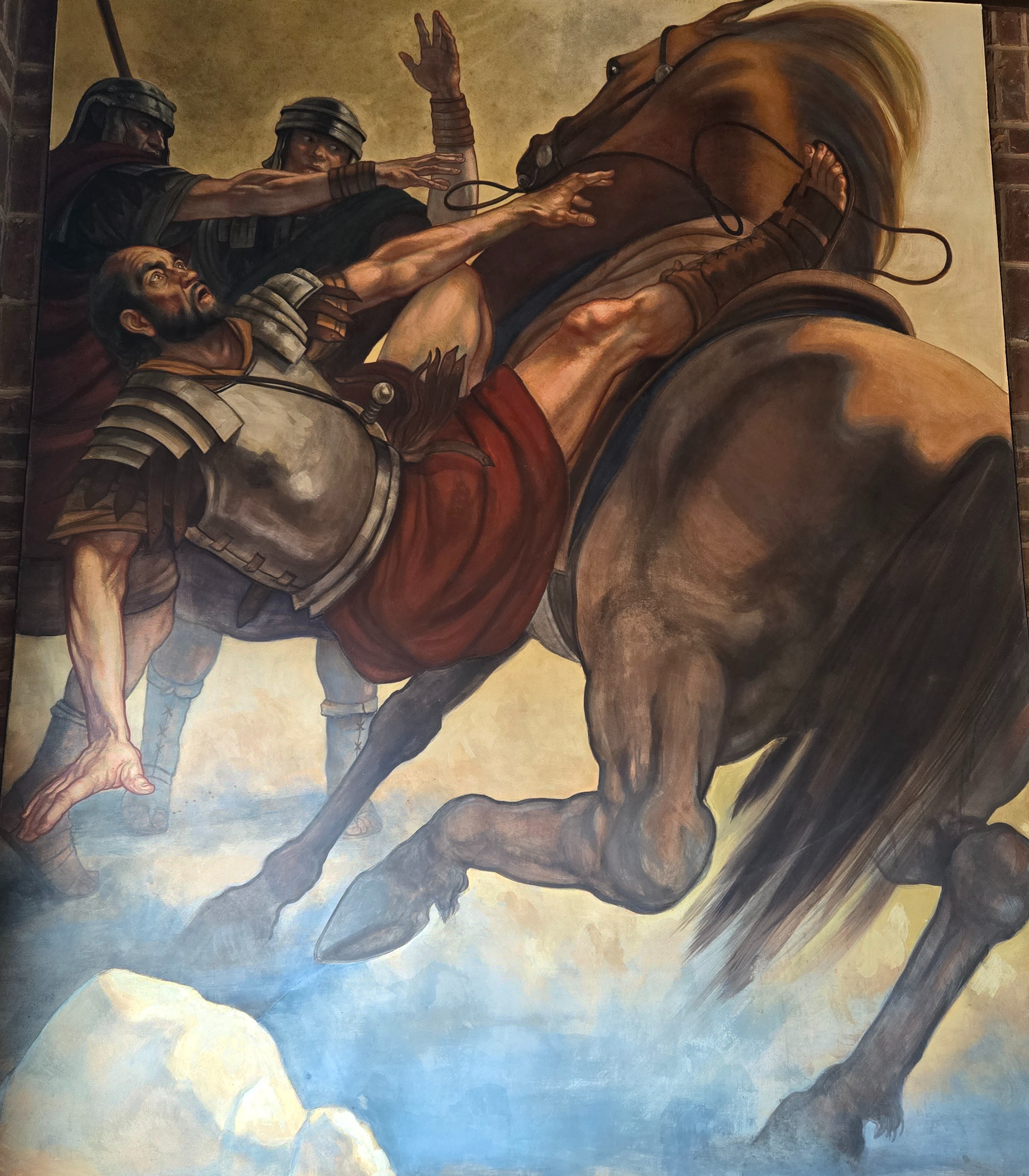
At St. Paul’s Episcopal Church (200 West Cowles St.) in the commons area joining the chapel and the sanctuary of this Gothic chapel, you’ll find two fresco paintings. The church is the oldest building in Wilkesboro, built between 1848 and 1849 by slaves. It is included in the National Register of Historic Places. Visit St. Paul’s sacristy shop, old cemetery, and Coventry Chapel, which includes a brick columbarium and labyrinth designed after the one at Chartres Cathedral. Docent led tours are available.
Wilkes Heritage Museum
The Wilkes Heritage Museum (100 East Main St.) was established in 1968 and subsequently managed the restoration of the Old Wilkes County Jail as well as the 1779 home of Captain Robert Cleveland, the late 19th century Finley Law Office, and the 1902 Wilkes County Courthouse. Since it’s official opening in November 2005 holds a collection of artifacts and images, and numerous stories of early settlement as well as documenting the area’s military history, industry, agriculture, medicine, communication, education, entertainment, and transportation.

Old Wilkes Jail
The Old Wilkes Jail (100 East Main St.) was constructed in 1859 and opened as a jail in 1860. During the war between the states, it was used to house confederate provisions as well as union prisoners. After the war, Tom Dula (of the famous ballad “Hang Down Your Head Tom Dooley”) was incarcerated here until the change of venue was obtained by his defense attorney, former Governor Zebulon Vance. Another famous inmate was that of North Carolina’s famous escape artist, “Otto Wood”. The building has now been restored to its original state using as much of the original materials as possible. The old Wilkes County jail is one of the best preserved examples of nineteenth century penal architecture in North Carolina. Of particular note is the survival of its primitive security, including the front door which contains nails an inch apart so that even if a prisoner got hold of an object he could not saw his way out of the building.

Robert Cleveland House
The home of Robert Cleveland, gentleman farmer, and his family of 17 children, is currently located behind the Old Wilkes Jail in full restoration and furnished in its period furniture. It was built in the 1770s and originally located in Purlear, the western portion of Wilkes County. Col. Benjamin Cleveland, Robert’s brother, led forces from Wilkes County to the Battle of Kings Mountain during the Revolutionary War.

North Wilkesboro
North Wilkesboro is the birthplace and original home of Lowe’s Home Improvement, which continues to have a major presence in the community. And the original building still stands today! The town is also known as one of the birthplaces of the sport of stock-car racing, and the North Wilkesboro Speedway was the first NASCAR-sanctioned track. Due to the town’s proximity to the nearby Blue Ridge Mountains and its numerous tourist venues, North Wilkesboro has been nicknamed the “Key to the Blue Ridge.”
North Wilkesboro was founded in 1891 when the Norfolk and Southern Railroad built a railroad line into Wilkes County. The line ended on the northern bank of the Yadkin River opposite Wilkesboro, the county seat. The town of North Wilkesboro quickly developed around the railroad tracks. North Wilkesboro was home of the Carolina Mirror Company, which for many years was the largest mirror factory in the United States. Lowe’s Foods, one of the Southeast’s largest supermarket chains, was started in North Wilkesboro in 1954. Lowe’s Home Improvement Warehouse, the nation’s second-largest chain of home-improvement stores, was started in North Wilkesboro in 1946.
While in North Wilkesboro, check out several public art wall murals and stop by the Liberty Theatre (816 Main St.) and the Art Gallery of Wilkes (913 C St.). Founded in 1962 in the parlor of art patron Annie Winkler’s home, the Wilkes Art Gallery has experienced many transformations over the years. Perhaps the most dramatic of these was the 2004 move into the renovated, original North Wilkesboro Post Office building located in the heart of downtown North Wilkesboro at 913 C Street. The Gallery’s 10,000 square foot facility includes an education center with a complete ceramics studio, gallery gift shop, more than 3,500 square feet of exhibition space, painting and drawing studios, and two multi-purpose classrooms.

North Wilkesboro Speedway
The North Wilkesboro Speedway was the first NASCAR (National Association of Stock Car Auto Racing) track; it held its first race on May 18, 1947 (pre-dating NASCAR), and the first NASCAR-sanctioned race on October 16, 1949. Wilkes County native and resident Junior Johnson was one of the early superstars of NASCAR, as well as a legendary moonshiner. Johnson was featured by the writer Tom Wolfe in a 1965 Esquire magazine article titled “The Last American Hero Is Junior Johnson. Yes!”, which gave him national exposure. Wolfe’s vivid article was later adapted as the movie The Last American Hero (1973), starring Jeff Bridges and Valerie Perrine. Benny Parsons and Jimmy Pardue were two other notable NASCAR drivers from Wilkes.
The North Wilkesboro Speedway was closed following the 1996 NASCAR season. The North Wilkesboro Speedway held NASCAR races for 50 years; on September 29, 1996 Jeff Gordon would win the final race to be held at the speedway. (This blogger was there!) Two new owners, Bob Bahre and Bruton Smith, moved North Wilkesboro’s NASCAR races to their tracks in Texas and New Hampshire. In September 2022, it was announced that the 2023 NASCAR All-Star Race would be held at the North Wilkesboro Speedway in May 2023, marking the first NASCAR race to be held at the track since 1996. The All-Star race was held on May 21, 2023, before a sellout crowd at the Speedway, Kyle Larson won the race. The NASCAR Craftsman Truck Series also held a race at the Speedway on May 20, 2023; it was also won by Kyle Larson. In November 2023, NASCAR announced that the 2024 NASCAR All-Star Race would also be held at the North Wilkesboro Speedway in May 2024.
Purlear
Rendezvous Mountain State Park
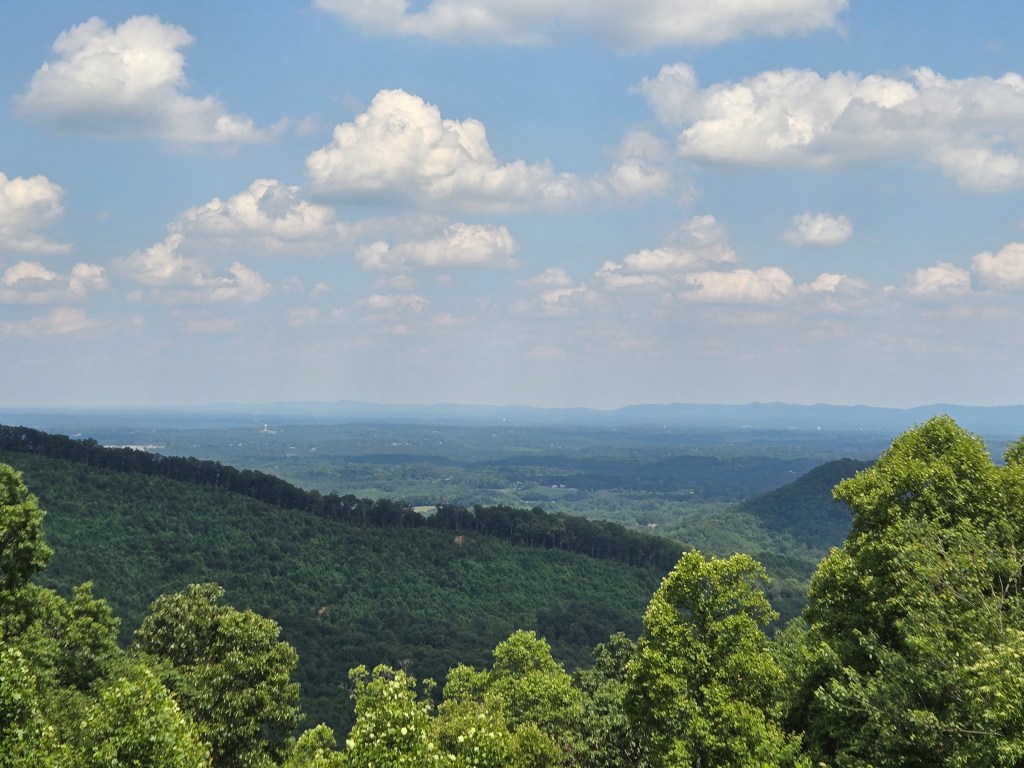
The drive up to the summit vista of Rendezvous Mountain State Park (1956 Rendezvous Mountain Rd.) is not for the faint of heart. The narrow-ish road is gravel all the way to the vista where there is some paved road. It starts on level ground, but quickly becomes a steep incline around a corner with no guardrail at the drop-off edge— and there is nowhere to turn around. Once you head up this road, you are committed. (Full disclosure: the ride down was a long seven minutes at 10 miles an hour.) The view at the top is definitely beautiful, but be forewarned that the ride up and down can be on the treacherous side.
Traphill
Joining other settlers on the northern edge of Wilkes County in 1775, William Blackburn settled in the present day area of Stone Mountain State Park. Blackburn devised an innovative rail-pen wild turkey trap. These traps and their eventual popularity are commonly recalled as the source of the town’s name.
During the American Civil War the citizens of Traphill were opposed to secession and gained a reputation as pro-Union sympathizers during the conflict. A Traphill resident, John Quincy Adams Bryan, helped recruit local men into the Union Army. In August 1863, a militia of pro-Union Traphill citizens marched into Wilkesboro and, during a pro-Union rally, defiantly raised a Union flag in front of the county courthouse. Traphill’s anti-Confederate, pro-Union reputation led deserters, outlaws, and refugees to move into the region. It is said that Traphill residents frequently helped Confederate deserters and escaped Union POWs evade Confederate and Home Guard forces.
During the Prohibition era of the 1920s and 1930s Traphill became a center of the mass production and exportation of illegal homemade liquor, or moonshine. Moonshine became the main source of income for many Traphill families, and until the 1980s, the town continued producing over a million gallons of white liquor each year. Traphill residents made sugar and grain liquor for sale and fruit “brandy” for personal consumption, and continue to do so, with apple and peach brandies being the most common. From the 1920s to the 1960s, Federal tax agents, state police units, and local police all patrolled the hills and hollows looking for moonshine stills.
During the Prohibition era, Traphill became known for violence and gunplay between the moonshiners and law-enforcement officials. The ridge along the east prong of the Roaring River in Traphill earned the nickname “cutthroat ridge” after consistent disputes between distillers and lawmen.
Today, Traphill is mostly a quiet farming community known for its superb mountain scenery. Stone Mountain State Park, one of North Carolina’s most popular state parks, is located in Traphill.
Chang and Eng Bunker
In 1839 Chang and Eng Bunker, the world-famous Siamese twins who were a popular attraction in Europe, Asia, and North America, settled in the Traphill community. The Twins purchased a 110-acre farm, where they lived until 1849. They married two local sisters, Chang to Adelaide Yates and Eng to Sarah Ann Yates. Chang and Adelaide had ten children; Eng and Sarah had twelve.
Ronda
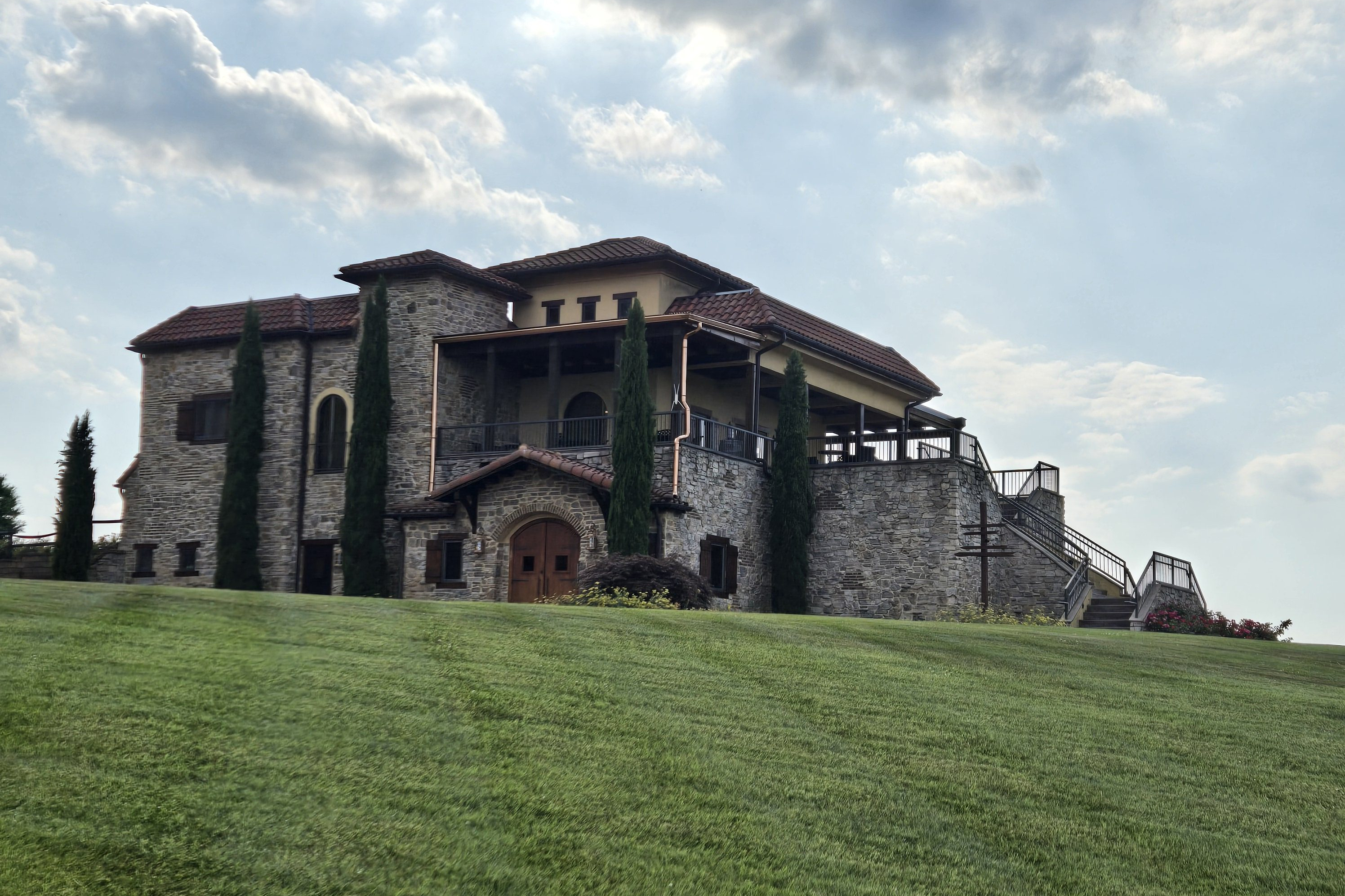
Ronda was named after a nearby estate called “Roundabout”, which was the residence of Benjamin Cleveland, a locally prominent planter and a colonel in the North Carolina militia during the Revolutionary War. Ronda was also the home of NASCAR pioneer and Hall of Famer Junior Johnson. The Town of Ronda Roundabout Festival is held on the second Saturday of September. In Ronda, you’ll find four vineyards/wineries within very close proximity to one another.
Raffaldini Vineyards & Winery
450 Groce Rd.
Castello Barone Vineyards
475 Groce Rd.
Sotrio Vineyards and Winery
211 Groce Rd.
Piccione Vineyards
2364 Cedar Forest Rd.
Next stop… Pitt County!

