

Dotted with family cemeteries and occasional solar farms, Hertford County is painted with a plethora of open land and fields, lush farms and forests, as well as marshland. Psst… from late spring to early fall, watch out for turtles, big and small, crossing the road.
The area was first settled in the 18th century with land deeds dating back to 1710. Early settlers were principally European immigrants, and native Americans were also well represented in the Colonial population. The County of Hertford was formed by an act of the state legislature in 1759 and named in honor of the first Earl of Hertford, then later the first Marquis of Hertford, Francis Conway, a distinguished member of parliament and a soldier. Winton was established as the county seat in 1766.
The first settlers from Southern Virginia came to take advantage of the more productive Carolina soil which could harvest two crops a year, according to folklore of the time. Land was taken from nearby Bertie, Northampton, and Chowan Counties to form the new County in 1759. Originally a part of the British Empire and known as the Parish of Saint Barnabas, Hertford County was named in honor of a British nobleman, Francis Seymour Conway, the Marquis of Hertford. The newly-arrived settlers readily recognized this area as a suitable place for farming. Agriculture is still the basis of Hertford County’s economy, with tobacco, cotton, peanuts, corn, and soybeans as the staples.
Located on the Chowan River, Winton was incorporated as a town in 1766. It replaced Cotton’s Ferry as the county seat, where the first court had been held. Later, Ahoskie was formed and became the center of business for Hertford County. By the 1950s, industrial development efforts brought in other industries, but farming continued as the economic backbone of Hertford County.
Hertford County is home of the Meherrin Indian Tribe, descendants of indigenous people who had inhabited the region for many centuries. After decades of encroachment by English colonists, the Tribe moved south from Virginia, where they settled in 1706 on a reservation abandoned by the Chowanoke. This six-square-mile reservation was at Parker’s Ferry (1132 Parkers Ferry Rd.) near the mouth of the Meherrin River. The Tribe today has approximately 900 enrolled members, most living within 10–15 miles of the former reservation. The Meherrin have an annual Pow Wow at the end of October.
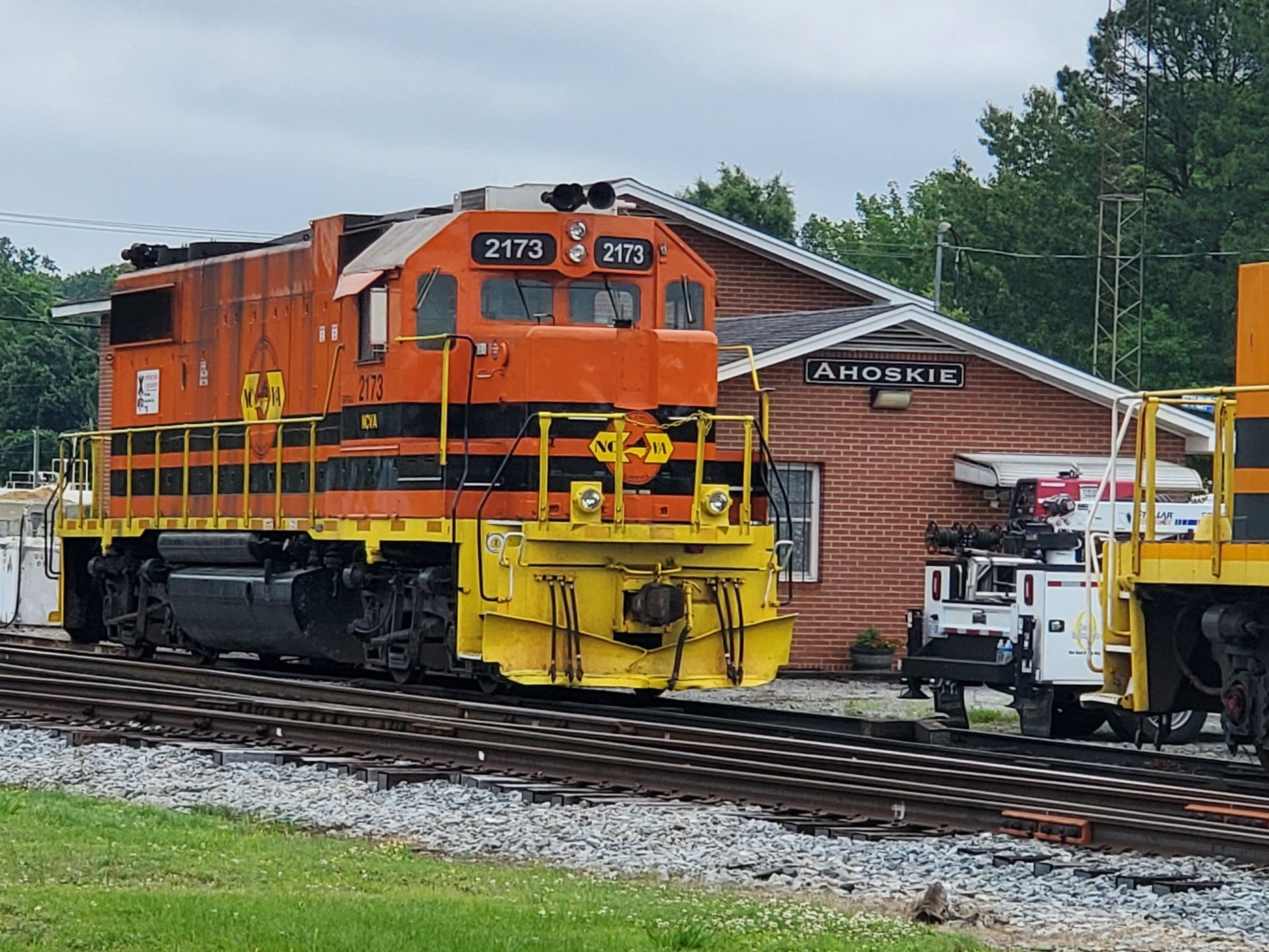
Ahoskie
Ahoskie is located in North Carolina’s Inner Banks region. Its nickname is “The Only One” because no other town in the world is known by the same name. The etymology of the word Ahoskie, which was originally spelled “Ahotsky”, was from the Wyanoke Indians, who entered the Hertford County area at the beginning of European settlement.
Ahoskie began as a railroad siding for log trains hauling timber from the forests of Bertie and Hertford counties to a sawmill at Tunis on the Chowan and Southern Railroad line beginning in 1885. The town grew out of a loading station and commissaries to supply the community workers who cut, hauled and loaded the logs. Ahoskie’s post office was established in 1889, and the first passenger train passed through town on the newly opened tracks of the Norfolk and Carolina line in 1890.
By the time of its incorporation on January 24, 1893, Ahoskie had grown to include several stores, a saw mill and gin, a one-room school, and a Baptist church. Other industries that flourished in the town’s early days included an ice plant, a laundry operated by a wandering Chinese man, and a number of horse and mule exchanges and sales stables. Since few of the smaller towns in Hertford and Bertie counties were located on passenger lines, traveling salesman or “drummers” would use the town as a base to make sales trips to outlying community stores by horse and buggy. The town’s first bank, the Bank of Ahoskie, was chartered in 1905. This area’s economy was initially based on the cultivation of tobacco and cotton. It has continued to be largely rural with small towns.
The county gave an acre of land on which the first Black school in Ahoskie was built, three years after the Civil War. The first Black church, The New Ahoskie Baptist Church, was organized in 1866. Other early churches in the Black community were The Methodist Church and Calvary Baptist Church. By 1939, the town had grown to include a number of Black-owned businesses including five grocery stores, three barber shops, three cafes, a dry goods store, a millinery shop, three hairdressers, three seamstresses, a doctor, a stenographer, two funeral homes, and a garage.
More fun facts…
- Perhaps the largest show seen in the town was a visit by Buffalo Bill’s Wild West Show in October 1916, an event that drew an estimated 12,000 people and required three shows to accommodate everybody.
- Electric lights were first turned on in Ahoskie around Christmas in 1915 with power generated by a gasoline engine. Within two years, electricity was available both day and night.
- Ahoskie was the first stop in North Carolina for first lady Ladybird Johnson during her whistle-stop tour of the South aboard the Lady Bird Express, on October 6, 1964.
- Graham Smith, one of the Tuskegee Airman, is from this area.
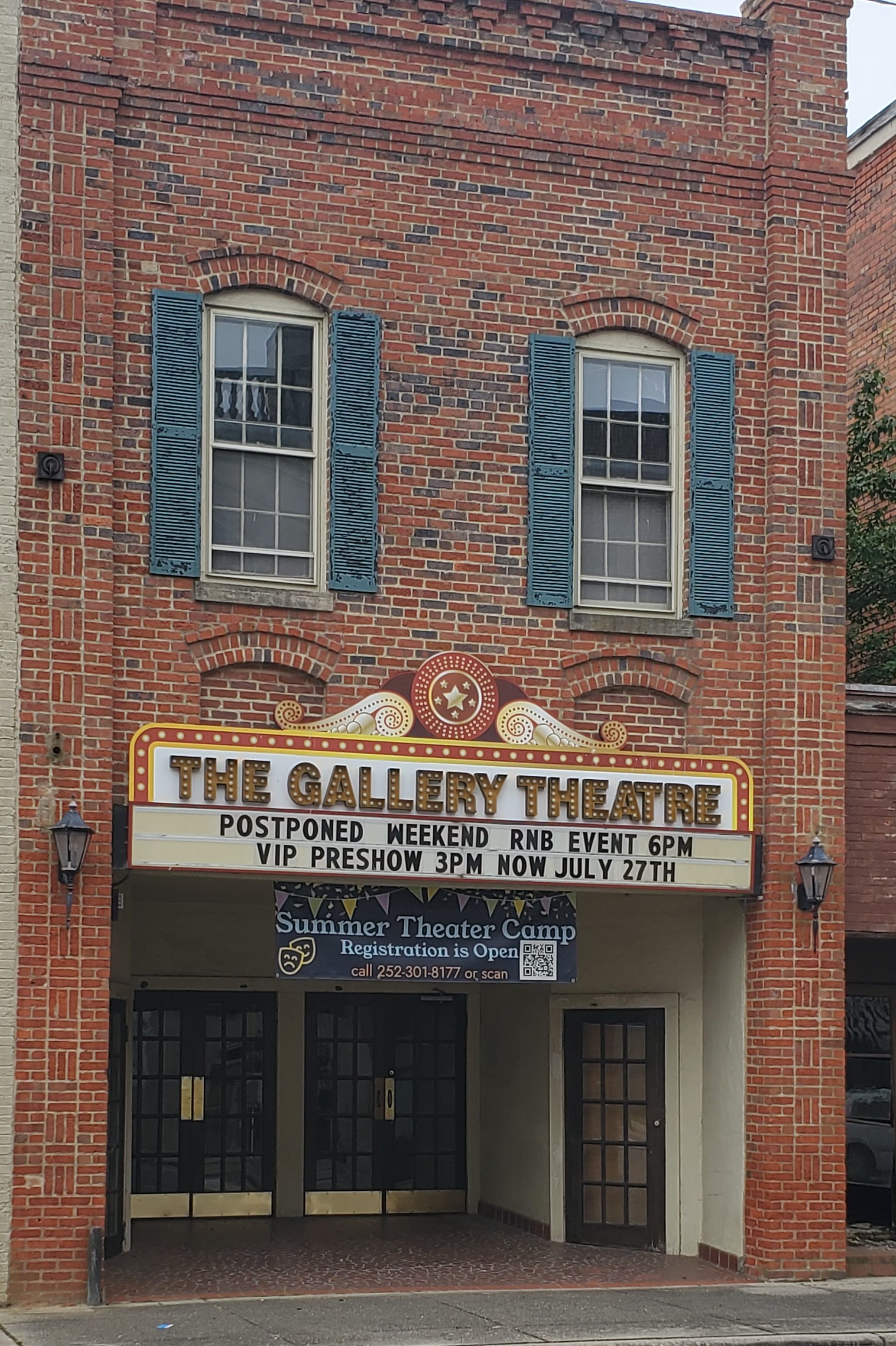
Gallery Theatre
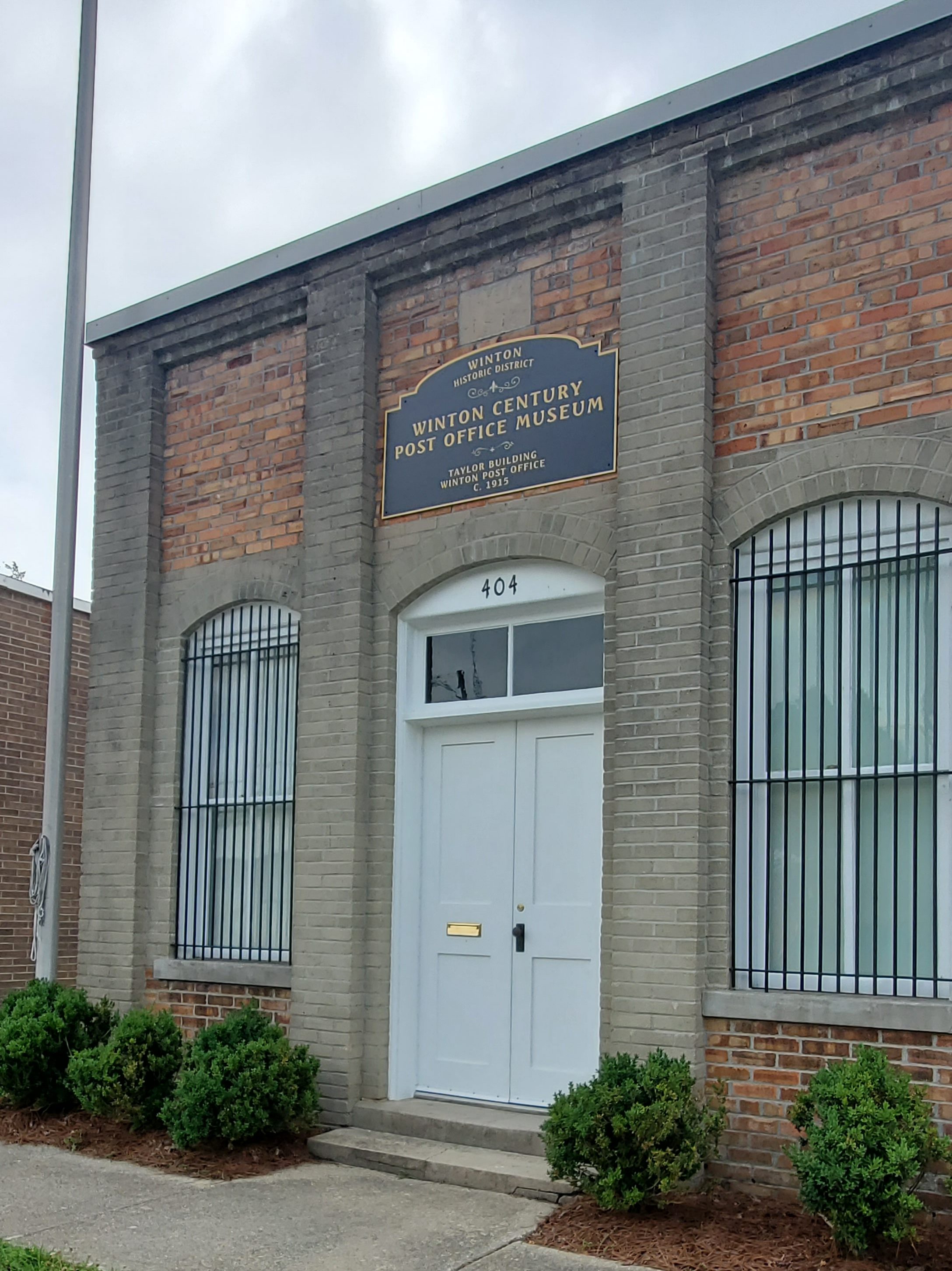
Winton
Winton was established and has been the county seat of Hertford County since 1766. On September 19, 1862, Union soldiers under Colonel Rush C. Hawkins sacked and burned the town. The earliest buildings in the Winton Historic District reflect the Italianate, Queen Anne, and Gothic Revival styles of the mid-to-late nineteenth century. In 1924, Winton was connected south to Ahoskie by the Winton-Ahoskie Highway, now US Highway 13, and a steel highway bridge was built across the Chowan River at Winton in 1925, the first in the county to cross the river. Thad Eure, a politician who holds the record for longest tenure as an elected official in the United States, serving as North Carolina Secretary of State from 1936 to 1989, is from the area.
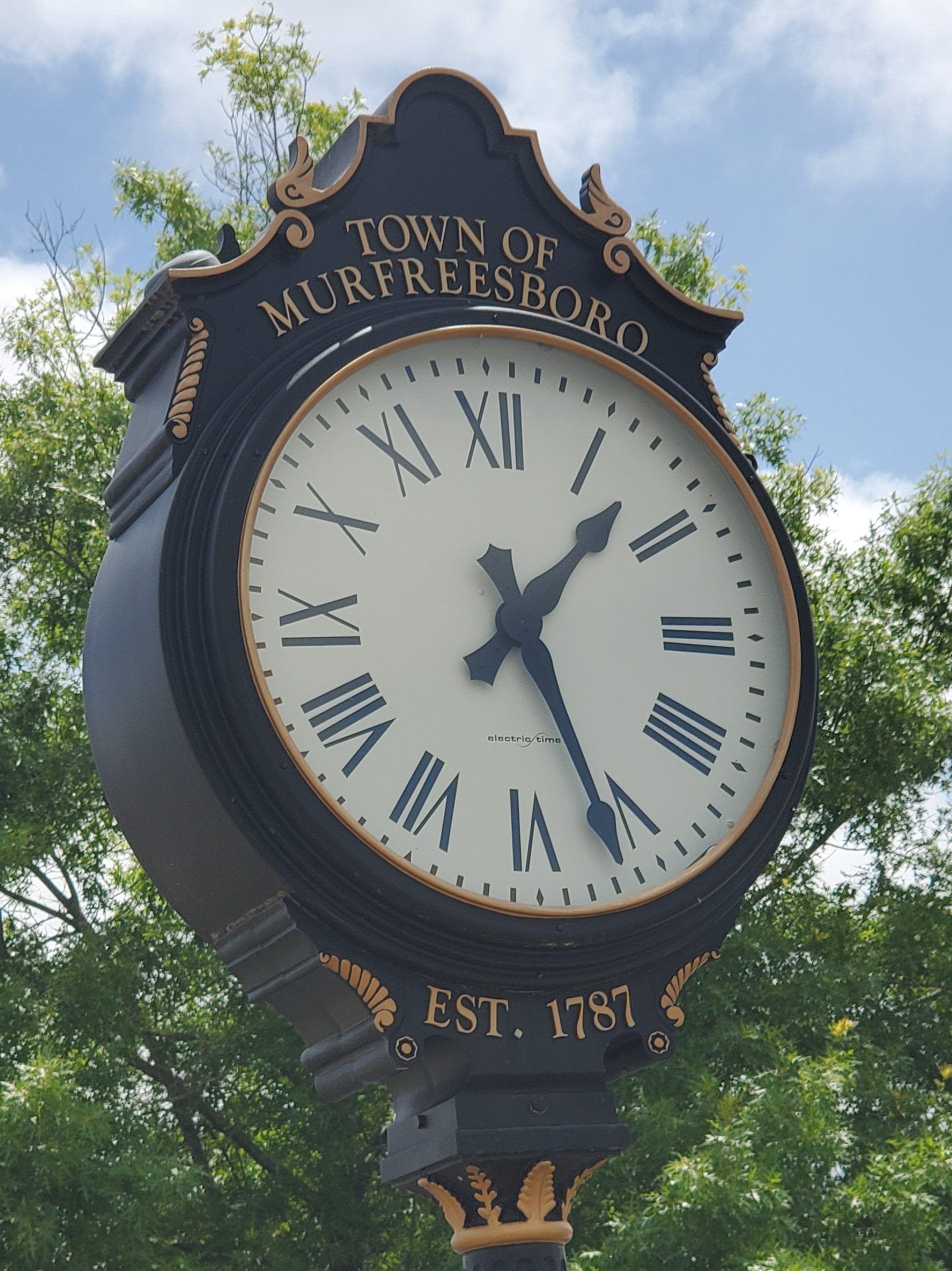
Murfreesboro
The first recorded inhabitants of the Hertford County area were Native Americans from the Nottoway, Meherrin, and Chowanoke tribes. The first European known to visit the area was John White of the Roanoke Colony in the 16th century. It was also visited by an expedition from Jamestown, Virginia, in the 17th century. The last native inhabitants, the Chowanoke, were expelled after warring with the English in 1675 and 1676. After that, they were moved to a reservation east of the Chowan River in what is now Gates County.
The first known deed to property in the area is a land grant dated November 5, 1714, made to Henry Wheeler for a tract on the Meherrin River which included what is now Murfreesboro. On May 27, 1746, James Jordon Scott sold 150 acres on the Meherrin River (part of Wheeler’s original grant) to an Irish immigrant, William Murfree, from Virginia. On December 12, 1754, the General Assembly designated Murfree’s Landing as a King’s Landing, where imports and exports would be inspected by a representative of the King. The town was chartered by the General Assembly and renamed Murfreesboro on January 6, 1787. Murfreesboro was designated by the US Congress in 1790 as an official port of entry, and the customs records indicate a profitable three-cornered trade with New England and the West Indies.
In 1831 Murfreesboro was among towns that sent armed forces to Southampton County, Virginia, to quell Nat Turner’s slave rebellion. As a result of these events, Virginia and North Carolina reduced the rights of free blacks, prohibiting education of both free blacks and slaves.
William Hill Brown, author of the first American novel, is from the area.

Brady C. Jefcoat Museum
The old Murfreesboro public school (which housed grades 1 – 12 until 1972) has been redeveloped as the Brady C. Jefcoat Museum (201 W High St.). It houses the collections of Brady Jefcoat, a Raleigh native, and includes hundreds of well-preserved ordinary items from the late 19th and early 20th century, including functional phonographs, radios, washing machines, washboards, and agricultural implements, as well as a wide variety of other novelties. The museum boasts several largest collections: washing machine equipment, butter churns, and irons.

Chowan University
One University Place
Historic Murfreesboro includes several buildings and historic homes, including the Dr. Walter Reed House, B.B. Winborne Country Store and Law Office Museum (201 N 4th St), and Vincent-Deale Blacksmith Shop (202 N 4th St.) as well as others. Start at the Visitors Center on Main St. for a video presentation before you tour the properties and enjoy your step back in time!
Next stop… Wilkes County!
 Portable NC