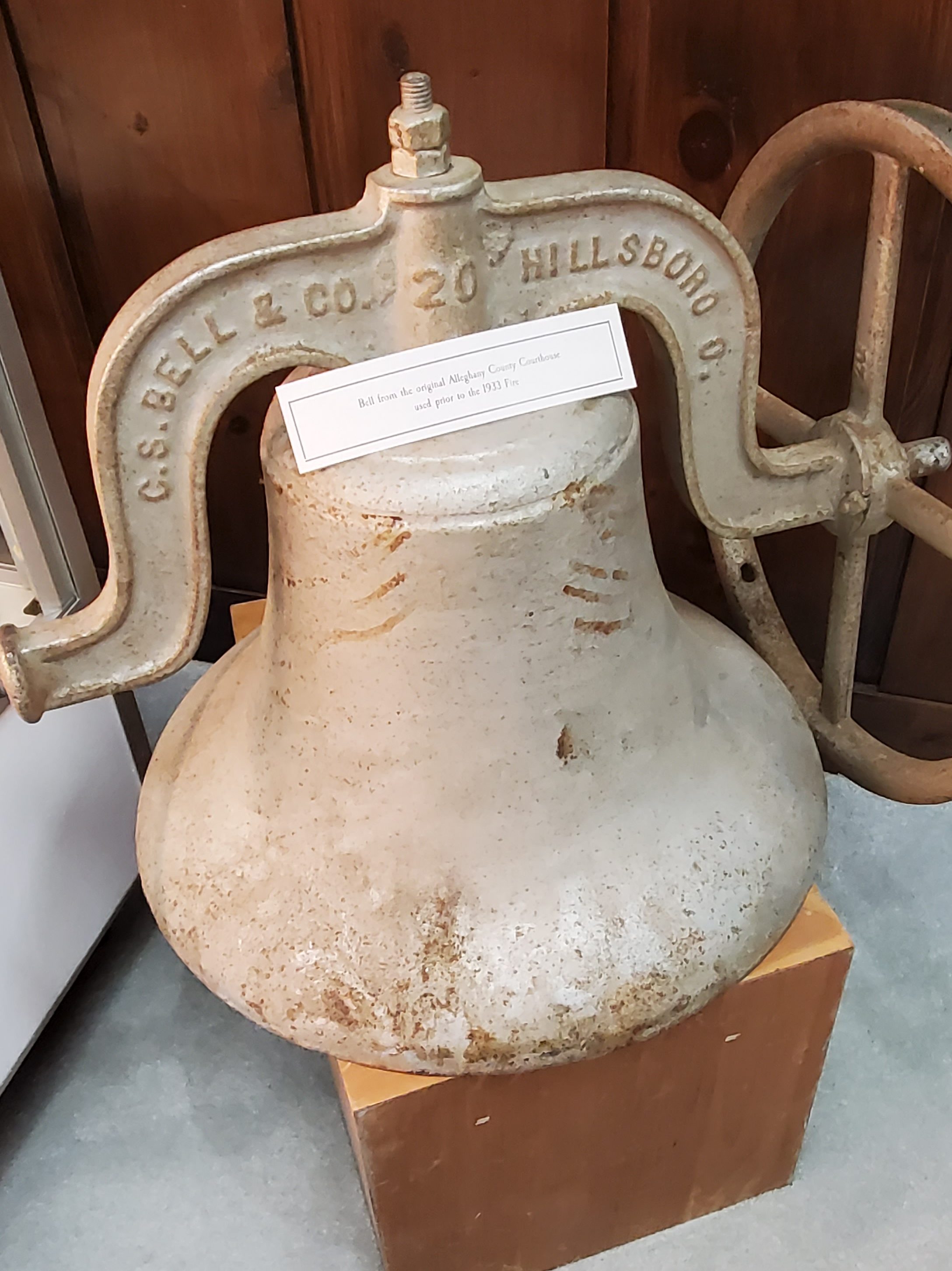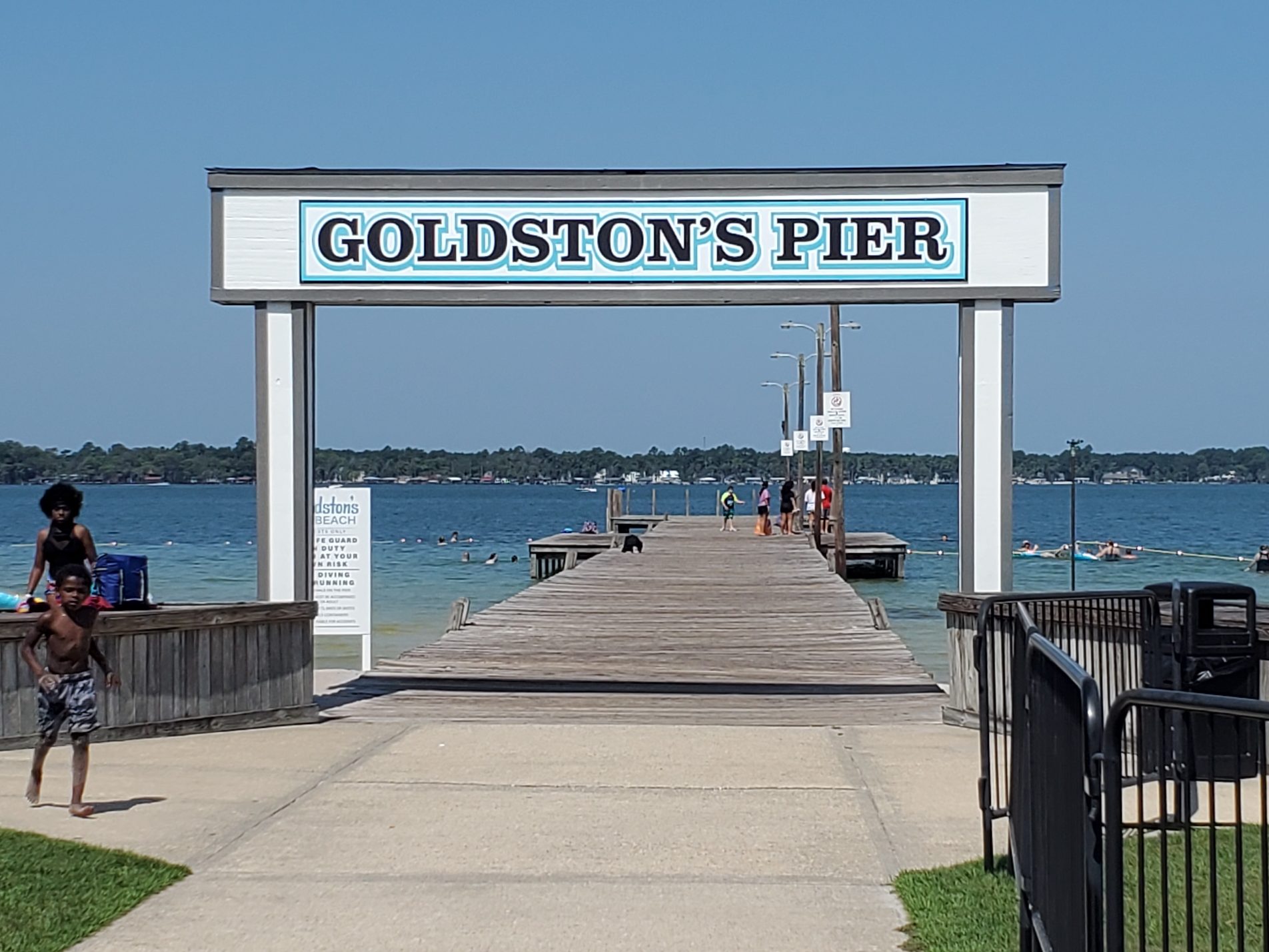
Journey through Stokes County

Stokes county was formed in 1789 from Surry County; and before 1770, it was part of Rowan County. The county was named for John Stokes, an American Revolutionary War captain severely wounded when British Colonel Banastre Tarleton’s cavalry practically destroyed Col. Abraham Buford’s Virginia regiment in the Waxhaws region in 1780.

Stokes was most heavily settled from 1750 to 1775. The Great Wagon Road passed through the eastern portion of the county, and this influenced the pattern of European settlement, so that most settlers came from the Virginia Piedmont, and some came from further away in Pennsylvania and other colonies.

During the American Civil War, Moratock Iron Furnace located near Danbury served as a foundry for the Confederate Army. It was destroyed in April 1865 when Union cavalry under the command of General George Stoneman conducted extensive raiding through the region.

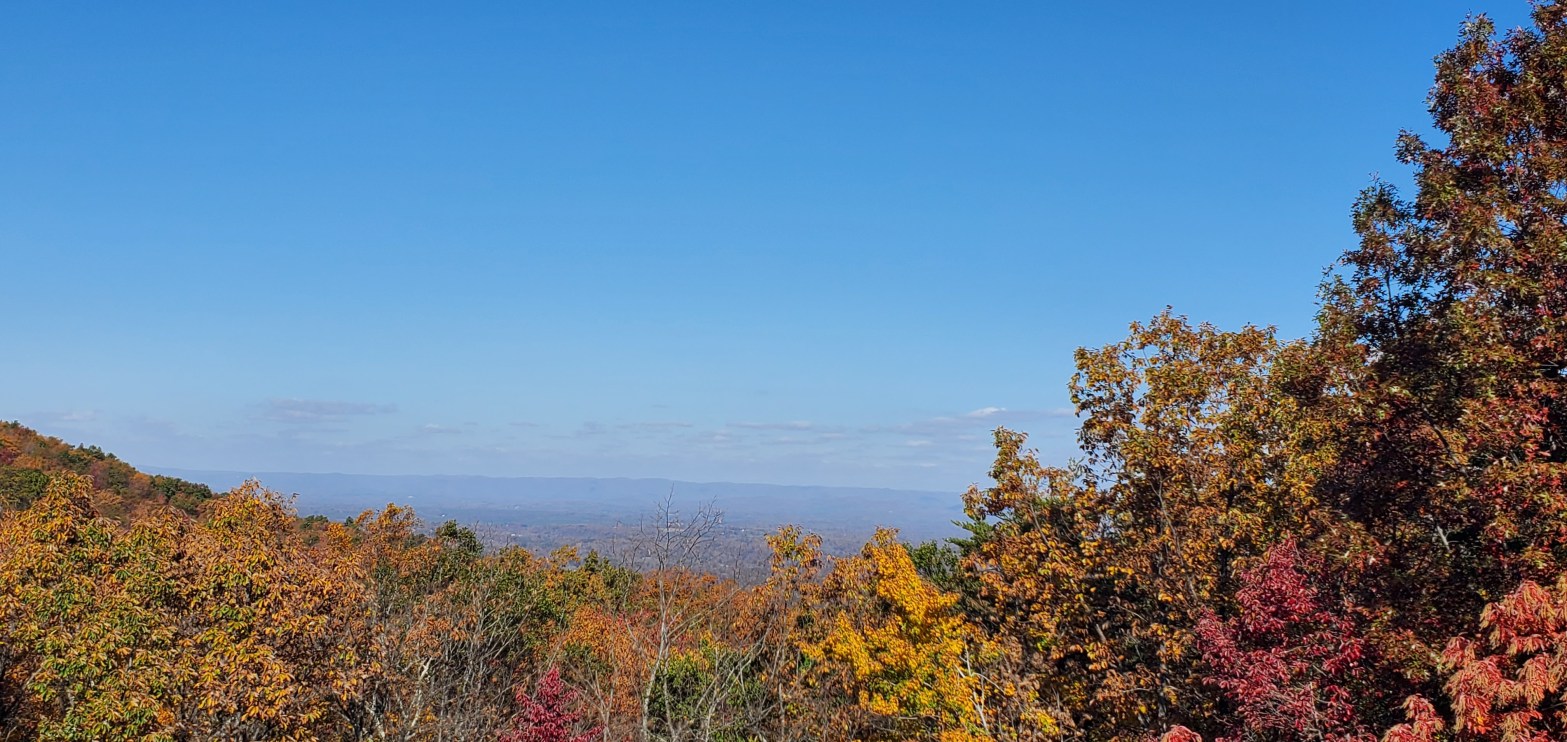
Hanging Rock State Park was formed primarily from blocks of land donated in 1936 and contained 6,921 acres in 2005. Many of the facilities in the park were built by the Civilian Conservation Corps (CCC) between 1935 and 1942. The park is located atop the Sauratown Mountains, and contains a visitor’s center, a manmade lake, and plenty of hiking trails, climbing trails, picnic areas, and primitive campgrounds.
Walnut Cove

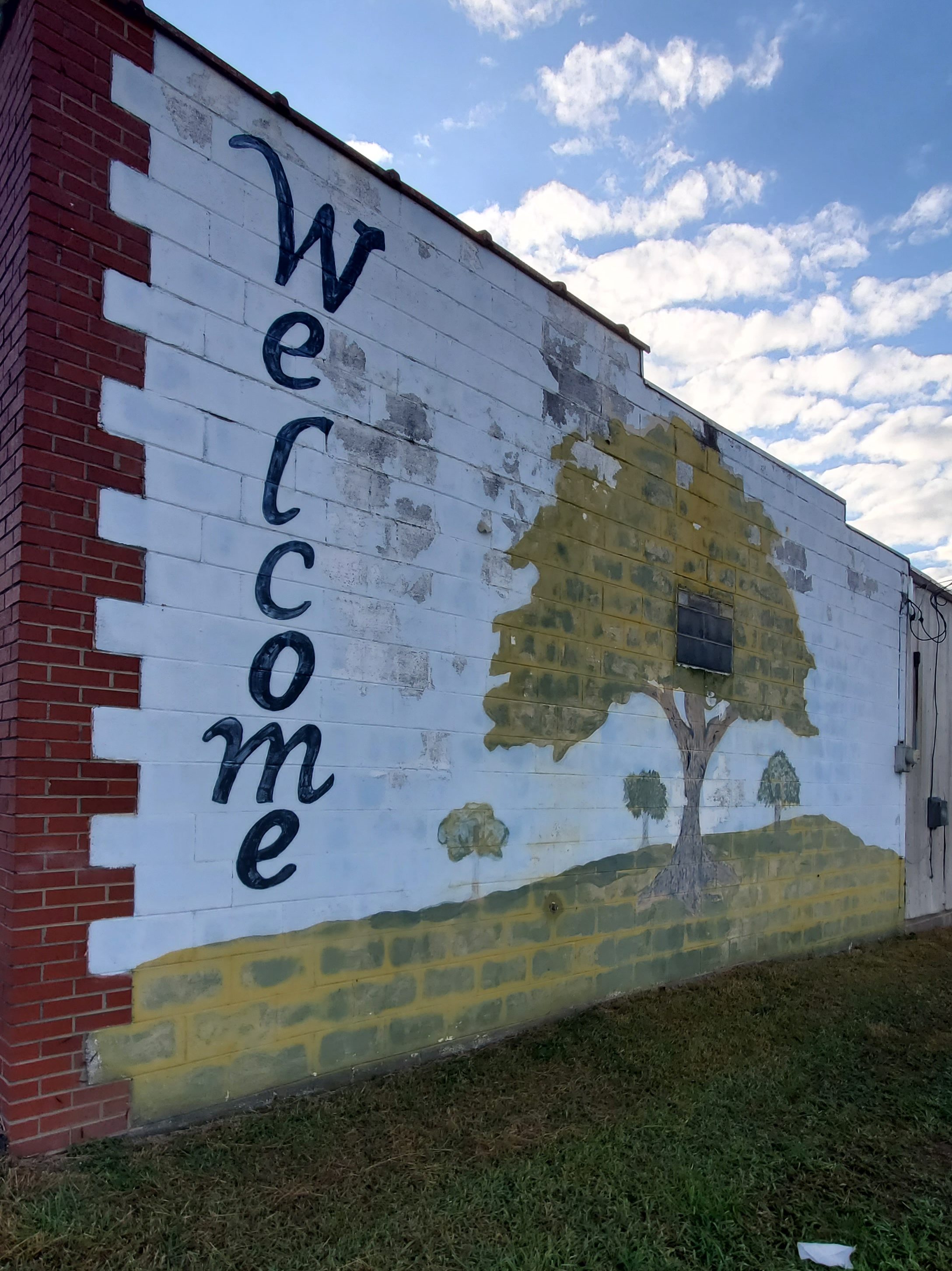
Walnut Cove is the home of Family Pharmacy and the Walnut Cove Springfest, which draws many visitors to the area. Festival organizers marked 1889 as the town’s incorporation date, but the town’s roots date to the mid-18th century when it was known as Town Fork. Town Fork settlers formed a bond with Moravians in Bethania and Bethabara. Eventually, William Lash, a Moravian settler at Bethania, bought land along the Town Fork Creek, which later developed into a large plantation named Walnut Cove. The Town was a railroad center in its former years, and today remnants of the old Train Depot still stand on Depot Street.

Later, a general store was built, and the area was commonly known as Lash’s Store. A windmill was erected to pump water for the plantation (hence, Windmill Street). Along Main Street, the Lash family built an office, a general store, a grist mill, a livery stable, a blacksmith shop, and (reportedly) a bar. The family built four homes along what is now known as Summit Street. One of these homes still remains today.

It is also home to historic Covington House (built in 1821), Fulp-Marshall Home (built in 1836), and Culler Roller Mill (built in 1900), now known as Monitor Roller Mill. Belews Lake and Hanging Rock State Park are located nearby. The Walnut Cove Colored School is listed on the National Register of Historic Places.

These remnants of yesteryear, along with many other historic homes and buildings that line Walnut Cove’s Main Street are a draw to a scenic small town, rich with history, and accentuated by a number of small businesses and restaurants that attract tourists and locals alike. Here, you can visit Cove Square, with a mediation path, and the Palmetto Theater.

Ceramic

Ceramic is a ghost town in Stokes County, North Carolina, United States, approximately 10 miles southeast of the county seat of Danbury, near Belews Lake. Ceramic, as a community, ceased to exist at least six decades ago. The community was started by a ceramic pipe and drain tile manufacturing company, presently the “Pine Hall” brick company. Only remnants of the factory exist; it appears that fire may have caused its demise. The huge clay pits are surrounded by overgrown trees and underbrush and are nearly impossible to find. The only residents are small game and coyotes.

Pine Hall

Pine Hall, a historic plantation house, bearing the same name was listed on the National Register of Historic Places in 1979. In 1922, Flake Steele took over Consolidated Brick Co. and bought hundreds of acres containing Triassic shale. Pine Hall Brick Co. moved its offices to Winston-Salem, North Carolina, two years later. In 2021, the company has two plants in Madison, North Carolina, and two in Fairmount, Georgia, and sells its brick products in 35 U.S. states and in other countries.

Jessup Mill

Behind Jessup Mill (1565 Collinstown Road, Westfield, NC), you can take a short (no more than five minutes) hike along the path to a waterfall dam and fishing hole. In fact, you’ll hear it before you see it… and you’ll be drawn to it. Plus, a bonus is that you can access both sides of the falls.

Danbury

Founded in 1851, Danbury is the county seat of Stokes County and is the “Gateway to Hanging Rock.” Danbury is a popular rest stop for bicyclists, motorcyclists, and driving enthusiasts due to the numerous scenic roads in Stokes County. Danbury also attracts outdoor enthusiasts because of its location on the Dan River and near the entrance to Hanging Rock State Park.

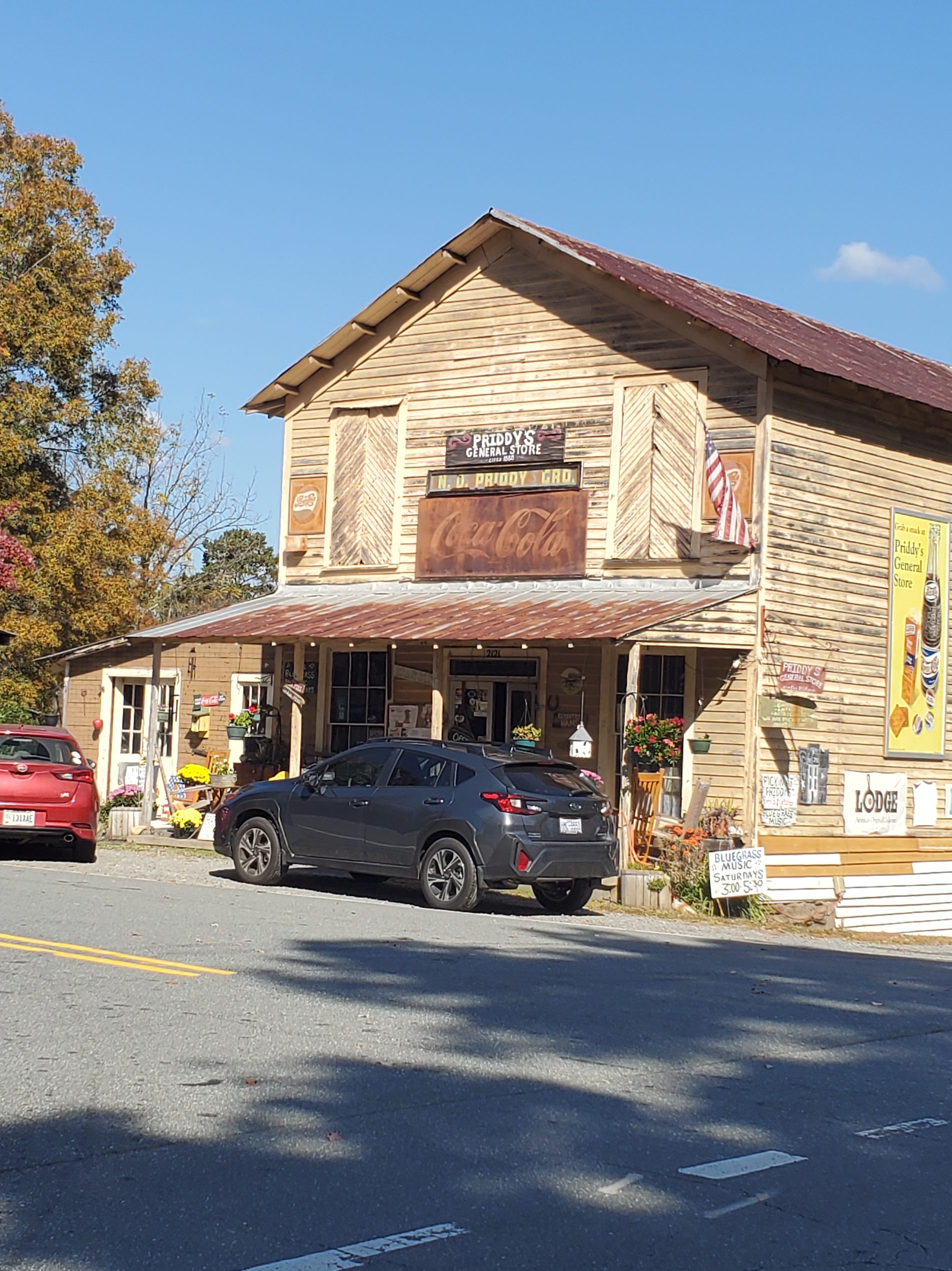
There are no regional or national franchises in Danbury, only local shops like the Danbury General Store, and small restaurants. J.E.Priddy’s General Store, a local historic landmark dating from the late 19th century, is still in business selling goods old and new. It is located about 2 miles east of town on Sheppard Mill Rd.

No battles occurred in Danbury during the Civil War, but it housed and supported the war efforts of the Confederate Army. The Moratock Iron Furnace, which is still found in Moratock Park, was used in the smelting of iron ore. General George Stoneman’s raid passed through Danbury on April 9, 1865, the day of the surrender of Confederate forces at Appomattox Court House, VA. Other historical features in the town include the Wilson Fulton House, the Old Stokes County Court House, and Moody’s Tavern (later McCanless Hotel).

In addition to the Moratock Iron Furnace, the Danbury Historic District, Hanging Rock State Park Bathhouse, and Stokes County Courthouse are listed on the National Register of Historic Places.
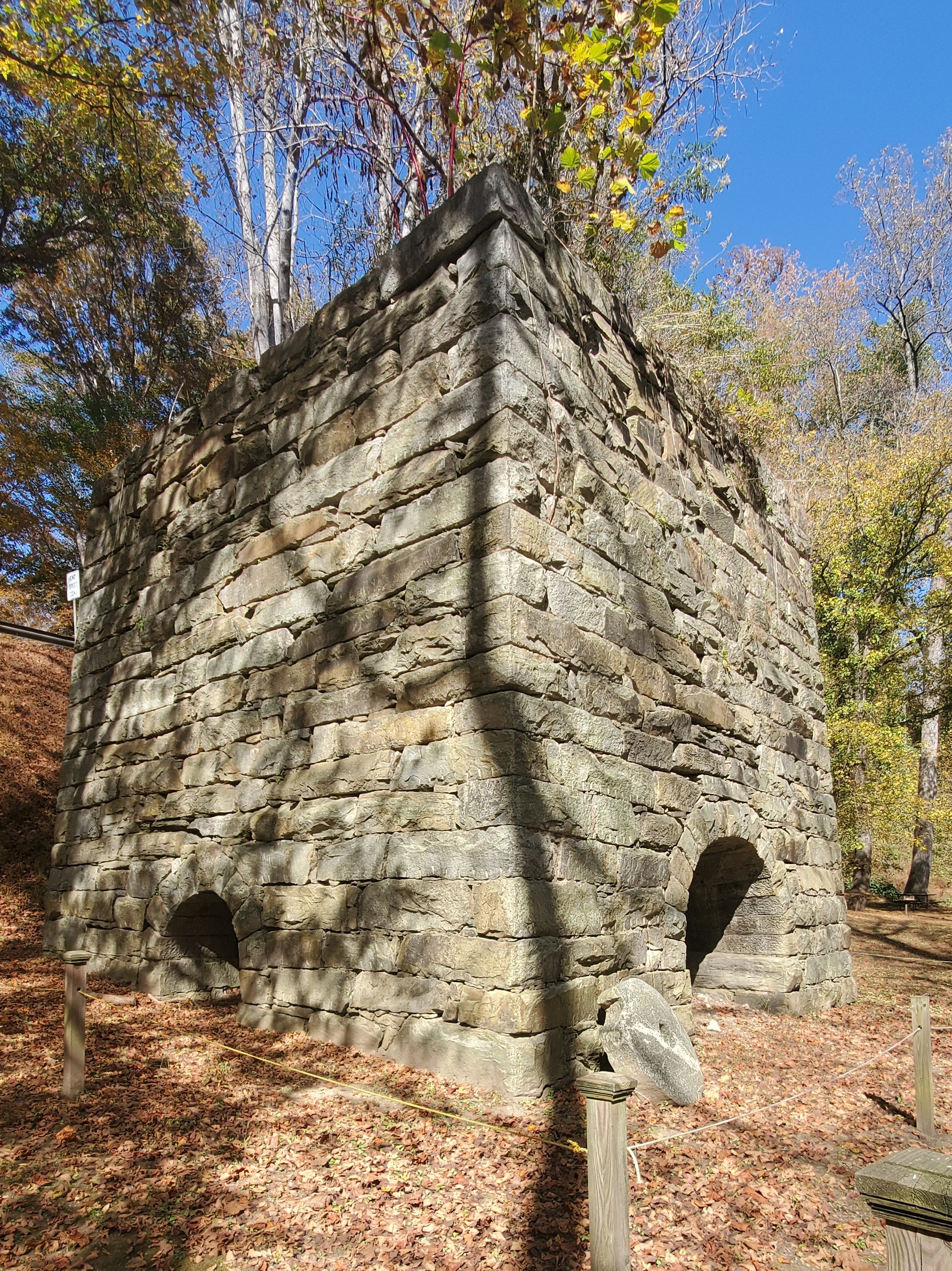
Moratock Iron Furnace – Moratock Park

One of several iron furnaces left in North Carolina (such as the Endor Iron Furnace in Lee County), the Moratock Iron Furnace is located beside the road at 1077 Sheppard Mill Road.

Danbury Historic District

Discover Danbury! Stop at the Danbury Historic District, where you’ll find The Arts Place (across from the Stokes County courthouse and Stokes County jail), an art and gift gallery that sometimes hosts live music and serves coffee and ice cream. (Two scoops seems more like four!)
Priddy’s General Store

Not far from the Moratock Iron Furnace, you’ll find Priddy’s General Store (2121 Sheppard Mill Rd.), which hosts live music in February, May, October, and December.
Hanging Rock State Park

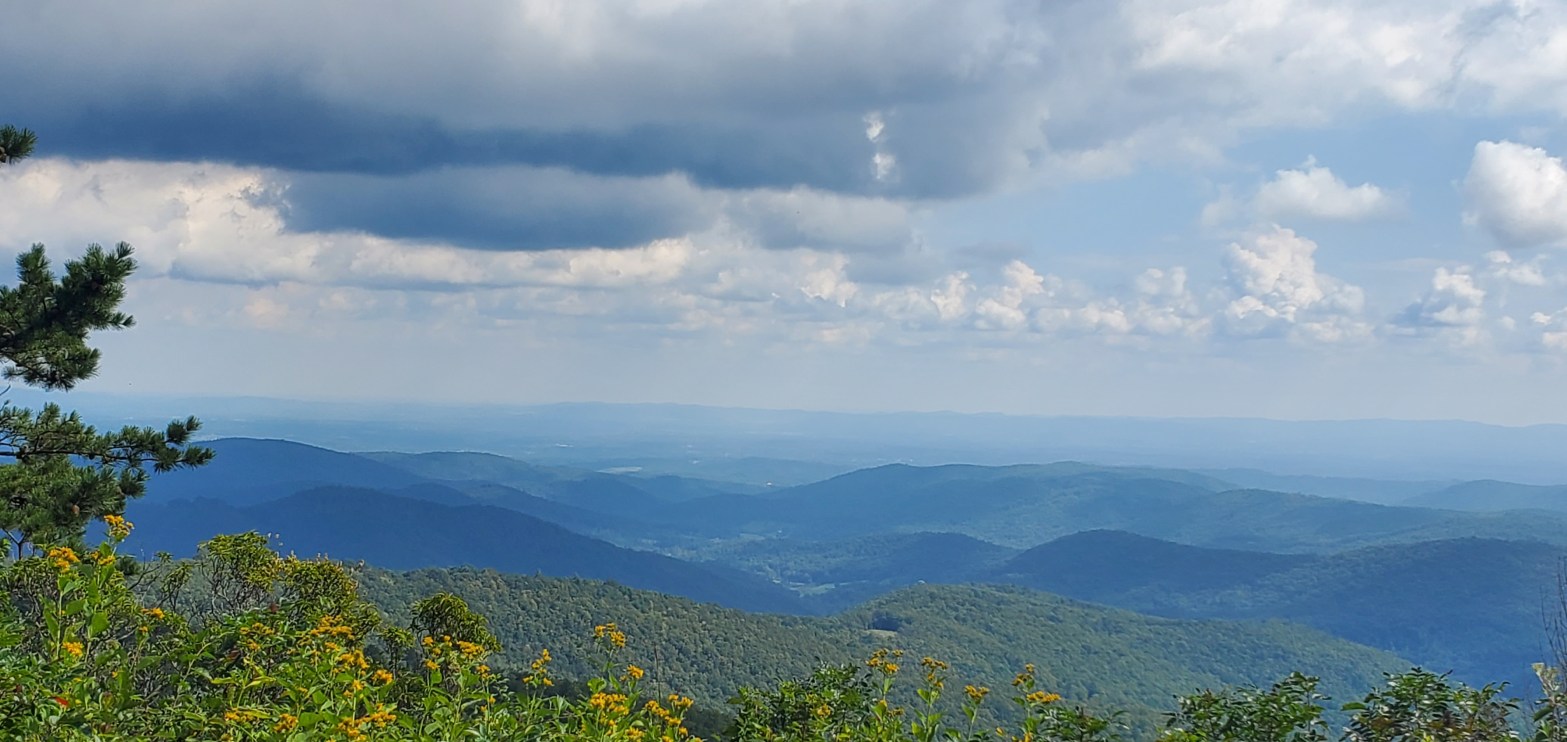
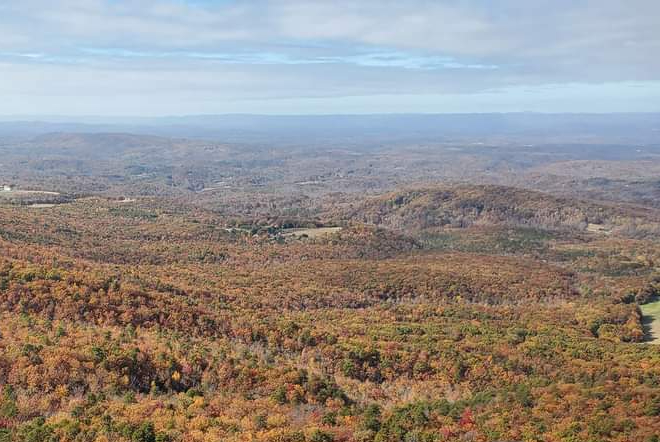
A trip to Stokes County is not complete without a visit to Hanging Rock State Park, one of North Carolina’s top 10 state parks. Located in the Sauratown mountain range, you’ll find shorter and longer hiking trails of all levels — some of them with a reward at the end, as in a waterfall. There are several in this park. Plus, you can take the somewhat strenuous hike all the way to the Hanging Rock, a quartzite formation that juts out over the landscape, offering breathtaking vistas of the Blue Ridge Mountains and the parks below. Rock climbers can tackle Moore’s Wall. Equestrians, there are trails for you too!

Pinnacle

The town was originally known as Culler, named for Emanuel W. Culler who owned the land on which a railroad station was built and served as the town’s first mayor. The present name of Pinnacle was adopted in 1894. Pinnacle was incorporated in 1901 but the charter was repealed in 1903.
Colonel Jack Martin Rock House

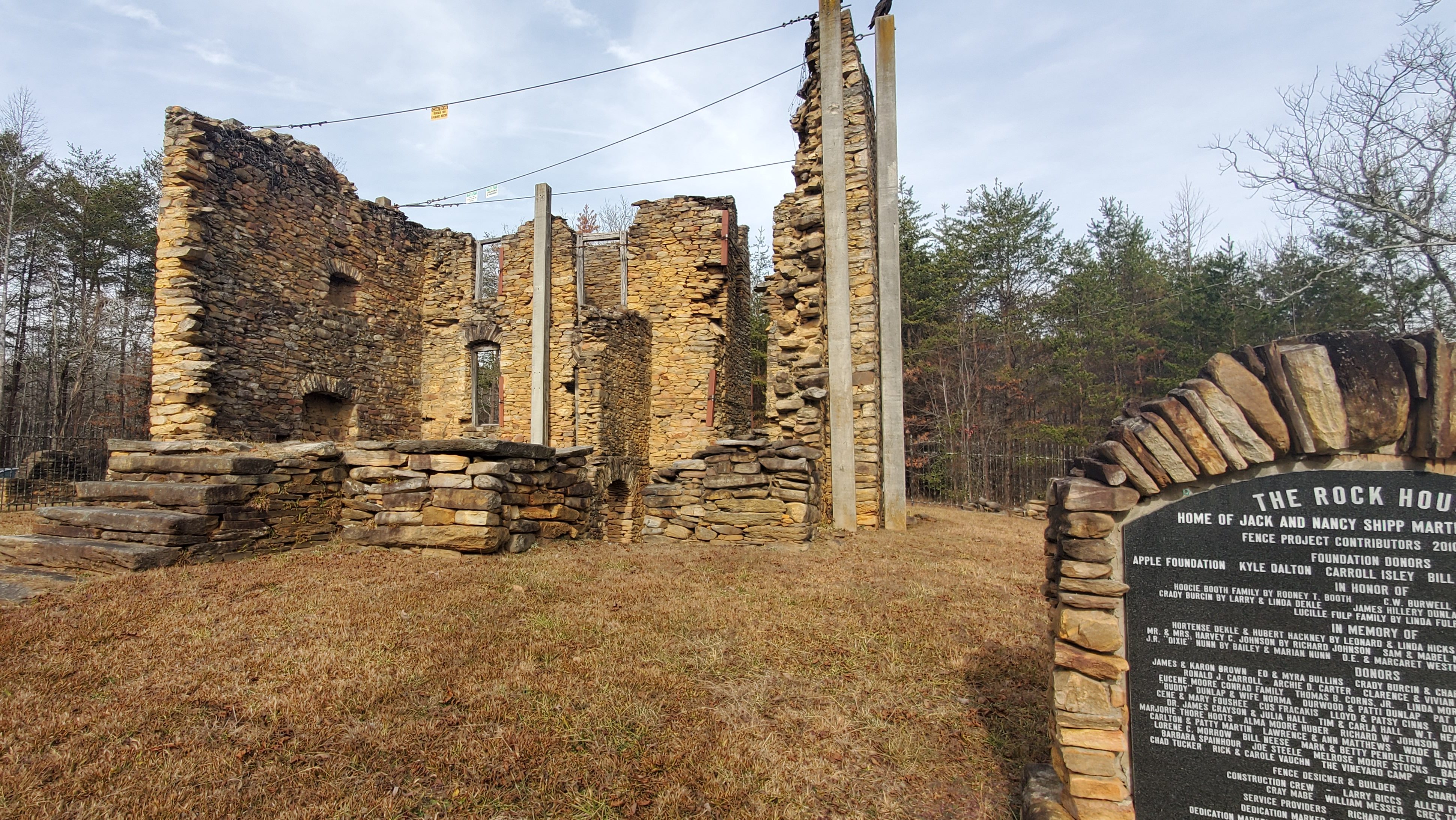
About 20 miles east of Pinnacle on State Route 1186 is the Rock House, the remains of a massive four-story stone structure with three-foot-thick walls built by Capt. John ‘Jack’ Martin (circa 1770), one of the first two settlers of Stokes County, on an 8,000-acre grant from the Crown. The house was built by slaves using local flint stones, with a fireplace large enough to roast an ox, and a stuccoed white plaster on the exterior. The Rock House served as the mustering ground for colonial forces during the Revolutionary War as well as the War of 1812. One of the oldest structures in Stokes County and listed on the National Register of Historic Places in 1975, the house burned in 1890, and only the great rock walls remain. Rock House was acquired in 1975 by the Stokes County Historical Society, which has struggled recently to protect the ruins from vandals. Jack Martin died in 1822, but his tombstone, erected many years after his death, incorrectly reflects 1823. His wife Nancy died in 1841.  They are buried in a small family graveyard southeast of the Rock House, which is listed on the National Register of Historic Places.
King/King’s Cabin

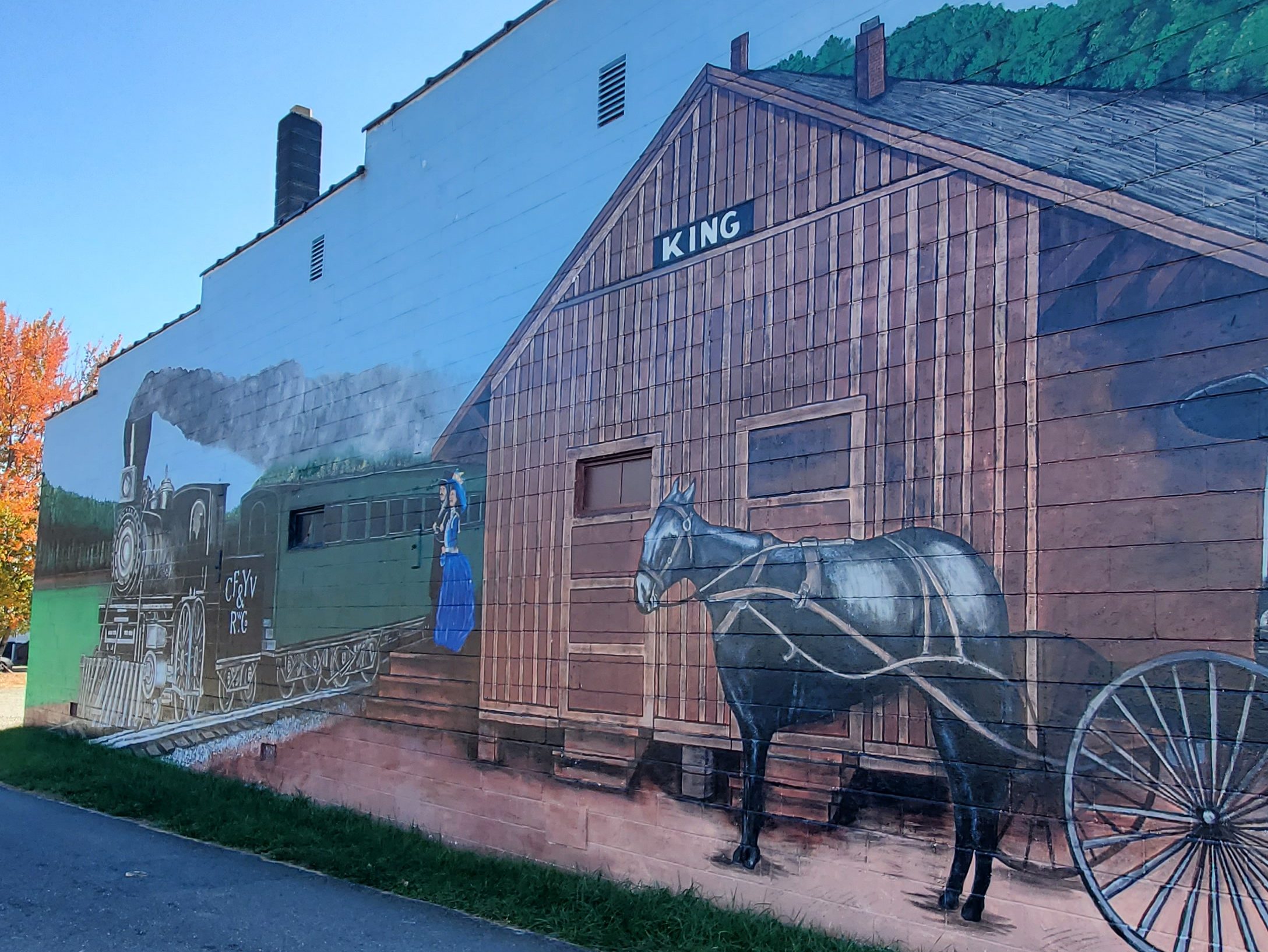
The town was originally called “King’s Cabin”. Charles and Francis King lived in a cabin owned by Francis’s father for a short time in the 1830s. Being Quakers and against slavery, the King family moved to the free North. According to television journalist and historian Chad Tucker’s book Images of America, King (2006), after the King family left their home it was used by locals as a landmark or reference point in giving directions. Several decades later when a post office was established in 1888, it was named for that reference point, King’s Cabin. The railroad laid tracks a few years later and shortened the name to “King” in its business transactions, and to eliminate confusion the post office followed on September 26, 1894. Charles and Francis King never returned to Stokes County and never knew their former home became the namesake of a town.

According to Tucker, the community grew into an unincorporated town of schools and businesses. With the first automobile arriving by train in October 1911, new highways followed. With new roads, the town’s proximity to Winston-Salem, and a new four-lane Highway 52 built in the 1960s, King opened its doors to growth, turning farmland into subdivisions. Community groups acted as an unofficial town council, providing services such as a fire department, water and sewer. On September 13, 1983, King became an incorporated city, 95 years after the King’s Cabin post office opened.

King is a new town when compared to the others in Stokes County. At one time, there were four tiny villages in all directions from where King is today. On September 11, 1812, John Fulk sold to Frederick Fiscus and Adam Fulk two acres on which they built the Bethlehem Lutheran Church. A school was operated there from 1840 to 1864. The townships first voting precinct was in this vicinity. This area is about one mile north of present King.

Trinity Methodist Church was organized in 1873. Also, near this site, H. C. Coe operated a general store and shoe shop. M. T. Choplin, a dealer in general merchandise, saddles, bridles, etc., operated a large store where Kirby Road comes into East King Street today. This was near the cabin where Charles King and his bride Francers Kiser built in 1826. The land was given to Frances by her father, Harmonius Kiser. This general area was known locally as “King’s Cabin”.

The village of Five Forks, so named because of the five roads that converged there, was a lively place beginning about 1871 when a post office was established there. Five Forks was on the stage coach road from Bethania to the Hollow Road at Trinity Church and northward. The King’s Cabin Post Office opened in March 1888 and the first train came through in June of 1888. S. R. Slate, first postmaster, named the post office “King’s Cabin” because the area had been known by that name for 60 years.

King would only have been a whistle stop on the railroad had it not been for the far sighted planning of the Spainhour, Grabs, Slate and a few other families. They built a depot and sold it to the railroad for $1.00. The railroad changed the name to King and the post office did the same in 1894.

Public spirited citizens and community cooperation have always been an important part of King. Just as the depot was built by local men, so too was the Tabernacle for public meetings. The first school in town was established in 1896. When the County Board of Education granted the request of several citizens for a high school, local men gathered at the two room elementary school and jacked it up and built two rooms beneath it for King’s first high school.

King is a bustling small town today with restaurants and shopping.

Germanton

Germanton was established in 1790 and is the oldest community in Stokes County. The town’s original 23 acres were part of a 700-acre tract that was granted to Jacob Lash by the Earl of Granville in 1762. The town was named after an influx of Germanic immigrants, who had served as veterans of the American Revolution, were given incentives to settle the area. These settlers included both Germans who fought against the crown, and Hessians who had been loyal to the crown.

Germanton is located near the older Moravian settlements of Bethabara and Bethania, which were part of the Wachovia Tract settlement. The etymology of the “Germanton” name is often mistakenly attributed to this proximity. While Wachovia was settled for religious reasons by people originally from what is today the Czech Republic, the settlers of the Germanton area were primarily Lutheran, originally from areas in what is today Germany, and settled the area for non-religious purposes. Early Stokes county settlers were the result of land incentives by the State in 1790 given as a reward to those Germanic people who had fought for Independence. And the use of German as a mother tongue died out by the 1850s. Coal was mined in the Germanton area in the late 19th century but was of low quality.

Next stop… Montgomery County!
Journey through Johnston County

Named for Governor Gabriel Johnston, Johnston County, or JoCo as it is affectionately called today, was established on June 28, 1746, from the upper part of Craven County. Located in the southeastern part of North Carolina, farming has a primary business since its earliest days. Most early growers in Johnston County were subsistence farmers. A few grew tobacco as a cash crop or reared pigs and cattle, which were sold in Virginia. Smithfield was the westernmost freight port on the Neuse River, and in 1770 the colonial government erected a tobacco warehouse there to store the crop before it was shipped out.

Eli Whitney’s cotton gin was introduced in the county in about 1804, leading cotton to become the area’s leading cash crop. Production for sale at markets remained low before the 1850s due to poor transportation links with other parts of the state. In 1856, the North Carolina Railroad was completed, connecting Johnston County with major urban areas. As result, farming for sale increased, lumber and turpentine industries developed, and the towns of Princeton, Pine Level, Selma, and Clayton were eventually created.

About 1,500 Johnstonian men fought in the American Civil War, of whom about a third died. Lingering political tensions and the emancipation of slaves created social and economic turmoil. In 1886, the “Short-Cut” line of the Wilmington and Weldon Railroad was laid through Johnston, eventually giving rise to the towns of Kenly, Micro, Four Oaks, and Benson.

The Panic of 1893 caused cotton prices to sharply decline, leading area farmers to switch to bright leaf tobacco as their primary cash crop. A new tobacco market was established in Smithfield in 1898, and the county’s first bank was created. Within several years, cotton mills were erected in Smithfield, Clayton, and Selma. During World War I, a brief surge in tobacco and cotton prices brought a boom to the local economy. As a result, the county embarked on a school-construction campaign and consolidated all public schools under a single county system. In the 1920s, the state built the county’s first two paved highways, and shortly thereafter many towns began paving their main streets. While local commerce enjoyed significant success during the decade, area farmers struggled due to drops in tobacco and cotton prices. The Wall Street Crash of 1929 and ensuing Great Depression caused all banks in the county to close. Following the passage of a state bond issue in 1949, most roads in the county and town streets were paved. Cotton and tobacco remain as the two major crops today.

You can Sip and Stay in Johnston County on the Beer Wine Shine Trail. The trail includes stops, such as Gregory Vineyards, Hinnant Family Vineyards, Broadslab Distillery, Fainting Goat Brewing Co., JoCo Brewing Co, and more. Get stamped while you hit all eight stops!

Gregory Vineyards

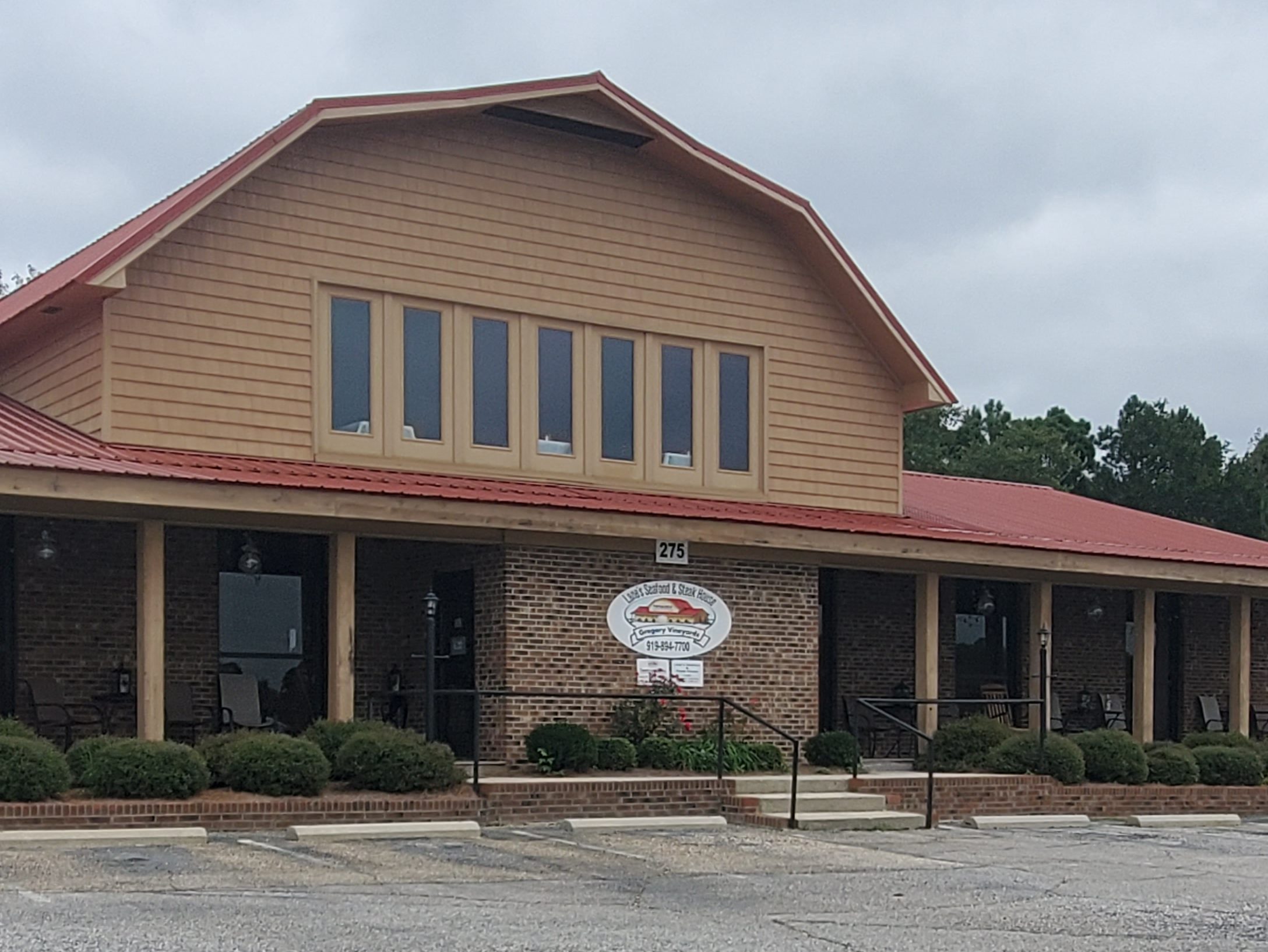
Gregory Vineyards is a charming winery located in North Carolina (275 Bowling Spring Dr.). Nestled in the town of Angier, it offers a serene and picturesque setting for wine enthusiasts.

With a passion for winemaking, Gregory Vineyards produces a variety of wines, each crafted with care and attention to detail. From their signature muscadine wines to traditional European-style varietals, there is something to suit every palate.

Apart from wine tastings, visitors can also enjoy guided tours of the vineyard and learn about the winemaking process from grape to bottle. The beautiful grounds offer a relaxing atmosphere, perfect for strolling through the vineyard or enjoying a picnic with friends and family.

Whether you’re a wine connoisseur or simply looking for a peaceful and enjoyable outing, Gregory Vineyards is worth a visit. Take in the beauty of the vineyard, savor the flavors of their wines, and create lasting memories in this idyllic wine destination.

Benson

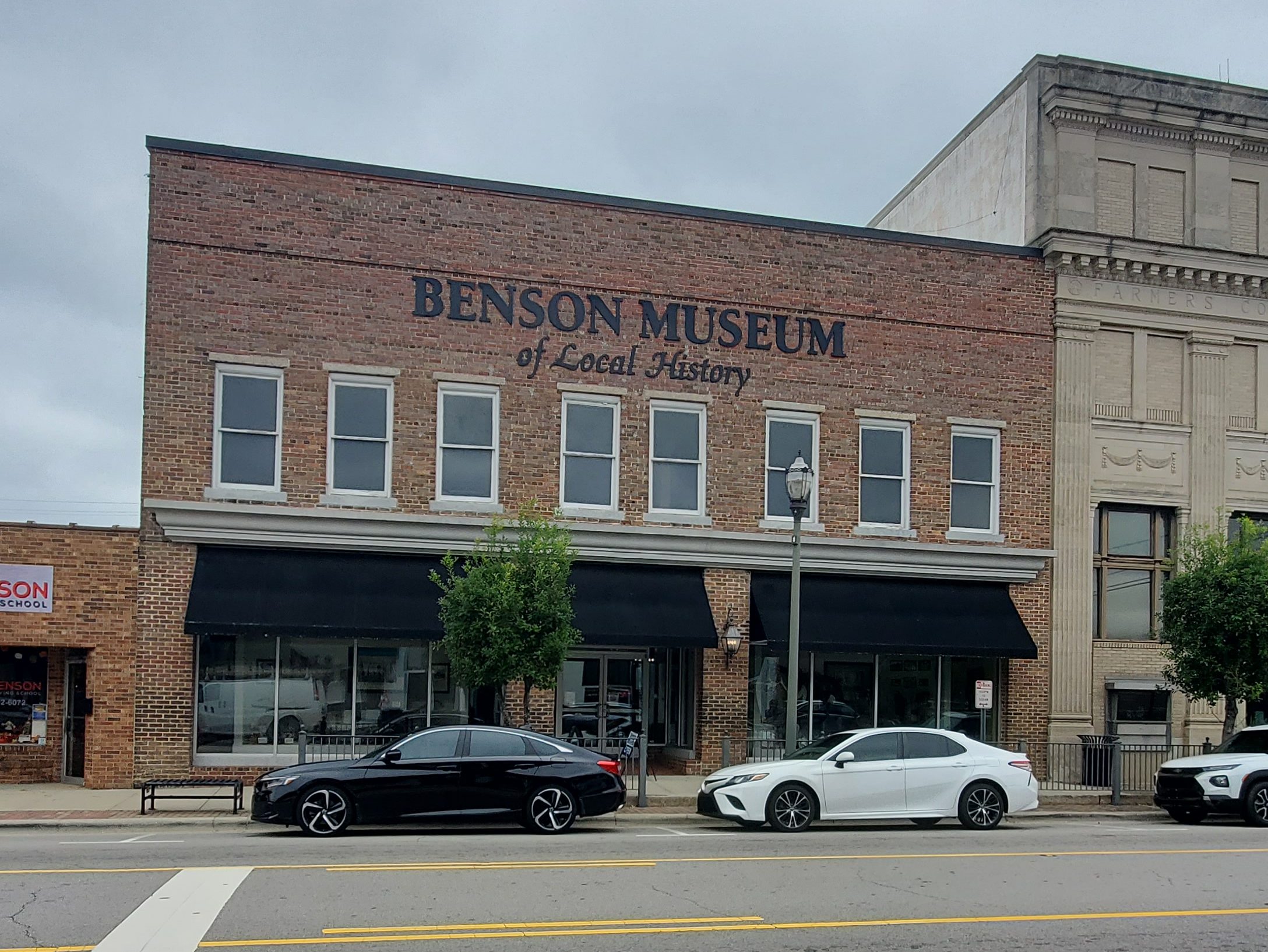
Throughout quaint downtown Benson, you’ll find a variety of local stores, a few coffee shops, the Benson Museum of Local History, some public art, the prominent train tracks that run through the middle of downtown, and lots of friendly people and shop owners. Trains pass through the area frequently, and the track are easily crossable by foot. It’s definitely worth the stop!

The town of Benson, named for an early settler Alfred Monroe (“Mim”) Benson, owes much of its historical development to the railroad line which passed through the town in 1886 on its route between Fayetteville and Contentnea. Mr. Benson’s purchase of a 402-acre tract along the Smithfield-Fayetteville Road in 1874 initiated the settlement of the area now known as Benson. During the 1880s, Benson sold portions of his original tract to incoming settlers, many of whom were farmers. Benson was incorporated in 1887 and soon attracted a number of entrepreneurs wishing to take advantage of this new town along an important transportation route.

A prominent early resident of the Benson area was John William Wood Sr. (December 28, 1855 – October 31, 1928), who rode to Benson each morning on a mule and wagon from his home at Peacocks Crossroads near Meadow. After having served on the Board of Education and as a county commissioner, where he was known to be a watchdog of the treasury, he was elected to a term in the State House of Representatives in 1927. Meadow School was built on land donated by him.

Although their “modern brick hotel” is gone, much of the Benson of 1924 remains today. And, because of that, in 1984, 54 acres of the town, the center of which is the downtown business district, was placed on the National Register of Historic Places. This historic district is comprised of the entire downtown business district and several blocks of surrounding residential neighborhoods.

The State Annual Singing Convention, which brings thousands of people to Benson each year, began modestly in a tobacco warehouse in 1921. About 200 people listened to two choirs that day. Since that time, the State Annual Singing Convention has grown and become one of the largest and oldest gospel sings in the United States. The singing is held outdoors in downtown Benson in a one-block oak grove with an open stage located at 400 E Main Street. The Gospel Museum is open and free to the public on Saturdays and Sundays. There is plenty of lodging in the area. Ample parking for buses is designated behind the stage area. The 103rd Singing Convention Scheduled is scheduled in June 2024.

In 1924, an article appearing in a local paper describing the physical appearance of the town stated:

“Within the past decade (Benson) has made rapid strides in different phases of improvements and now presents to the visitor a neat, clean little town sprinkled about with a goodly number of lovely homes, handsome churches and school buildings, a modern brick hotel, (and) two large banks, the Farmers Commercial occupying one of the most expensive and up to date buildings in the state.”

For more than 60 years, Benson celebrates Mule Days on the fourth Saturday of September, a festival that attracts over 60,000 people each year to a town of just a few thousand people.

On the outside of Benson, you’ll also find Broadslab Distillery (4834 NC Hwy 50 South), located in the Broadslab community with a rich history of moonshining. The distillery features their own moonshine and run spirits as well as canned and jarred goods, such as pickled asparagus and more.

Grab yourself an area map and explore the area!

Benson Museum of Local History

Come and step into another time. From farming and merchants to the railroad and baseball, experience life from earlier days and learn about how Benson’s past has made it the great community it is today. The Benson Museum of Local History (102 West Main St.) was established in 1987 to collect, preserve, and display items of historical significance related to the Benson area. The museum, which was originally located in the Benson Municipal Building, is now located in a beautiful building on Main Street, just steps from the railroad track. Visitors will see exhibits on a variety of subjects that defines Benson’s heritage, including Benson’s agricultural heritage, founding fathers, country doctors, military, education, plus much more.

Benson’s Art Trail

Benson’s Art Trail consists of two murals and two sculptures.

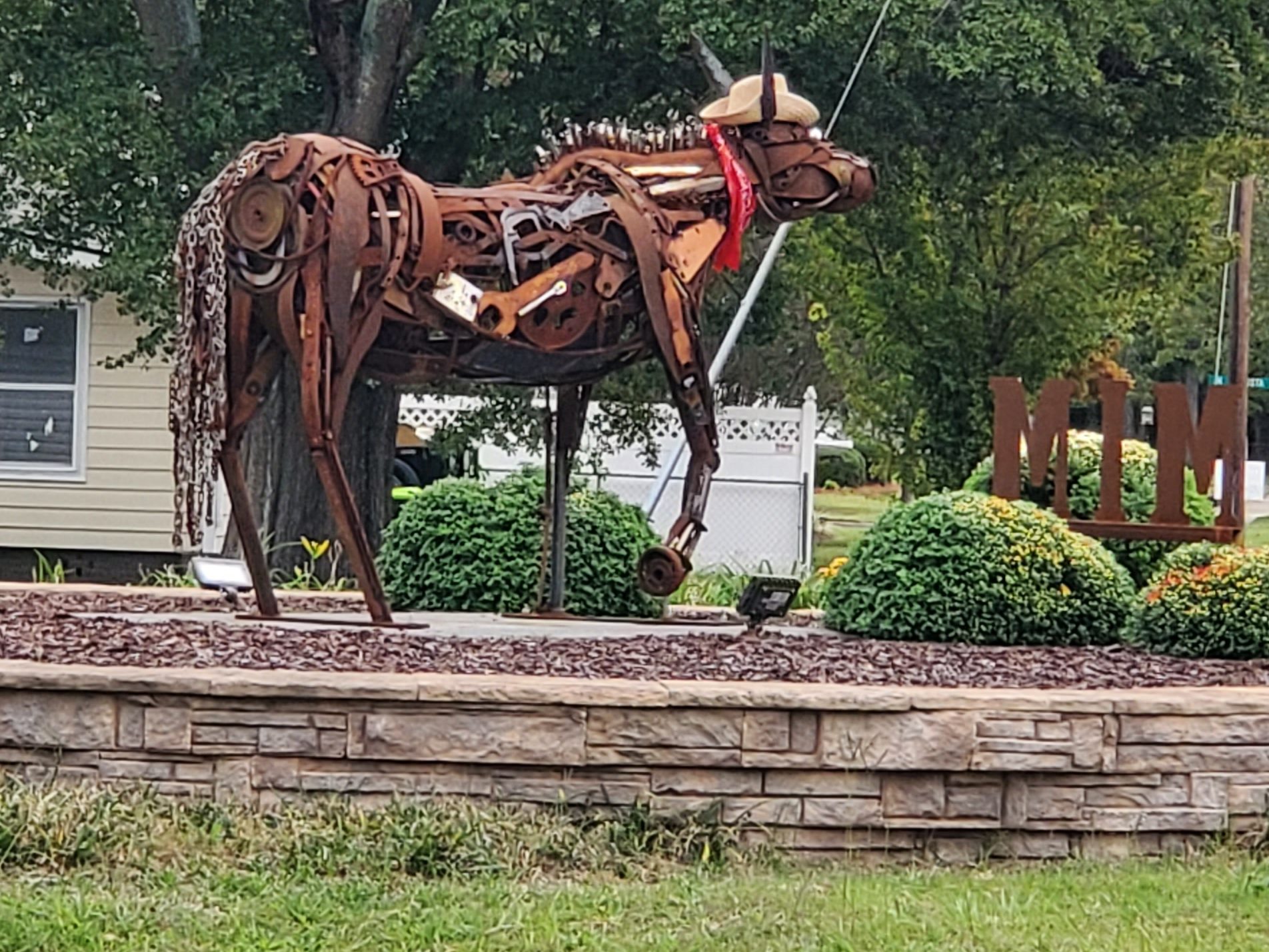
  • Mim the Mule Sculpture: You’ll find this as you head into town from the north on route 50. (It’s tough to take a photo here, since it is at the intersection of a few roads and there’s not a good spot to pull over.)
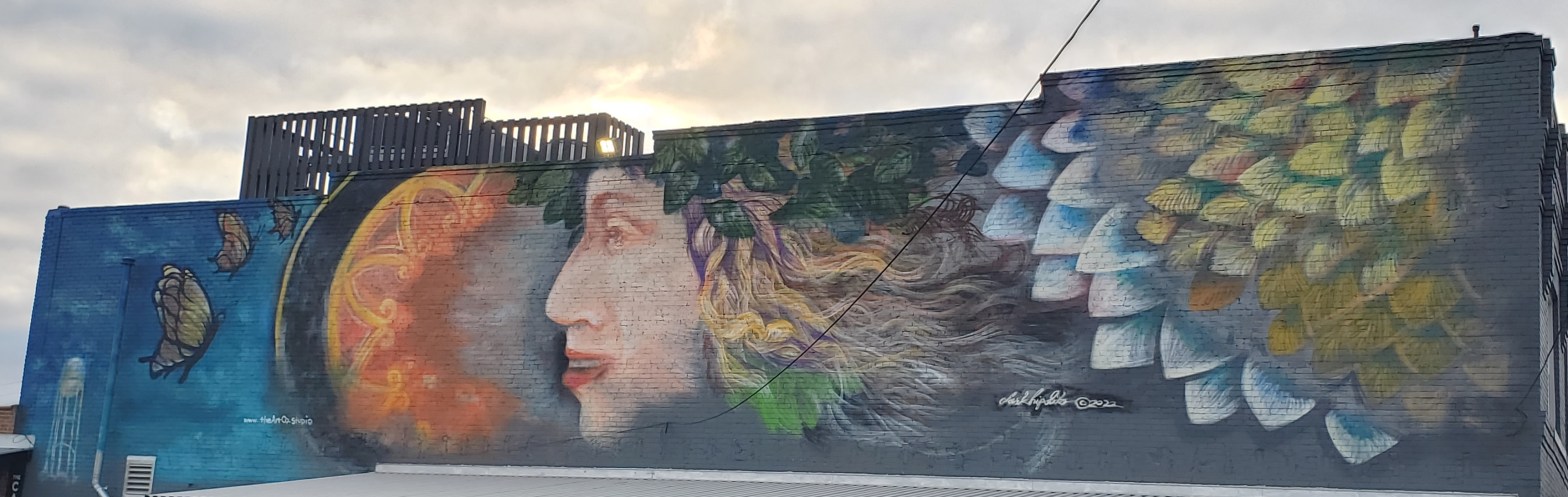
  • Benson Mural: Right in the middle of downtown beside the railroad tracks, you’ll find this colorful, photo-perfect wall mural that depicts the best of Benson for all to see.
  • Open Hand Sculpture: You’ll also find this oversized metal sculpture in the heart of downtown right beside the railroad tracks and across from the Benson Mural. (I’m not sure what the actual name of this sculpture is, but this seems like an appropriate name.)
  • Coffee Cup Mural: Heading out of Benson past the Singing Convention stage, you’ll find this colorful mural on the side of a gas station (left side of the road) across from the McDonald’s.

Tucker Lake
If you’ve driven I-40 through Raleigh, you’ve passed by Tucker Lake in Benson (3025 Allen’s Crossroads Rd.), a campground with a spring-fed lake and sandy beaches.

Four Oaks

Four Oaks was one of several towns founded along a branch of the Wilmington and Weldon Railroad, completed though Johnston County in 1886. Named for four oak tree sprouts growing from a stump, the town was incorporated in 1889. At that time, the town had a post office, a public gin, saw and grist mills, a saloon and general store, a church, and a population of 25. Cotton and tobacco farming were notable industries in the surrounding community.

A brick school for white students opened in 1923. By the 1930s, several rural schools near Four Oaks consolidated, and enrollment at the brick school increased to over 1,900 students, after which the school claimed to be the world’s “largest rural consolidated school”. An arsonist destroyed the building in 1987, and an elementary school for black students opened in 1928. Street lights were installed in 1907, and by 1910 Four Oaks had a population of 329.

The Four Oaks Commercial Historic District, consisting of 29 buildings dating from the late 19th and early 20th centuries, was listed on the National Register of Historic Places in 2006. Each year, the Four Oaks Acorn Festival features live entertainment, vendors, children’s activities, a barbecue competition, and an antique car and tractor show.

Bentonville Battlefield
In the town of Four Oaks, you’ll also find a North Carolina state Historic Site at Bentonville Battlefield (over 2,000 acres at 5466 Harper House Rd.) — the site of the South’s last major offensive and the largest Civil War battle in North Carolina fought between March 19-21, 1865. Here you can discover the area’s history through inside exhibits and explore the grounds on both sides of the street as well as take a 10-mile loop, guided driving tour. Historic buildings and sites include historic waysides and brigade markers plus over 3 miles of original trenches.

Smithfield

Smithfield is a town in and the county seat of Johnston County. Founded near Smith’s ferry on the Neuse River, Smithfield was Johnston County’s first town and second county seat. The settlement was first known as Johnston County Court House and was incorporated as Smithfield in 1777. Smithfield is home to the Ava Gardner Museum and is situated along the Neuse River, where visitors enjoy the annual Smithfield Ham and Yam Festival (among nearly 20 annual town events), walks along the Buffalo Creek Greenway, and the historic downtown district. Stop here for a variety of local shopping, dining, and attractions.

Ava Gardner Museum
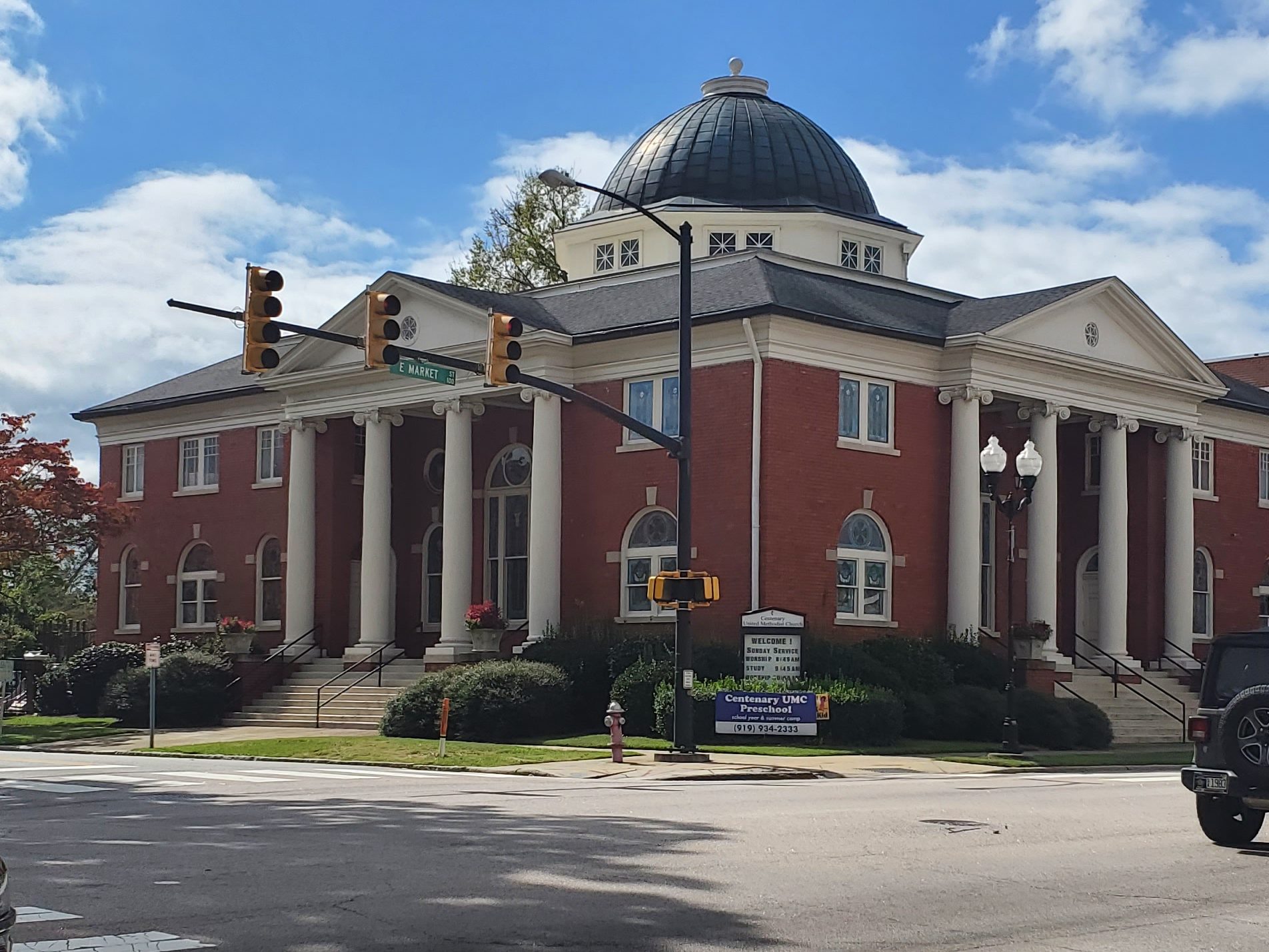
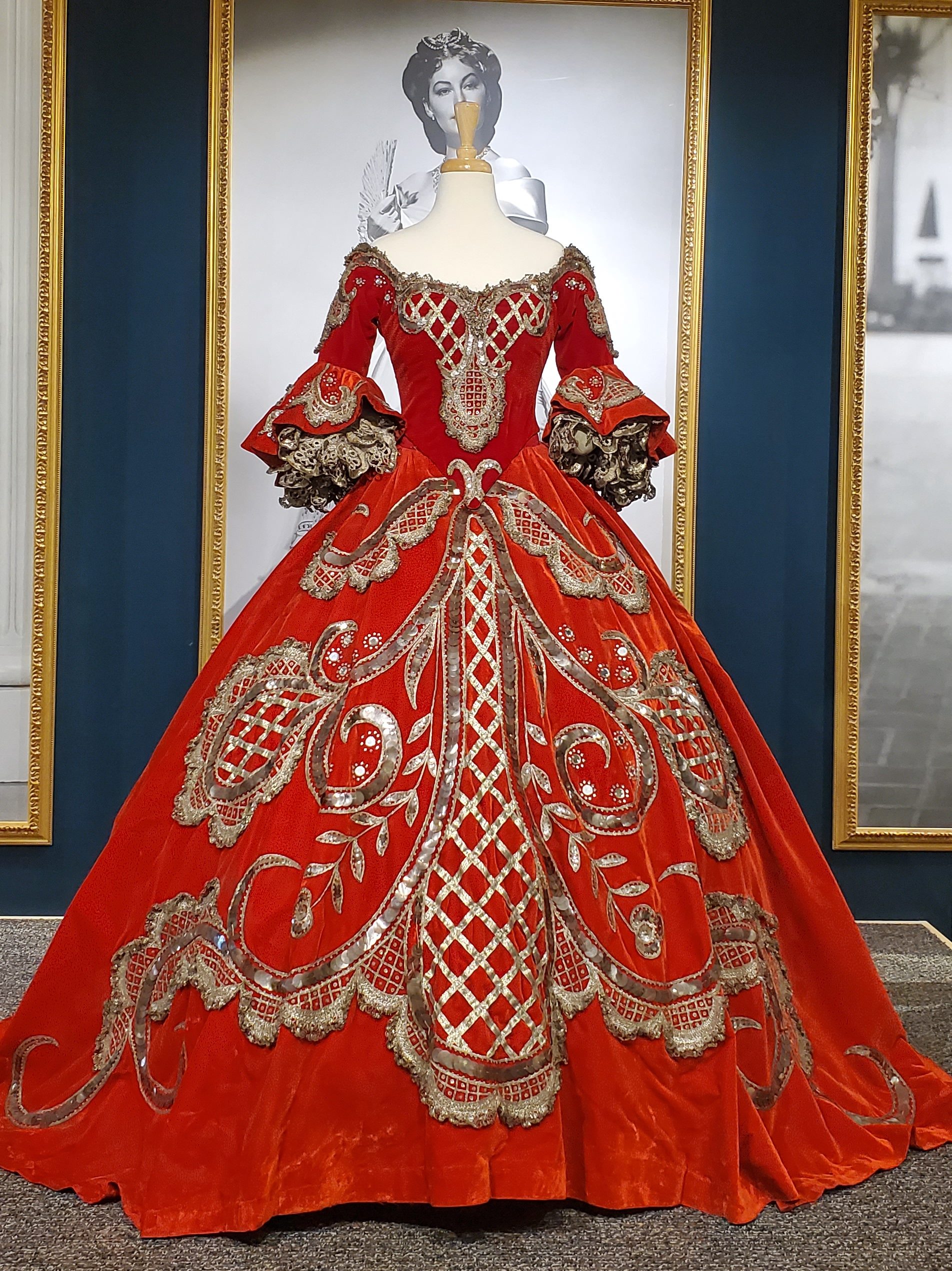
The Ava Gardner Museum (325 E Market St.) is home to an incredible collection of memorabilia including original scripts, photos, costumes, and personal effects of screen legend Ava Gardner—a true Hollywood “Cinderella” story. Experience her rise to fame from a country girl to one of Hollywood’s film goddesses.

Born near Smithfield, in the rural crossroads known as Grabtown, Ava’s friends and co-stars included Mickey Rooney, Clark Gable, Frank Sinatra, and Gregory Peck. Her grave site is located in nearby Sunset Memorial Gardens, approximately two miles from the museum.

In 2022, the museum held the “Ava 100” festival to celebrate what would have been the actress’s 100th birthday.

Johnston County Heritage Center

The Johnston County Heritage Center (241 E. Market St.) preserves the history and material culture of Johnston County for the educational benefit of its citizens and visitors; and it promotes the understanding of and appreciation for its past through interpretive exhibits, programs, and publications. It has become known as one of the best equipped facilities in the country for scholars, amateur historians, genealogists, and students to research the history and culture of Johnston County and its people.

Located in the renovated former home office of First Citizens Bank in the heart of downtown Smithfield, the location has space for exhibits, secure artifact storage, and ongoing expansion of the widely acclaimed Johnston County Room collection of local history and genealogy that was previously housed in the Public Library of Johnston County and Smithfield.

Visitors can peruse through rotating exhibits and attend special events held throughout the year. Be sure to pick up the Historic Walking Tour Brochure to explore the Downtown Smithfield area and its rich history. Admission is free.

Shadow Hawk Western Town

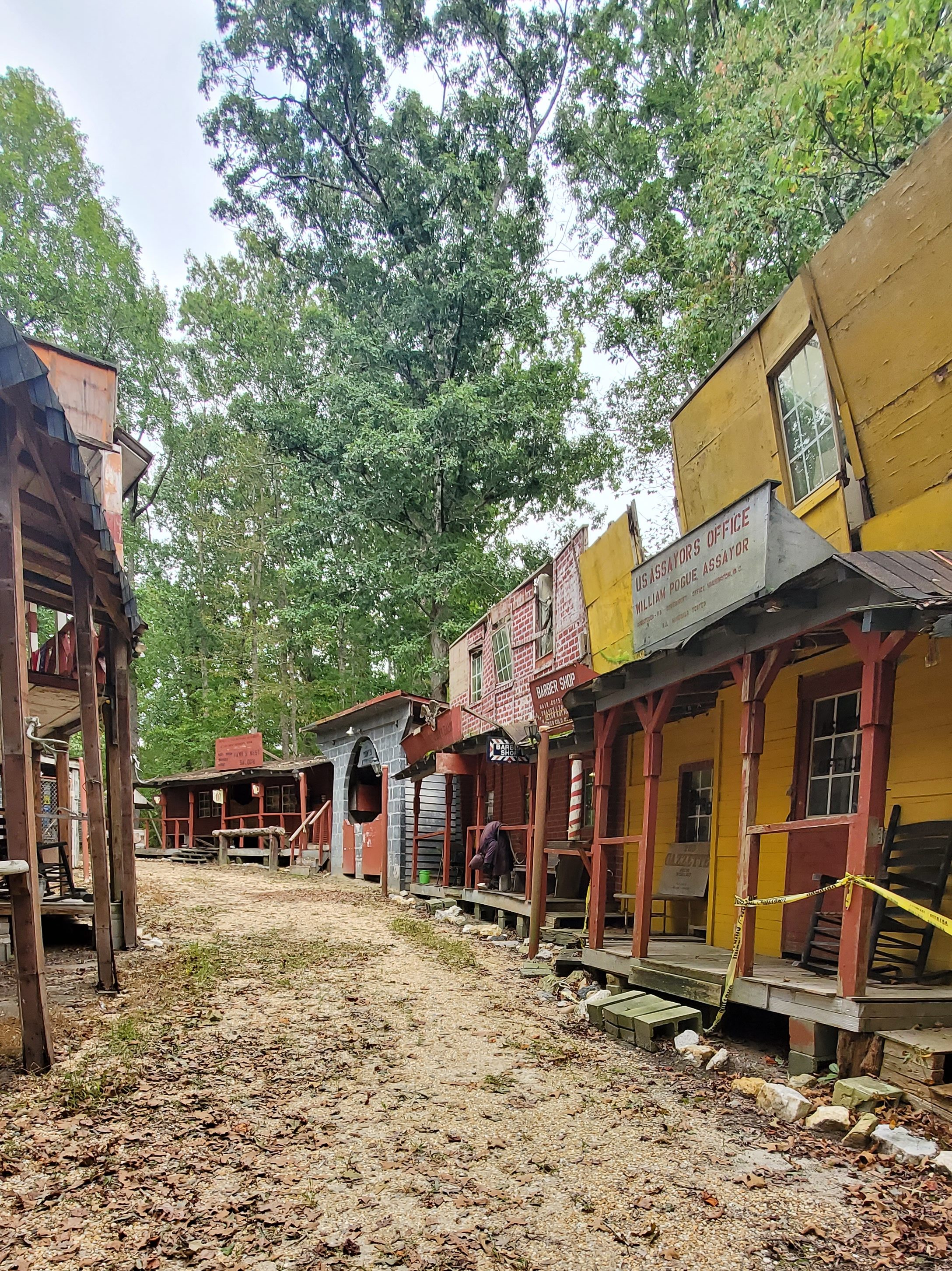
Here is a true hidden gem for you! On the outskirts of Smithfield, you’ll find this gem entirely built in someone’s back yard (494 Bonnie Ave.). Visitors are welcome to stop by and wander through unannounced if it is open. However, be aware that filming can be happening on any given day. So, walk quietly through if they’re filming. (They usually post a sign out front to let you know.) On the day we were there, filming was going on in the chapel. The attraction opens at 12pm daily.

DeWayne’s
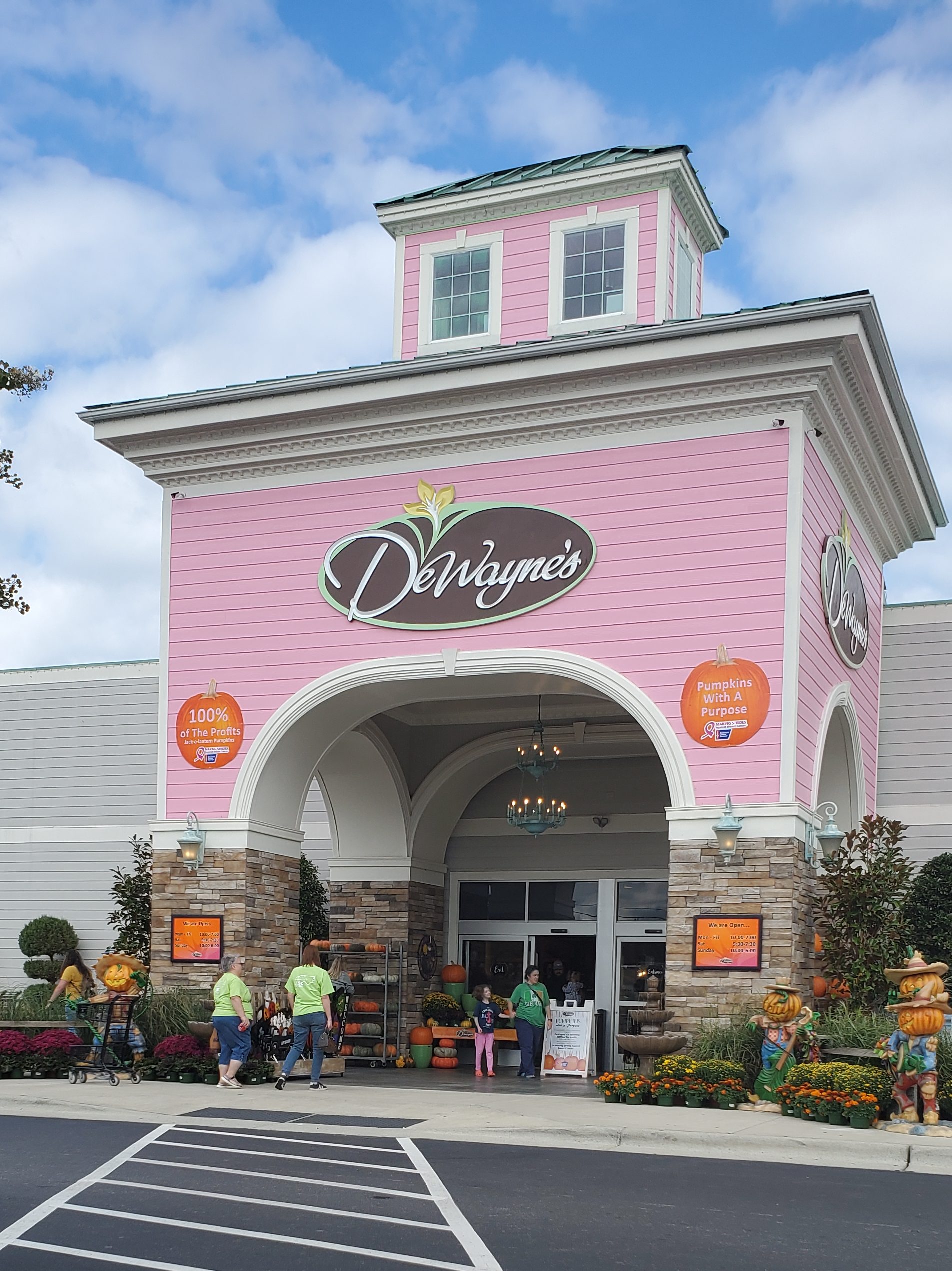
If you’ve never heard of or been to DeWayne’s (1575 Outlet Center Dr.), this is a must stop if you’re in the area. DeWayne’s has an award-winning and nationally recognized garden center with cast iron fountains and statuary plus a large year-round Christmas shop, designer boutiques, a fudge and sweet shop with ice cream, and so much more. It is definitely a destination shopping experience.

Selma

Selma was officially chartered as a Town on February 11, 1873, but the Town’s true birth took place on May 1, 1867, when there was a public sale of lots around a newly established station on the North Carolina Railroad.  Selma was born as a “Railroad Town,” and our rail heritage is still evident today, with our recently renovated 1924 Union Depot (Selma Union Depot) supporting Amtrak service.

The town is also home to the Mitchener Station, which was built in 1855 and is thought to be the oldest surviving train station in North Carolina. After Interstate 95 was built in the late 1950s, the town experienced growth due to its location next to the interstate. Today, there are many hotels and restaurants located in the area thanks to the traffic from I-95.

Selma Railroad Days is held in September/October of each year. You can also discover several artistic murals around town.

  • Vick Park Mural
  • Love Mural
  • Children Playing Mural
  • Selma Firefighter
  • Swing Mural

Union Station
This 1924 train station (500 E. Railroad St.) was completely restored in the Fall of 2002. Enjoy exhibits and memorabilia on rail history and the Town of Selma as well as the grounds, including a caboose.

Strickland Art Gallery

Located in Downtown Selma, Strickland Art Gallery (115 S. Raiford St.) features a wide variety of art for your home which is all painted by owner/artist William Strickland. William Strickland has lived in Selma for over 20 years and his work can be found around Downtown Selma as street art, in DeWayne’s, and in the Johnston County Hospice House. He was named the 2020 Artist of the Year for Johnston County in the Johnston Now Magazine.

Pine Level

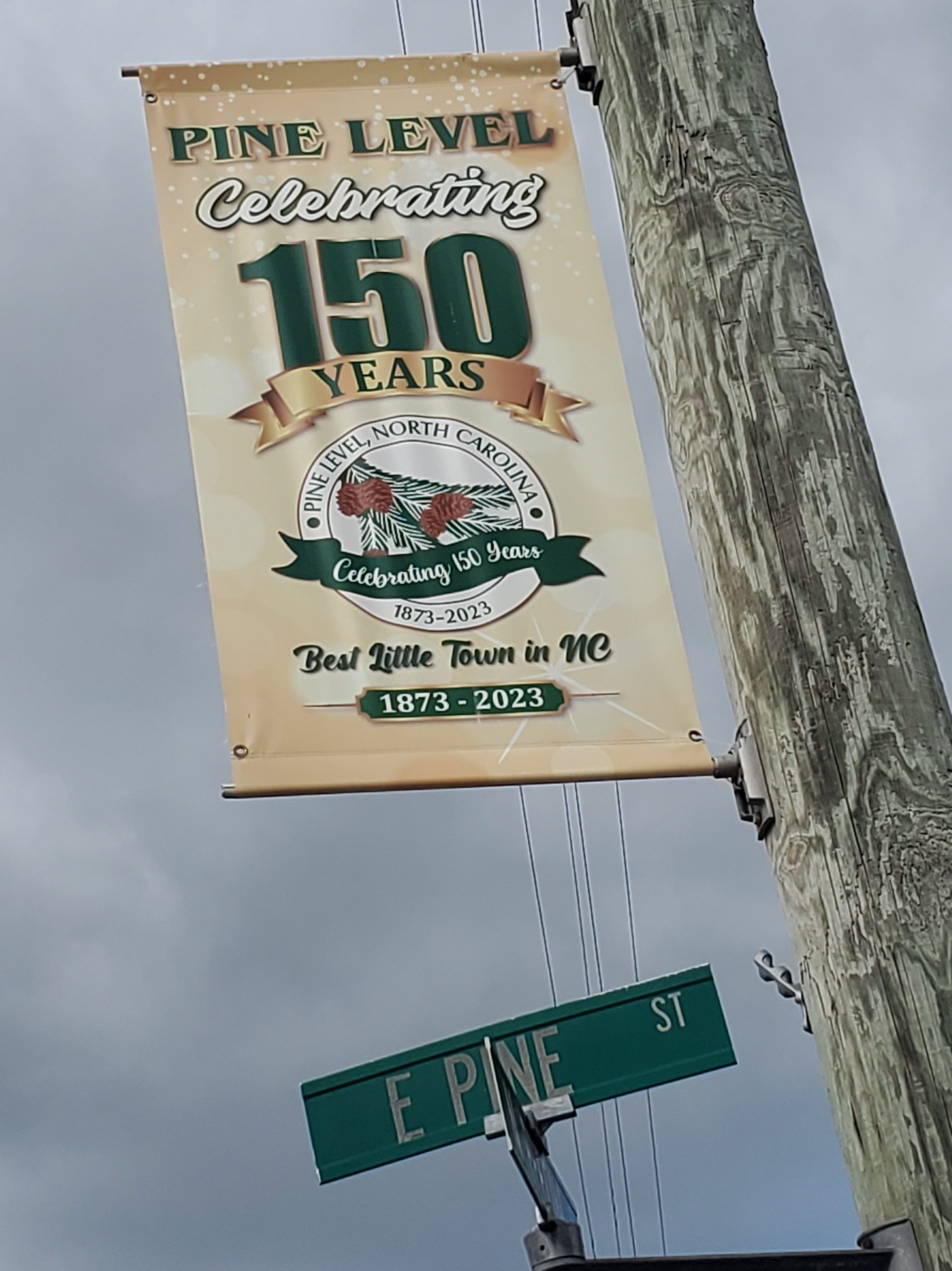
In 1963, Floyd G. Hinnant, Postmaster of Pine Level, wrote down his history of Pine Level:

In the days of slow transportation this little town, the third oldest in Johnston County, was a trading center for the pioneer turpentine prospectors and merchants who were obligated to feed the workers who followed those who were setting up turpentine distilleries. In 1868 two brothers, Daniel Thomas Oliver and William Berry Oliver, migrated from Robinson County in the interest of turpentine, setting up a distillery. Finding the natural setting of pine trees applicable to their need and in a fairly level country, the town found its name: Pine Level.

Some records say Gaston Britt and Bryant Hinnant were merchants at the time the Oliver boys landed. They, too, built two separate stores with supplies for the workers. The D. T. Oliver Store is no longer doing business but the original building is still standing and is used as a workshop by a great grandson. The William Berry Store was purchased by the only surviving son, the late D. B. Oliver, in 1900 and is still in operation by his four sons. The Southern Railroad running through the pine tree growth enabled the turpentine dealers to dispose of the turpentine by the railroad placing a train stop in town. Then a place for a post office was arranged with Mr. Thomas Hinnant being the first recorded post master in 1886. Happy were the people when the Post Office Dept. in Washington, D.C. gave the south the free mail delivery service. Pine Level has an up-to-date post office with efficient service rendered.

During the early nineteen hundreds many more settlers moved into our little town and at this time we have one of the most progressive rural sections in the state. Pine Level has a population of nearly 1,000. It has a bank, oil mill, modern cotton gin, mercantile businesses which service the farmers of a large area, five churches, two civic clubs, a veteran’s organization, and a fine volunteer fire department. Work is now progressing on a modern water system to keep pace with the rapidly growing town.

Hinnant Family Vineyards

Hinnant Family Vineyards and Winery (826 Pine Level-Micro Rd.), the largest muscadine vineyard in North Carolina with over 100 acres, is truly a tradition in the making. For over 30 years, the Hinnant Family has dedicated countless hours into cultivating the best quality muscadine grapes in the state. From their dry white and reds to the traditional sweet scuppernong grape, they catch a spectrum of flavors in their internationally award-winning wines.

Pine Level Hardware and Furniture Store

Pine Level features the large shop of Pine Level Furniture (219 N. Peedin Ave.).

Kenly

Kenly is a town in Johnston and Wilson counties in the U.S. state of North Carolina. It was named for John R. Kenly, Northern Division Superintendent of the Atlantic Coast Line Railroad, who later became president of the railroad in 1913. The community was settled in about 1875, developing along the “Short-Cut” rail line of the Wilmington and Weldon Railroad. It was incorporated in 1887 as Kenly, and the community’s first school, Kenly Academy, a private boarding institution, was established. Kenly High School, a public institution, was opened in 1914, and the town received its first electric service that year.

Flower Hill Nature Preserve
9038 Flower Hill Rd.

Kenly 95 Truck Stop

The Kenly 95 Truck Stop (923 Johnston Pkwy.) features a large, 1/3-scale replica of the Cape Hatteras Lighthouse. It’s definitely the largest truck stop this traveler has seen, complete with a full-size cabs and trucks inside, plus selections of tractor trailer parts, including grills, exhaust pipes and more — for truckers who want to trick out their ride!

Boyette Slave and Schoolhouse
NC Hwy 222, Glendale Rd.

The Tobacco Farm Life Museum
Stop by The Tobacco Farm Life Museum (709 N Church St.) for a step back in historic farming throughout the area. Visitors can tour through several buildings, antique farming equipment, and a gift shop.

Clayton

Clayton is a town in Johnston County and is considered a satellite town of Raleigh. Clayton is filled with local boutique shops, unique restaurants, public squares (Horne Square and Clayton Town Square), a public garden, plus art murals and sculptures. This enclave has a bustling downtown area with lots to do — and a nice environment for a day trip.

Sculpture Trail

Take some time to discover the 10 sculptures along Clayton’s Sculpture Trail.

Next Stop, Stokes County!

Journey through Alleghany County

The fifth smallest county in North Carolina, Alleghany County was formed from parts of Ashe County in 1859 by an act of the North Carolina General Assembly. The county received its name from the Allegewi Indian word “oolikhanna” (beautiful stream). In 1825, Bower’s Store became Alleghany’s county seat.

The earliest inhabitants of the area eventually comprising Alleghany County were Cherokee and Shawnee Native Americans. By the late 1700s, these people had been displaced by English, German, and Scotch-Irish settlers. The county was formed in 1859 from the eastern part of Ashe County. A group of commissioners selected a site near the center of the county to build a courthouse and established the county seat of Sparta. The county was expanded through annexations at the expense of its neighbors from 1869 and 1903, and a portion was moved to Wilkes County in 1909.

The construction of the Blue Ridge Parkway in the 1930s led to increased tourism and growth in Alleghany County. In 1936, the regional Blue Ridge Electric Membership Corporation was founded with the support of the Rural Electrification Act, leading to the eventual expansion of electric utility service in Alleghany. In 1944, the county’s first major manufacturer—D&P Pipe Works—opened after relocating from Chicago to Sparta to be closer to supplies of local mountain laurel roots which were used during World War II in the production of wooden tobacco pipes. Due to unreliable electricity, the company relied on its own generator for power, but utility service improved after the war.

Alleghany County’s economy grew in the 30 years following World War II with the expansion of manufacturing, aided by the improved electricity service and company’s desire to locate their facilities in areas with lower land costs, fewer regulations, and less competitive wages. Service-oriented businesses cropped up along U.S. Route 21 to accommodate travelers driving north out of the state. Use of the highway decreased after Interstate 77 was completed in 1975. D&P Pipe Works, later renamed Dr. Grabow, peaked with about 350 employees before health concerns regarding tobacco smoking led to a decline in demand for pipes in the late 20th century. Between 2000 and 2005, the county lost 60 percent of its manufacturing jobs.

The county is located entirely within the Appalachian Mountains region of western North Carolina. Most of the county is located atop a rolling plateau that ranges from 2,500 to 3,000 feet (760 to 910 m) above sea level. The southern border of the county drops abruptly nearly 1,500 feet (460 m) to the Foothills region of North Carolina. The plateau is crossed by numerous hills and mountains, and the highest point in the county is Peach Bottom Mountain/Catherine Knob at 4,175 feet (1,273 m) above sea level. The major rivers of Alleghany County are the New River and the Little River; the latter flows through the town of Sparta, the county seat.

Alleghany County is one of several North Carolina counties which produces a significant amount of Christmas trees, with an estimated 1.2 million such trees from the county being sold in 2022. You’ll see Christmas tree farms throughout the county, including on hill and mountainsides. Alleghany also produces the most pumpkins among the counties in the state, so pumpkin fields abound hear — and you’ll see many trucks loaded up with pumpkins from September onward — as they make their way to porches across the state.

Alleghany County’s Barn Quilt Trail features 98 barn quilts spread across the county. An arts community is centered in Sparta. The NC Mountain Arts Adventure is held each year in October, featuring 12 studios throughout two weekends across the county.

Roaring Gap

Roaring Gap was established in 1890 as a summer resort by Elkin, North Carolina industrialist Alexander Chatham, one of the founders of the Chatham Manufacturing Company. The community derives its name from the noise the wind makes when rushing through the mountains located there. Roaring Gap has 3 golf and country clubs.

Stone Mountain State Park
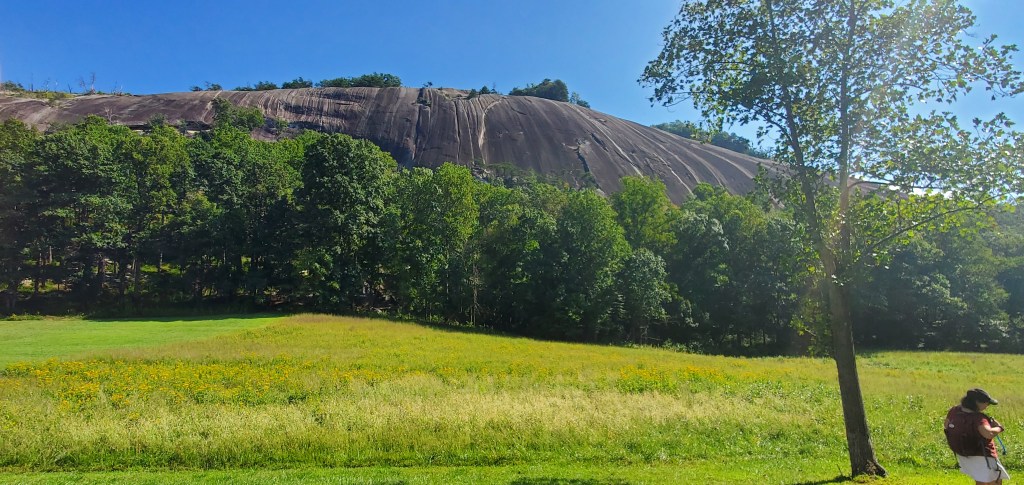
The centerpiece of the park is Stone Mountain (accessed via Frank Parkway in Roaring Gap), a dome of exposed granite (specifically a quartz diorite to granodiorite) of Devonian age, which has intruded into the gneiss of the Precambrian Alligator Back Formation. It rises sharply over 600 feet (183 m) above the surrounding terrain. The mountain, which has an elevation of 2,305 feet (706 m) above sea level, is known for its barren sides and distinctive brown-gray color, and can be seen for miles. The mountain offers some of the best rock climbing in North Carolina, and the park’s creeks and streams feature excellent brook trout fishing. Because the mountain is the best example of a monadnock in massive granite in North Carolina it was designated a National Natural Landmark in May 1974. The park visitor center features the Mountain Culture Exhibit, including mountain settler life and artifacts and natural history, including trout, butterflies, and moths.

The mid-19th century Hutchinson Homestead sits at the foot of Stone Mountain and includes a log cabin, barn, blacksmith shop, corncrib, meat house, and original furnishings. The Homestead is open Thursday through Sunday from March – October. The grounds can be visited year round.

The Stone Mountain viewing area can be accessed easily from the Lower Trailhead parking area. You can also access through the Upper Trailhead Parking. From both directions, you can hike the Stone Mountain Loop Trail, which features a beautiful waterfall, and view the dome from below or hike to the see the vista from atop the dome. The loop is listed as strenuous. However, this blogger (who is not a frequent hiker) found the trail to be easier–except going up the stairs on the way back. If you’ve hiked all the way out to the hanging rock, I would rate this trail easier (other than the stairs).

Sparta

Sparta is the county seat of Alleghany County. James H. Parks, an early businessman whose store stood near the present location of the ABC store, was one of three men who donated land for the county seat in 1866. Parks is credited with suggesting the name “Sparta”, after the Greek city-state.

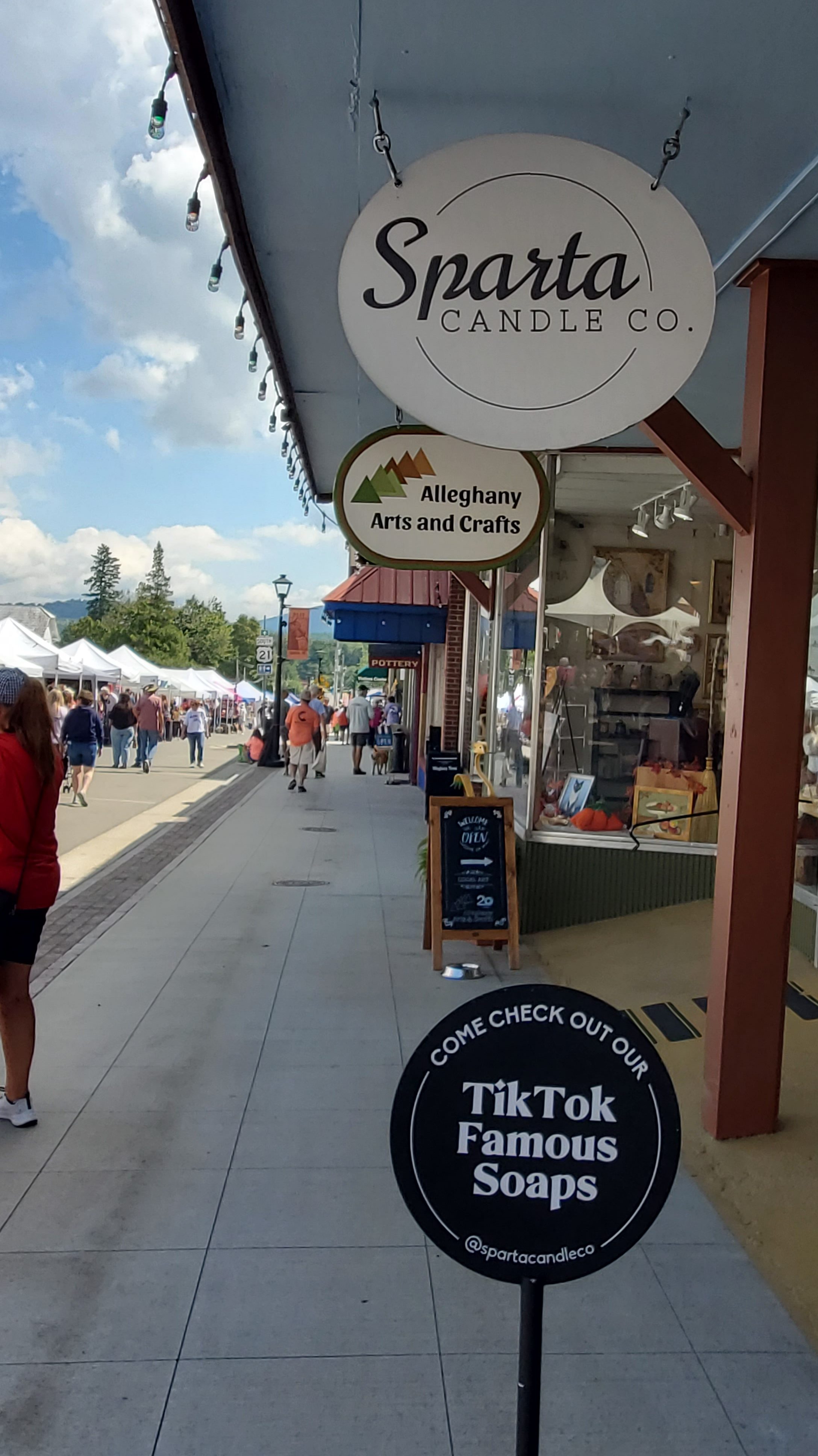
When passing through the city, which is surrounded by additional peaks, you still get an on-top-of-the-world feeling with vistas all around. Stop by the many shops, including Sparta Candle Co., as well as the Visitors Center with information about the area, plus view exceptional photography of the county’s most iconic scenes and Blue Ridge Mountains overlooks.

The town of Sparta hosts a “Music on Main” series of weekly public concerts for local musicians from June through September every year as well as the annual Mountain Heritage Festival held in downtown Sparta (on Main St.) in mid-September. Stop by for crafts, vendors, food, music, and more!

On August 9, 2020, the town was the epicenter of a moderate earthquake that was felt as far as Georgia and into the Piedmont area of North Carolina. The earthquake, which registered as a 5.1 on the Richter magnitude scale, was the largest earthquake to occur in North Carolina in over 100 years.

Doughton Park

Doughton Park is a landscape of mountains, open meadows and pioneer cabins, hiking trails and a place to view wildlife and get a feel for the lives of those who lived here long ago. Originally known as the Bluffs, this area came by its present name in honor of Congressman Robert L. Doughton, a long-time advocate and supporter of the Parkway. The 7,000-acre park is one of the best places along the motor road to view white-tailed deer, raccoons, red and grey foxes, and bobcats, as well as spectacular shows of flame azalea and rhododendron in the late spring.

Alleghany Historical Museum
While in Sparta, stop by the Alleghany Historical Museum (45 N Main St.) and learn about the area’s history, including farming and schooling as well as typical life. View relics from the past, including a schoolhouse desk, tobacco farming tools, historic bibles, and a large thimble collection.

Freeborne’s Restaurant and Lodge is an iconic biker’s gathering spot located at 14300 NC-18 South.

Laurel Springs

Thistle Meadow Winery
Visit the Alleghany County’s only winery (102 Thistle Meadow), just 12 miles southwest of Sparta. Located in the heart of the Blue Ridge Mountains, the winery offers tastings of wines made from grapes grown around the world. The winery is dog friendly.

P.S. NC’s Hugging Tree is located on Bluff Mountain Trail in Laurel Springs.

Next stop… Johnston County!

Journey through Bladen County

Throughout Bladen County, you’ll find a plethora of pine trees, as it is part of the Southern Pines/Sandhills region, as well as corn, soy bean, watermelon, and blueberry fields as well as turf farms. Curiously, you’ll also happen upon a large number of private family cemeteries–some roadside and some set back on private land. As the third largest county in North Carolina, Blade County encompasses 879 square miles and is known for Houston peanuts.

Named for Martin Bladen, a member of the Board of Trade, Bladen County was first settled by Highland Scots who came to the Cape Fear Valley in 1734 seeking religious freedom. Bladen’s original residents also included the Waccamaw people. Once North Carolina’s largest county, Bladen received its name, “Mother of Counties,” because 55 counties have been carved from it. It now contains some 879 square miles and is the fourth largest county in the state. Originally, Bladen contained over 1,000 lakes and was the state’s most beautiful county. The lakes, believed to have been created by a bombardment of meteors 100,000 years ago, have developed into important recreational areas and tourist attractions. Within its present boundaries, seven of them remain.

Prior to European settlement, the area was occupied by Native American peoples: Waccamaw and Cape Fear. (Cape Fear has come to represent a general population of Native Americans that lived along the river, and identified as such by the European settlers.) During this time, the Native Americans were growing food, hunting with bows and arrows, and making pottery.

Bladen County is abundant in natural recreation areas with three rivers within its boundaries, including the Black River, South River, and the Cape Fear River, which is the largest and bisects the county. These rivers provided transportation for crops and naval stores products, allowing for farmers to export their goods. In addition to three rivers, Bladen County is home to the Bay Lakes and 2 State Parks: Jones Lake State Park and Singletary Lake State Park. White Lake is also a popular attraction for swimming and camping.

The county is rich in colonial history starting with the Scottish settlers. It was the site of the Battle of Elizabethtown, where the Patriots broke Loyalists/Tory power. When the American Revolutionary War began, records indicate that 300 men served in the Bladen County Militia.

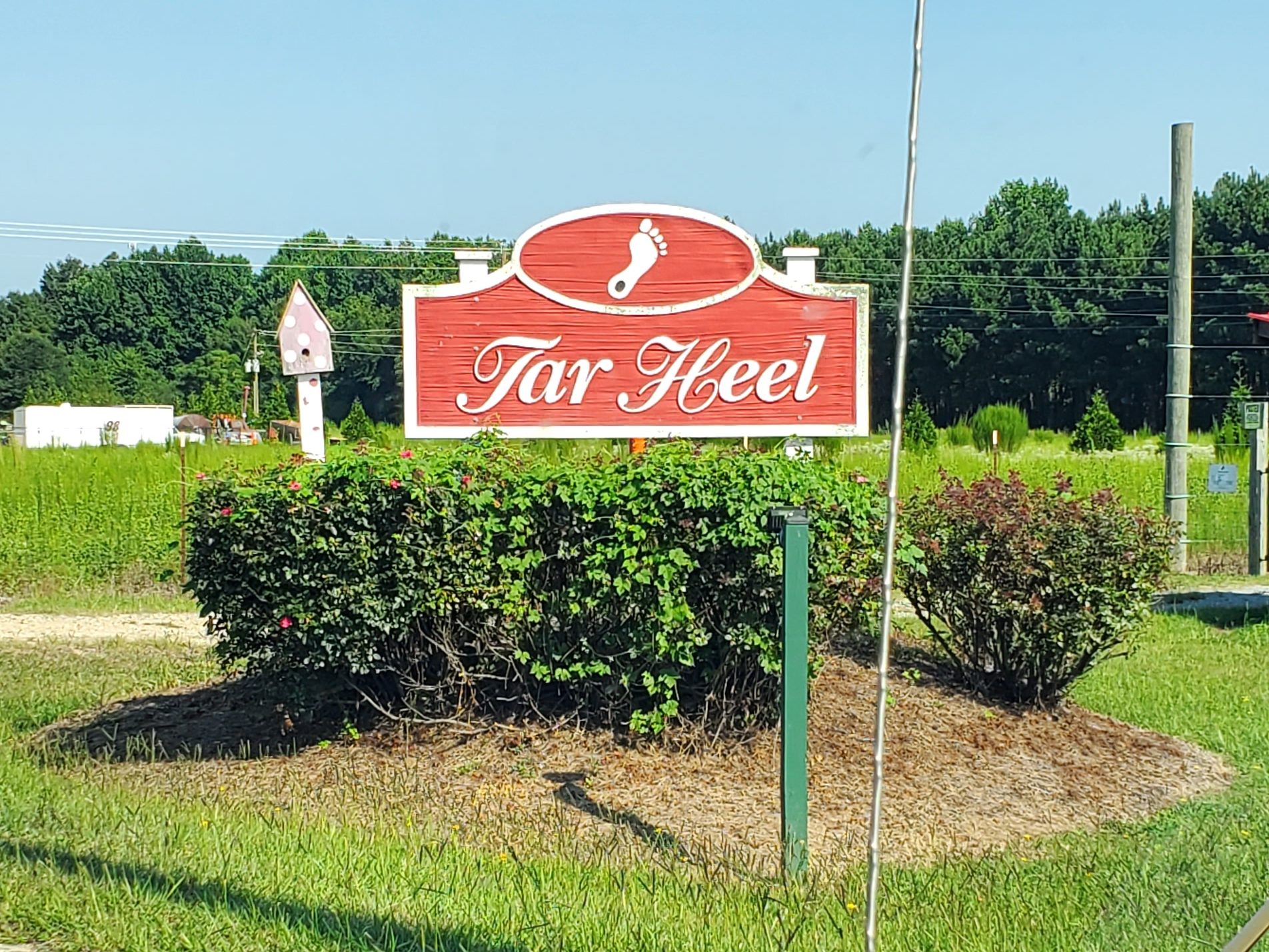
Tar Heel

Incorporated by the State of North Carolina in 1964, the town of Tar Heel is home to the largest pig processing plant in the world, which opened in 1992, operated by Smithfield Foods and is located just north of the town limits.

This farming community has a history dating back to the Revolutionary War. Colonel Thomas Robeson, for whom Robeson County was named, lived in the Tar Heel community. The town was known for its landing on the Cape Fear River. The state operated a ferry at this landing, and it was a major loading point for vessels that transported agricultural goods to the market in Wilmington. The major product was barrels of turpentine. Tar Heel had several turpentine stills, and the remains of some of the old stills can be found in the area. The results of transporting the barrels of turpentine, leaking barrels, caused a tar-like material to be found around the landing and the access to the river. When the community people talked of going to the village, it was said they were going to get tar on their heels, thus the name ‘Tar Heel.’

Harmony Hall Village
Harmony Hall Plantation (1615 River Rd.) is the 1760s-era home of Col. James Richardson on the Cape Fear River. The plantation today is home to several buildings that span the years from the home’s origin to 1900, including a one-room school that operated in Bladen County during the last quarter of the 19th century. The Harmony Hall Plantation grounds are open to the public – but the hiking trail to the Cape Fear River may be currently closed. Unfortunately, the house is closed too due to mold damage caused by Hurricane Florence.

White Lake

The community of White Lake along with the lake itself and the nearby White Lake Water Park (192 NC-53) has been a leisurely summer family destination for generations of North Carolinian families. From summer rental cottages to gated communities and year-round homes and estates, plus local favorite restaurants, watering holes, an arcade, and more, you’ll find this area well visited throughout the summer months as well as the off season. It has been labeled “The Nation’s Safest Beach.” Some accommodations are open year-round. White Lake is also the home of the annual White Lake Water Festival, held the third weekend in May each year.

Elizabethtown

Some maintain that Elizabethtown is named for Elizabeth, the wife of George Carteret, while others believe it was named for the love interest of a local landowner. In the 1970s, Elizabethtown more than doubled its size through annexation, increasing from about 1,400 square feet to 3,700 square feet in area.

Elizabethtown’s downtown area contains tree-lined streets and brick sidewalks, plus a variety of quaint shops (Sassy Chick Boutique, The People’s Emporium, and more) and eateries, such as Burney’s Sweets & More, as well as the Cape Fear Farmer’s Market. Be sure to stop at the Lt. Col. Curtis L. Brown, Jr. mural, which memorializes a former NASA astronaut and retired United States Air Force colonel who participated in six space missions and is considered a local hero. Brown was born in Elizabethtown on March 11, 1956, and their airport, the Curtis L. Brown Jr. Field Airport, is named in his honor.

In Elizabethtown, you’ll also find the Cape Fear ATV Park as well as the Elizabethtown Half-Pipe Skate Park (in Leinwand Park), featuring a quarter-acre half-pipe along with other skateboarding obstacles. The park can host up to 50 skateboarders. Elizabethtown hosts the Pork and Beats Festival the first weekend in November each year at the Cape Fear Farmers Market. The town is due to hold its 250th Celebration on September 23, 2023.

P.S. If you are a fan of the Mermaid Castle shop (originally at Carolina Beach, which then relocated over the bridge to the Monkey Junction area of Wilmington), they have now relocated to Elizabethtown.

Cape Fear Vineyard and Winery
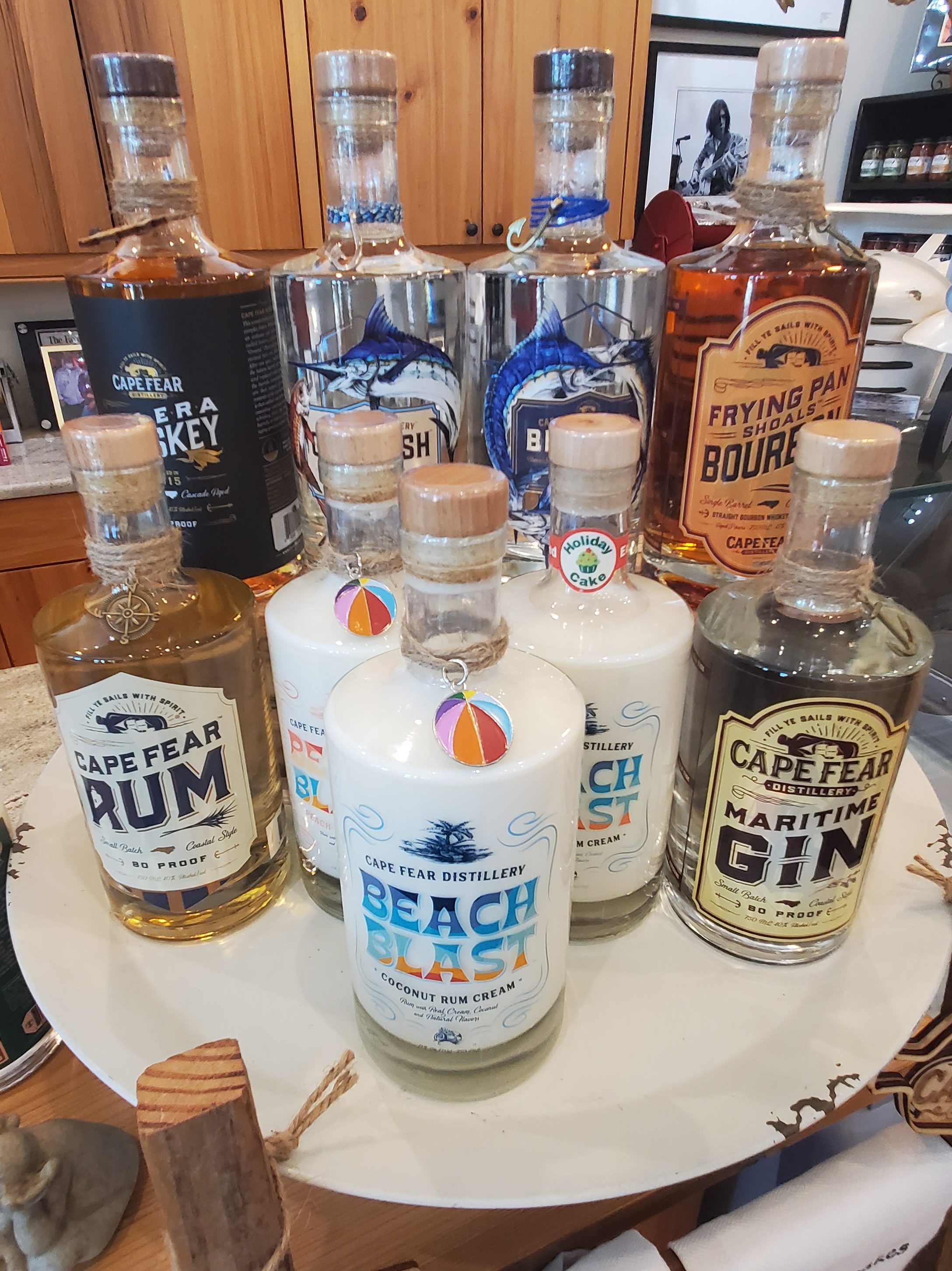
The Cape Fear Vineyard and Winery is a MUST SEE (195 Vineyard Dr.). This enterprise distills and bottles its own gin, rum, coconut rum, vodka, whiskey, and bourbon. Stop by the Tipsy Toad gift shop to purchase your own bottles and singles, gifts, swag, and ice cream. Stroll the grounds to discover statuary and public art sculptures, including some pieces from Michael Jackson’s Neverland Ranch. The owner is also quite the collector, and on the grounds you’ll find an AMAZING collection of original and lithograph artwork by both world-renown artists and celebrities, including Dr. Seuss, Richard Petty, David Bowie, Olivia Newton-John, Elton John, Frank Sinatra, Michael Jackson, Marilyn Monroe, Burt Reynolds, Marlon Brando, David Lee Roth, Alice Cooper, Jimi Hendrix, Redd Foxx, Grace Slick, Billy Bob Thornton, Pablo Picasso, and much more! You’ll also find articles of clothing worn by Whitney Houston, Michael Jackson, James Brown, and Prince. Altogether, the collection (I was told) is probably valued at more than $2 million.

Oh, and they also have a number of small, truly quaint, modern cottages for those who’d like to stay for a weekend or an entire week.

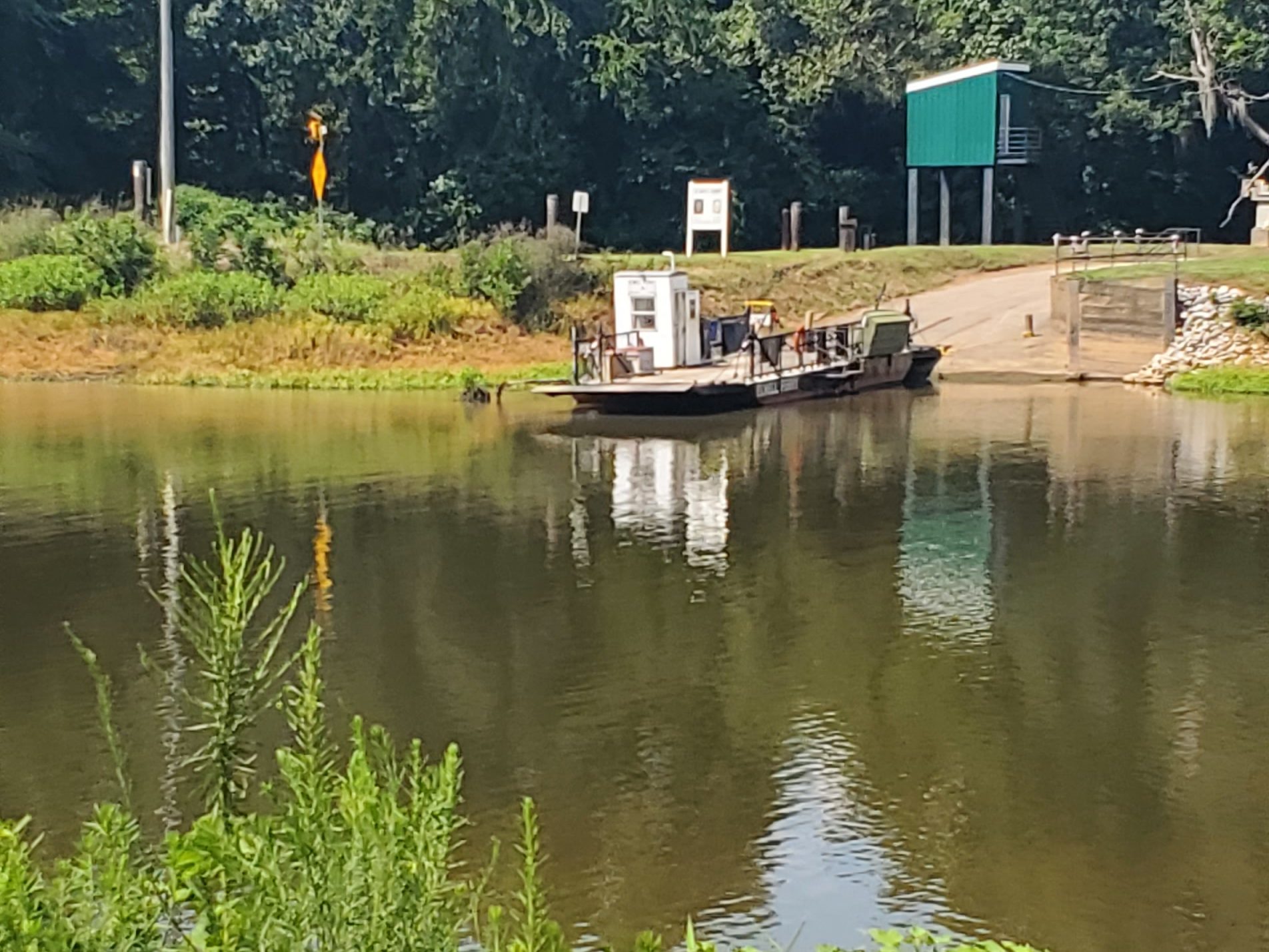
Elwell Ferry

Tucked away in Southeastern Bladen County, one of the last remaining inland river ferries crosses a sleepy Cape Fear River. For more than a century, the Elwell Ferry has shuttled local residents and farmers across the river between the tiny crossroad towns of Kelly and Carvers.

The Elwell Ferry began operation in 1905. Two brothers, John R. and Walter H. Russ, began the service, which crosses the same point to this day. At the time, the Elwell Ferry was one of numerous river ferries in the state and the country operated by local residents to connect local farms and villages to each other. Nearly all of the Elwell’s sister ferries have been replaced by bridges or abandoned altogether. Many consider the Elwell Ferry a living relic of early transportation within North Carolina.

Today, the ferry is owned and operated by the NC Department of Transportation. The ferry holds a maximum of two passenger vehicles or about four tons in total weight capacity. It runs from 6:00 a.m. to 6:00 p.m. in the spring and summer and from sunrise to sunset in the winter and fall. On average, anywhere from 60 to 80 vehicles per day utilize Elwell Ferry. (There is no ferry service on Christmas Day.)

Directions: From Fayetteville or Elizabethtown: Follow NC 87 South approximately 14 miles past the end of the Elizabethtown Bypass. Turn left onto Elwell Ferry Road, and the ferry is about one and a half miles straight ahead. If the ferry is not on your side of the river when you arrive, just beep your horn and the operator will come and pick you up. The total ferry crossing is about five minutes. 

P.S. If you want to get to the tow of Kelly, this is truly the quickest way, as it is a 24-minute trip by road–or just 5 minutes across the river. The town of Kelly was severely flooded from Hurricane Florence in September 2018 and nearly all of the town’s 800+ inhabitants had to be evacuated or rescued.

Bladenboro

The town of Bladenboro was incorporated in 1903. Development around Bladenboro, a farming community also known in its earliest days for its turpentine and lumber, began to take off after a railroad was built through the area in 1859. In 1885, brothers R.L. and H.C. Bridger came to Bladenboro from Little River, South Carolina, to operate a turpentine business. They soon became involved in the timber business and operated a cotton gin. The brothers and their descendants would have a major effect on the shaping of the town and its economy for much of the next century. Major businesses, owned and operated by members of the Bridger family and which employed many area residents, have included Bridger Corporation (a farming supply company and general store no longer in operation), Bladenboro Cotton Mills (established in 1912 and later sold to become Highland Mills), and the Bank of Bladenboro (established in 1908 and now part of First Citizens Bank). Bladenboro’s downtown was also heavily damaged by hurricanes Matthew and Florence.

In 1954, Bladenboro received national attention for several mysterious animal killings, mostly of dogs and livestock, in the area. The animals had broken jaws and had been drained of blood in a fashion not unlike the supposed attacks of the legendary Chupacabra monster. However, sightings describe the attacker as resembling a cat or wolf, which led to the local legend known as the “Beast of Bladenboro.” In 2008, the History Channel television series Monster Quest performed an analysis concerning these attacks, which were beginning to happen again, and concluded that the attacker might have been a cougar.

Lu  Mil Vineyard
Sitting on a lush, rolling rural landscape, including ponds, trails, and gardens, Lu Mil Vineyard (438 Suggs-Taylor Rd.) is the family farm of the late Lucille and Miller Taylor. It is one of North Carolina’s oldest working farms. The gift shop is open daily for both shopping and wine tasting, and the facility hosts events and weddings on the grounds as well. Plus, you can stay in one of their 12 Vineyard Cabins, with nightly rates available on both weekends and week nights.

Next stop… Alleghany County!
Journey through Sampson County

A drive through Sampson County will quickly reveal that it is largely an agricultural area. You’ll pass by outstretched fields of corn, tobacco, soy bean, and even watermelon. The area is also known for its blueberry farms, sandy soil, pine groves and forests, and cypress swamps as well as occasional palm trees and Spanish moss. Sampson County is also The Barn Quilt Capital of North Carolina ® with at least 140 recognized barn quilts across the county’s Barn Quilt Trail– and the county even has its own signature barn quilt!

Among the first European settlers of the area was John Sampson, who was appointed as the first Register of Deeds for Duplin County. He served as a Lt. Colonel, and then a Lt. General in the county’s militia, and was later elected as the first mayor of Wilmington. Sampson brought with him Richard Clinton, who was believed to be his stepson.

In 1776, at the outbreak of the Revolution, Clinton organized a company of militia from upper Duplin County and led them as captain in the defense of Wilmington against the British. He was later appointed Colonel of Cavalry and Brigadier General of the Fayetteville District. Upon the establishment of the state government of North Carolina by the Halifax Constitution of 1776, Clinton was elected as one of the first members of the House of Commons, representing the County of Duplin as a House member. Clinton continued as a representative of Duplin County until the creation of Sampson County in 1784. Clinton secured passage of the act creating the new county, and proposed the name “Sampson” in honor of John Sampson, his stepfather and benefactor.

According to the 2000 census, there were 1,029 members of the state-recognized Coharie Intra-tribal Council, Inc., a state-recognized tribe in Sampson County, who claim descent from certain tribes of Indians originally inhabiting the coastal regions of North Carolina.

Spivey’s Corner

From 1969 to 2015, Spivey’s Corner was the home of the nationally known National Hollerin’ Contest. Contestants from the contest have appeared on Johnny Carson’s The Tonight Show and the Late Show with David Letterman. The National Hollerin’ Contest, first held in 1969, was an annual competition held in Spivey’s Corner. It continued for nearly 50 years, before ending in 2015.

The contest, which was held on the first Saturday in September, was inaugurated in order to revive the almost-lost art of “hollerin”, a sophisticated vocal tradition that served as a means of long-distance communication between individuals as well as an amusing form of entertainment, before the widespread adoption of the telephone. From 1969 until 2012, the contest was held on the third Saturday of June, with it changing to September beginning in 2013. The final contest was held in 2015.

Newton Grove

The town of Newton Grove was first incorporated in 1879 as the New Town at the Grove, because of the prominent oak grove, then again in 1935 as Newton Grove. Early courthouse records of Sampson County show that the Newton Grove post office was once known as Blackman’s Store. Another post office six miles west of Newton Grove was known as Blackman’s Mills from 1858 to 1914. The Blackman family were affluent planters who settled in the area in the early 18th century. They were descendants of Jeremiah Blackman, mariner of London who captained several ships that brought English settlers to the Colony of Virginia in the 17th century.

During the Civil War, the Battle of Bentonville was fought nearby.

Clinton

Clinton is named for Richard Clinton, a Brigadier General of the North Carolina militia in the American Revolution.

The first settlers came to the Clinton area around 1740. The community was originally known as Clinton Courthouse. There was an earlier incorporated town of Clinton elsewhere in the state; however, that town in old Rowan County (Now Davie) folded in 1822 and Clinton in Sampson County was incorporated as a town in the same year. In 1852, the corporate limits of the town extended a half mile each way from the courthouse.

Clinton, the county seat of Sampson County, is the largest and oldest city in the county, having been incorporated in 1822. As the geographic center of the county, and because Sampson County is primarily rural farmland, Clinton developed as the major agricultural marketing center. The city had a minor league baseball team in the Tobacco State League from 1946 to 1950.

The first European settlers to come to the Sampson County area were Scotch-Irish immigrants from North Ireland around 1740. One of the many Scotch-Irish drawn to the area in search of rich farmland and flowing rivers was John Sampson. Sampson was Duplin County’s first Register of Deeds. He served as a Lieutenant Colonel, and then a Lieutenant General in the county’s militia and was later the first mayor of Wilmington, North Carolina.

In April of 1784, the North Carolina General Assembly established Sampson County from land taken from neighboring Duplin County. Land from Wayne and New Hanover counties would be annexed later to form the present-day boundaries. The early records of the town have been lost due to one or more of the disastrous fires that have swept Clinton. The largest was a Tuesday night, March 2, 1877, that many said could be seen from 10 miles away.

Sampson Arts Council
Stop by the Sampson Arts Council (709 College St.), located in the historic Victor Small House, during the week to view art exhibits or partake in community art classes.

Sampson County History Museum
Founded in 1997, the Sampson County History Museum (313 Lisbon St.) has grown into a “village” of eleven buildings, representing over 250 years of Sampson County history. With thousands of permanent artifacts, visitors are encouraged to explore these pages from the past and reflect as they search through their own lives and their place in history.

Each building holds a unique key to the past: military history, sports, law enforcement, fire department, agriculture, and more. A restored country store, 18th-century log cabins, and a 19th-century farmhouse stand side by side with modern exhibit halls, telling the story of Sampson County.

Tours are free, though donations are accepted.

Hubb’s Farm

Families can enjoy a day at Hubb’s Farm (10273 N US Hwy 421) with special events in the spring, fall, and at Christmas, including a corn maze, pumpkin patch, farm animals, rides, and more.

Turkey

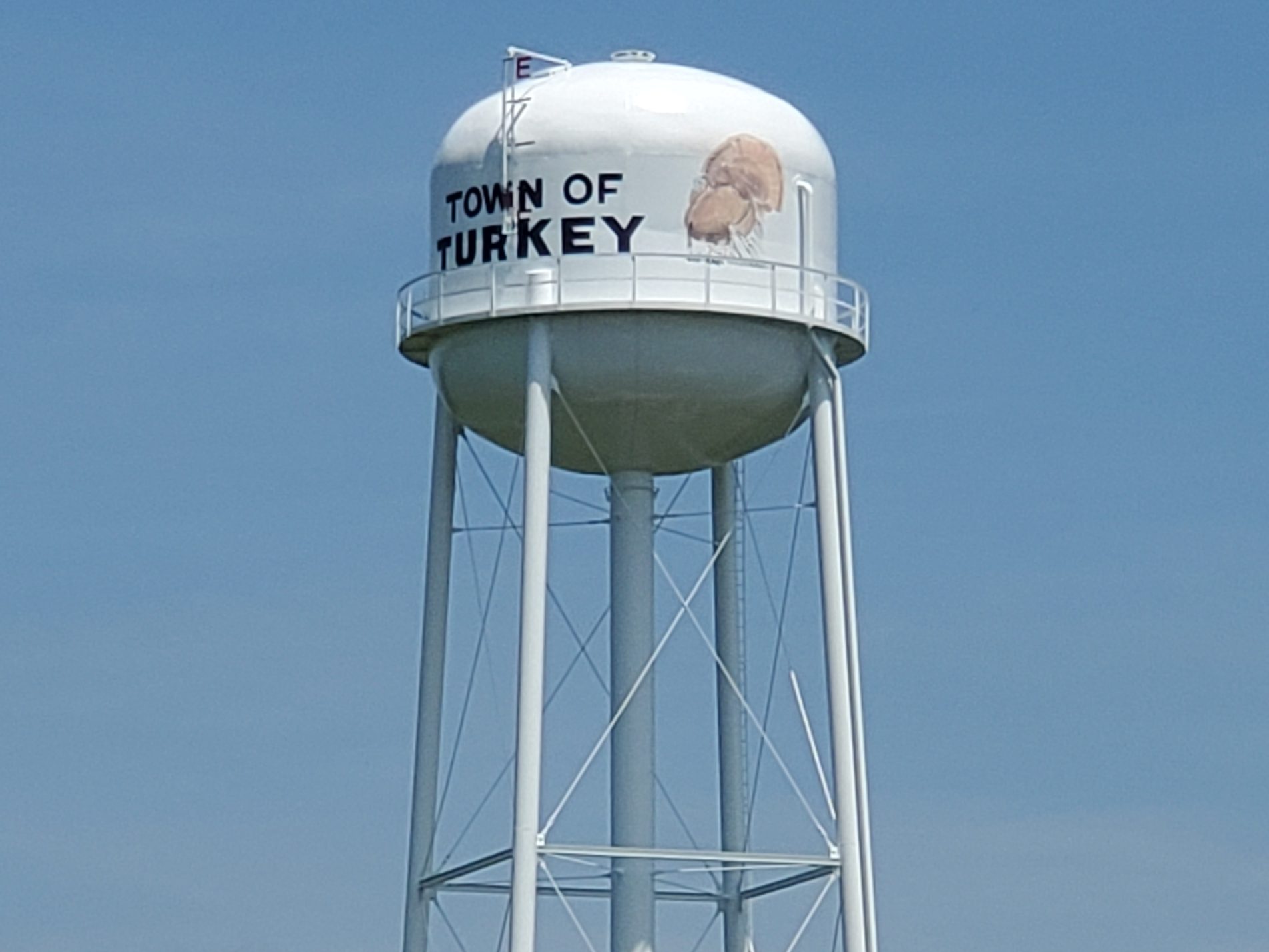
The name of the town was once Springville, but during the town’s early history a large group of wild turkey moved into the area, and the people regarded that as a sign. The town’s post office sometimes has received mail intended for the Republic of Turkey. At one time, the post office received letters from stamp collectors asking for a Thanksgiving Day postmark.

P.S. On the way into Turkey from Clinton, you’ll pass by a Butterball Turkey plant!

Ivanhoe

The town of Ivanhoe was nearly completely submerged from Hurricane Florence in 2018.

Garland

The community of Garland was settled in about 1888 and named Sloan’s Crossing. It was incorporated in 1907 as Garland, after U.S. Attorney General Augustus Hill Garland. Garland is home to Cashwell Farms, a 100-year-old farm that currently serves as a working blueberry farm has many varietals blueberry bushes for sale–far better than the ones you’ll find at your local garden store. The Garland Shirt Company, the town’s major employer, produces shirts and other assorted apparel items for Brooks Brothers.

The Garland Rotary Parade & Festival was formerly held the first Saturday in October on Front St. with food, games, shops, and music until 2012. However, after the Garland Rotary Club lost its charter in 2013, the town organized a Community Day with a parade and festival beginning on October 4, 2014.

Roseboro

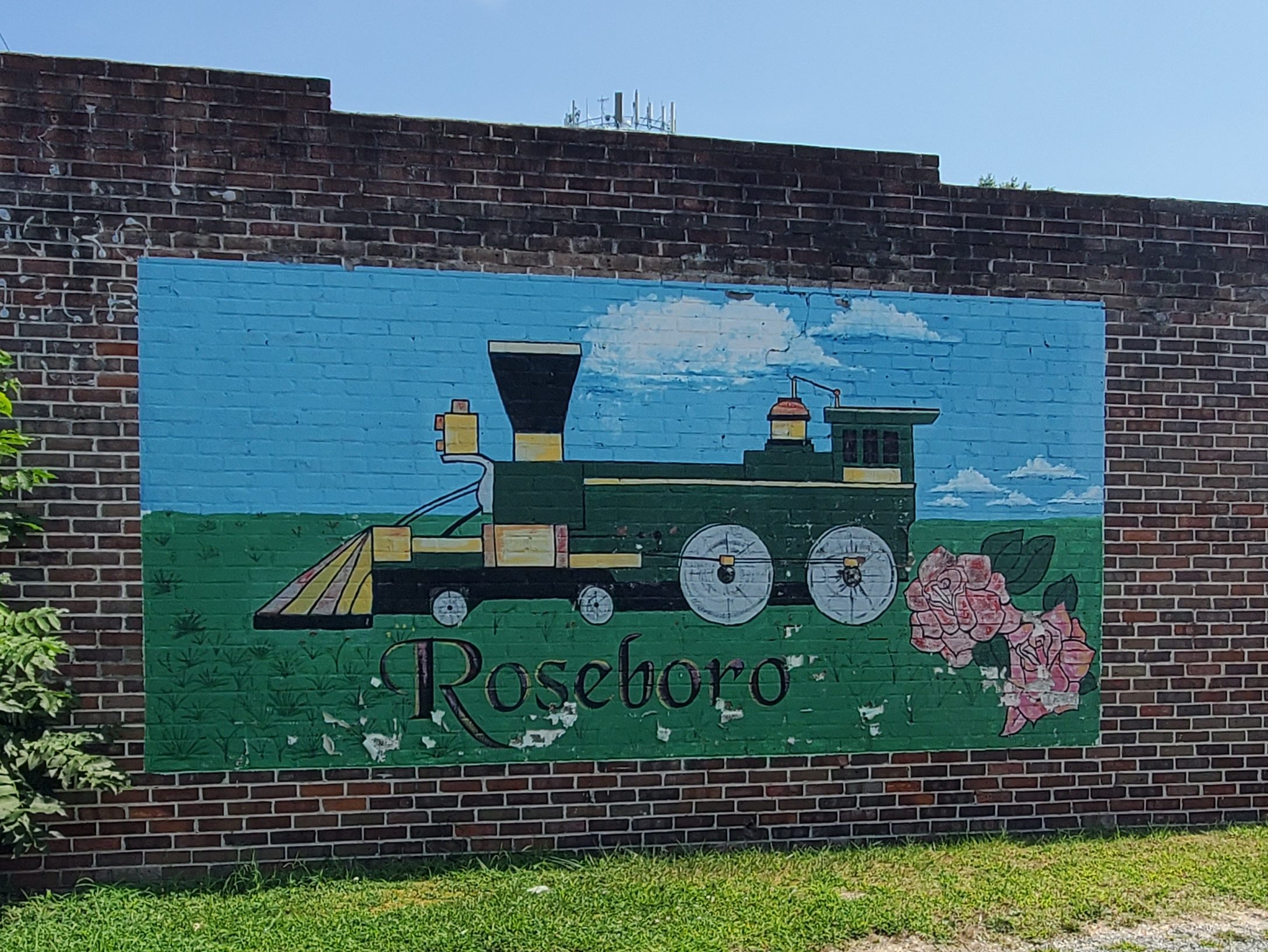
Roseboro was founded when the Cape Fear and Yadkin Valley Railroad built a line in 1889-1890 from Fayetteville to Wilmington, and it joined Stedman, Autryville, Garland, Kerr Station and several other communities that sprang to life when depots were built and commerce came into being.

There are two stories of how Roseboro got its name, but research has proven it to be named after John M. Rose, secretary of the Cape Fear and Yadkin Valley Railroad. Roseboro was incorporated in 1891, and all but one of the first commissioner’s last names is still prominent in the town.

Roseboro’s oldest building was constructed around 1897 by W.J. Fisher. In 1908, Dr. Paul M. Crumpler practiced medicine in front of the building while Whit Tart operated a drug store in the rear, thus the beginning of Tart & West Drug Store. In 1930, Paul and Sammy Butler opened a barber shop at the site. In the 1950s, Willie Butler moved in and began a mortgage and finance company. In the late 1950s, it was leased to Vander Simmons who used it for an accounting office. In 1961, Mr. Lennon H. Fisher, grandson of W.J. Fisher, took occupancy of this building and formed Fisher Insurance Agency. It remained at that location until 1978. In 1989, Jim Buchanan moved into this building and opened a photography business. In 1990, he changed the name to Jim B’S E-Z Rental. At last check, Summerlyn Naylor, great-great-granddaughter of W.J. Fisher, operates a business in the building.

Roseboro has a cute, walkable downtown with several restaurants and shops, including the James Trading Company (est. 1995). The town is planning a Bloomfest 2024 with a Kickoff Event on April 26 and the festival on April 27, 2024.

Earl Strickland, professional pool player and 9 ball world champion, is from the area.

Autryville

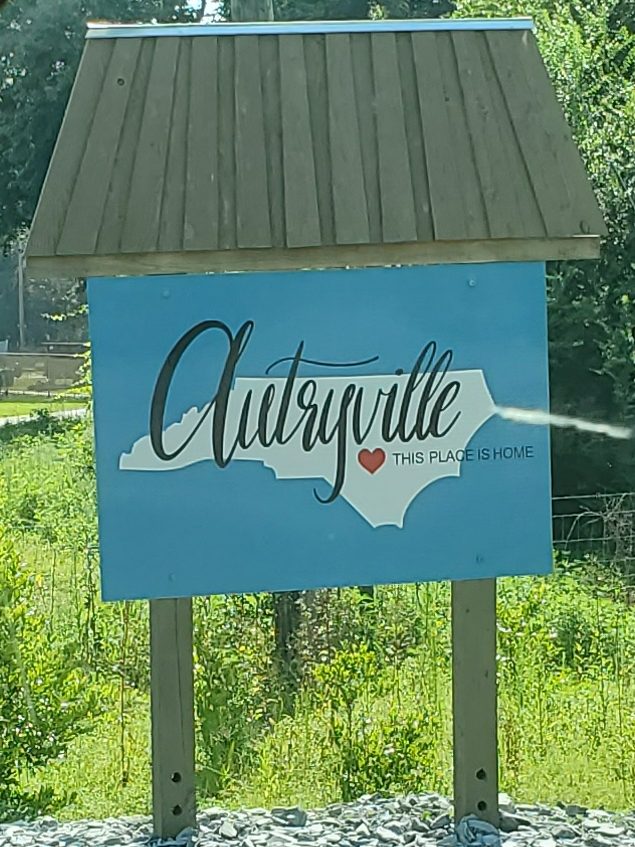
The town of Autryville was named for Micajah Autry (1794 – March 6, 1836), an American merchant, poet, and lawyer who died in the Texas Revolution at the Battle of the Alamo.

Next Stop… Bladen County!

Journey through Wayne County

Wayne County, North Carolina was founded in 1779 and named for the Revolutionary War hero from Pennsylvania, General Anthony Wayne. Prior to 1730, Indians and wild animals were the only known occupants of the territory. Settlers trickled into the territory, but there was no general movement of immigration until after 1750.

During the Revolutionary War, the County of Wayne was carved from Dobbs County and established on November 2, 1779. The County is named for General George Washington’s most trusted soldier, General Anthony Wayne, who was nicknamed “Mad Anthony Wayne” for his courage and valor. In 1855, parts of Wayne, Edgecombe, Johnston, and Nash Counties were combined to form Wilson County.

Fremont

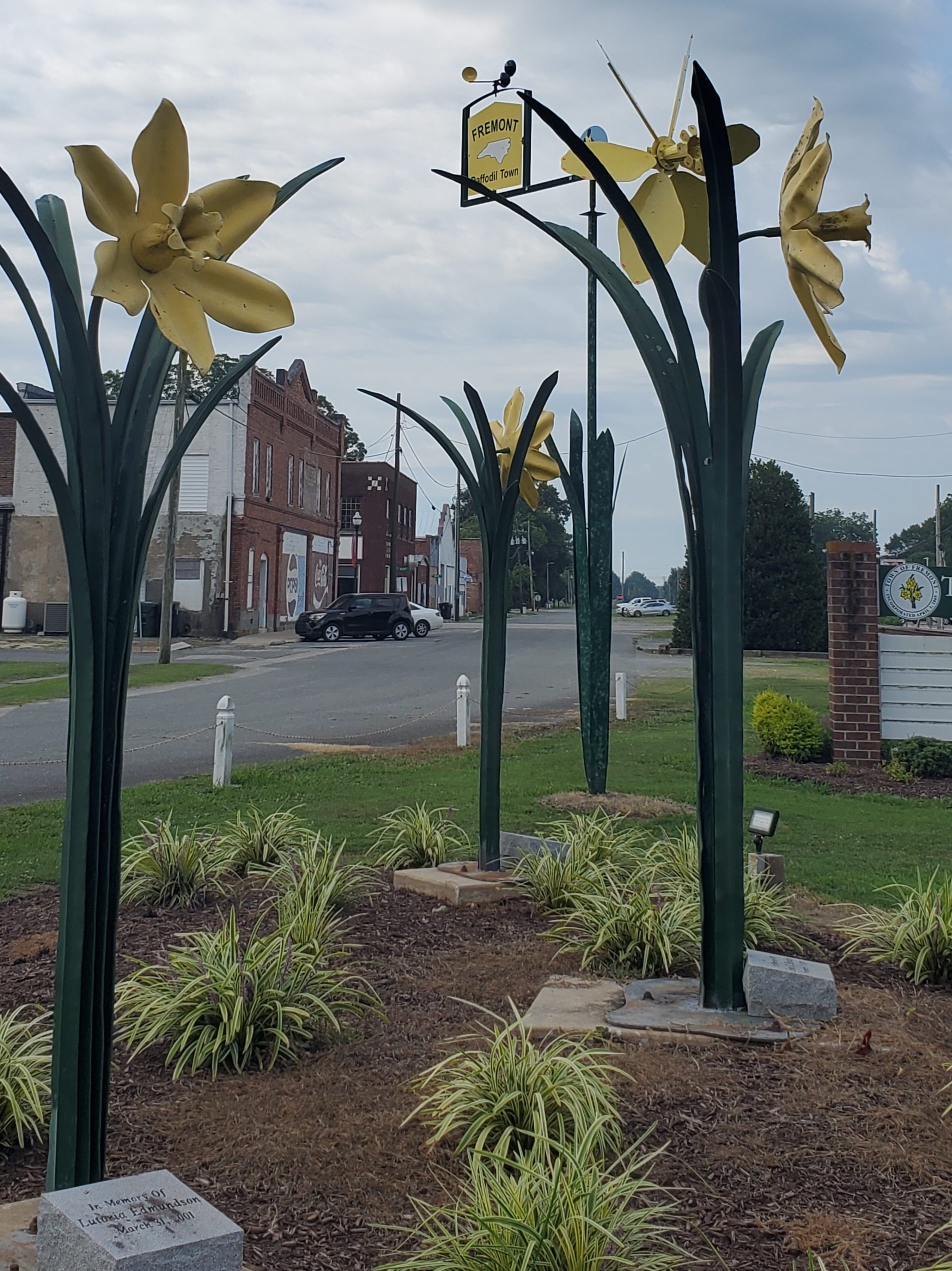
Originally named Nahunta, the town was renamed Fremont in 1869 after Col. Sewall Lawrence Fremont, a former U.S. Army artilleryman and chief engineer of the Wilmington and Wheldon Railroad from 1854 to 1871. (Nahunta is generally accepted to be a name from the Tuscarora Nation that inhabited the area.) Over time a few homes began to pop-up but growth remained slow. Residents took advantage of the fertile lands and found forestry and agriculture to be the foundation of their earnings.  Unfortunately, since the roads were made of dirt, shipping was quite a difficult process until the Wilmington and Weldon Railroad was completed in 1840. This line, which at the time was the longest railroad in the world, ran through town providing a much better transportation option resulting in increased trade.

Fremont reached it’s peak population of 1,800 in 1980, and over the last 30 years it has seen a steady decline to its current resident count of 1,430. Today, Fremont remains a small town with a little bit of public art and a few downtown businesses as well as vacant storefronts.

Governor Charles B. Aycock Birthplace
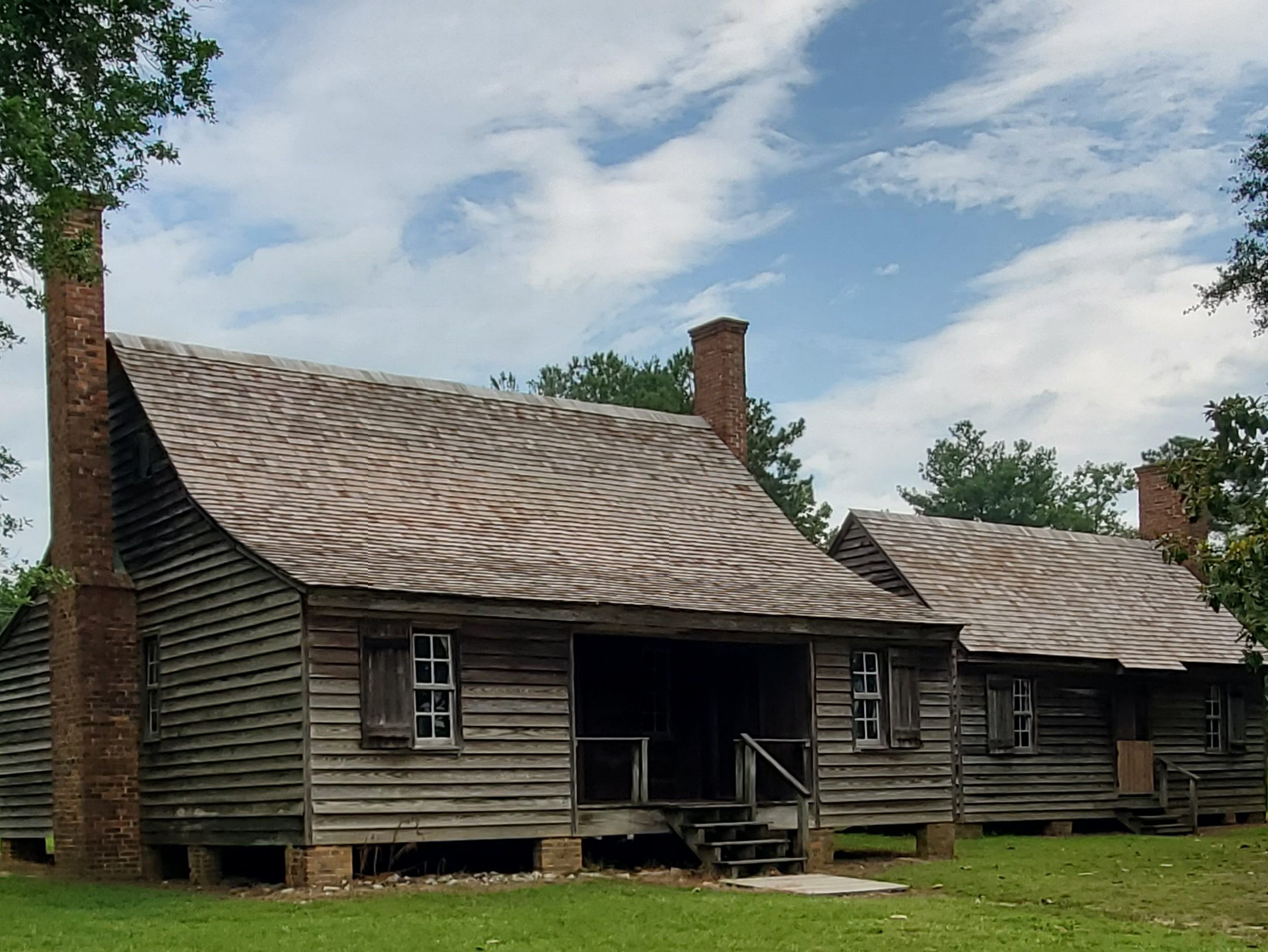
This 19th-century farm (264 Governor Aycock Rd.),consists of a museum exhibit building plus several restored homeplaces, including an original 1893 one-rooms schoolhouse and a mid-19th century farmstead. The property is Aycock’s birthplace and boyhood home. Tours and hands-on activities are available to school and scout groups.

Faro

In Faro—12 miles north of Seymour Johnson Air Force Base—two 3.8-megaton hydrogen bombs dropped accidentally during the 1961 Goldsboro B-52 crash as the aircraft broke up in flight. The two Mark 39 weapons were released after the crew abandoned a B-52 bomber, which had suffered mid-flight structural failure. Both bombs went through several steps in the arming sequence, but neither detonated. One bomb was recovered.

The crazy history is that we nearly nuked ourselves. Of the 4 switches that controlled the bombs at the time, three were activated during the crash. In 2013, it was revealed that three safety mechanisms on one bomb had failed, leaving just one low-voltage switch preventing detonation.

The crash site is 1.5 miles southwest of Faro on Big Daddy’s Road. The North Carolina Highway Historical Marker Program erected a historical marker about the accident at nearby Eureka in July 2012. It stands at the intersection of Main and Church Streets in Eureka, just three miles northwest of the impact site.

Although much of the second bomb was also recovered, a missing piece containing uranium was believed to have sunk deep into the swampy earth and could not be recovered. To this day, the uranium piece sits about 80 feet underground and is considered too unstable to dig up and diffuse. The Air Force has purchased the property to prevent any land use or digging, and it is protected and guarded should any curiosity seekers wander near.

Pikeville

Before the Pikeville we know came into existence, the Torhunta, a large Native American farming community, lived in this area. The community was destroyed by settlers and the rest of the Torhunta community returned to New York and joined the Iriquois. After they left, the settlers, mostly Society of Friends/Quakers, settled into this land. Pikeville has been in a state of development for over 260 years. When the Society of Friends settled, Nathan Pike owned and operated a large tavern inn, stables, shops, and trading posts. During this time, Pikeville was known as Pike’s Junction.

Samuel Pike moved to the area and settled on the south side of Nahunta Swamp, which had been granted by King George II of Great Britain in 1763. This grant of land included between 2,500 and 3,000 acres. In 1785, Pike deeded most of this land to his only son, Nathan. It was this Nathan Pike for whom the township, the Post Office, and later the town was named. Nathan Pike owned and operated a large tavern, shop, trading post, and hotel. It was then known as Pike’s Junction. In 1856, the first post office opened. During the period of 1793 to 1835, Pike sold around 2,000 acres of his land to other families who came here to settle.

During General Sherman’s Carolinas Campaign in 1865, Pikeville suffered the same fate of many southern towns. Union soldiers destroyed the hotel and tavern Nathan Pike had built, and many buildings and homes were damaged or destroyed. Some of General Sherman’s forces camped in areas east of Pikeville during this time. In 1960, Charles B. Aycock High School was opened in Pikeville in honor of the state governor who was an advocate for quality education.

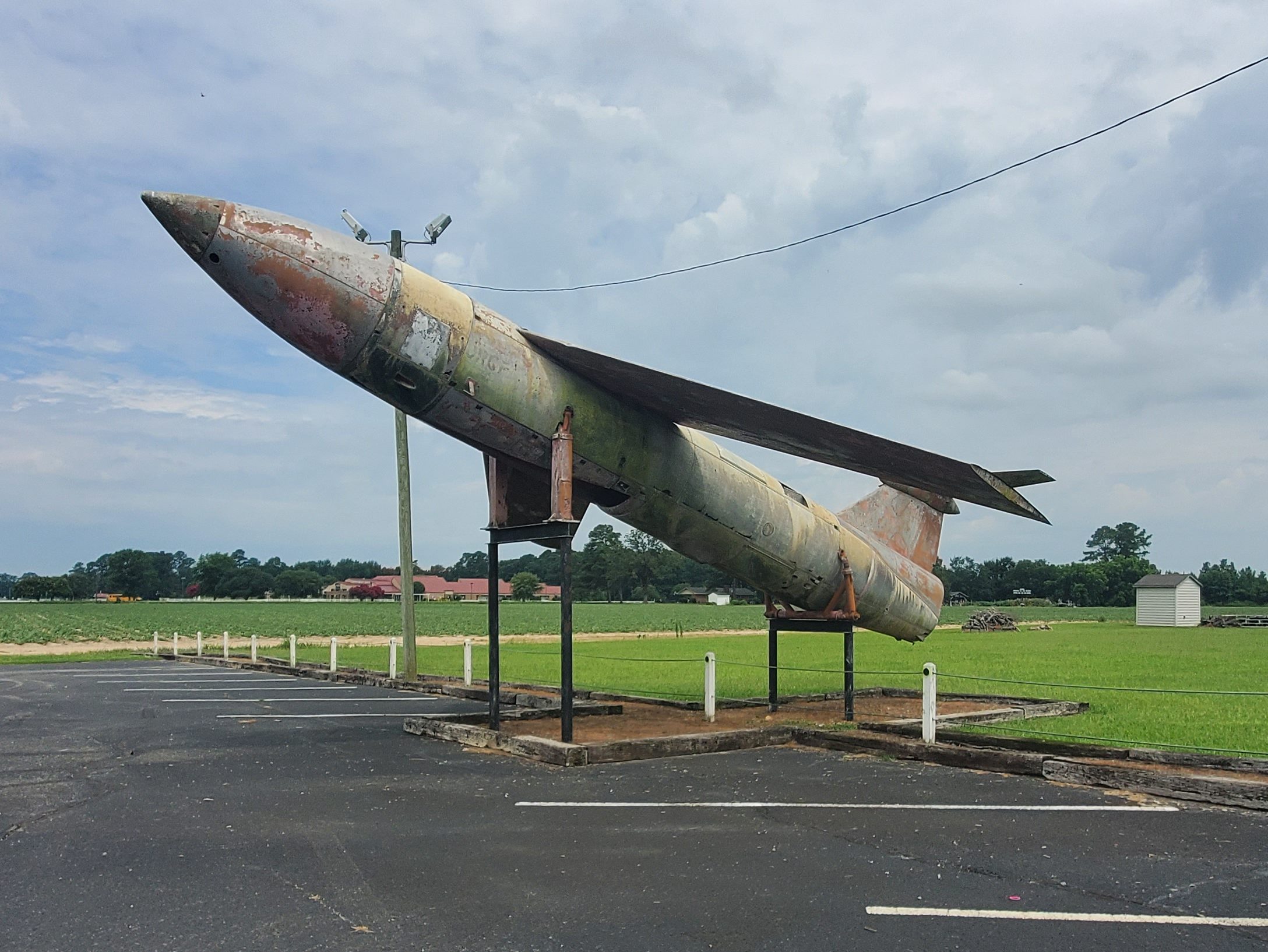
TM-61C Matador Cruise Missile
Oddly located in a church parking lot at 2089 Big Daddy’s Rd., you’ll find this relic TM-61C matador cruise missile on display.

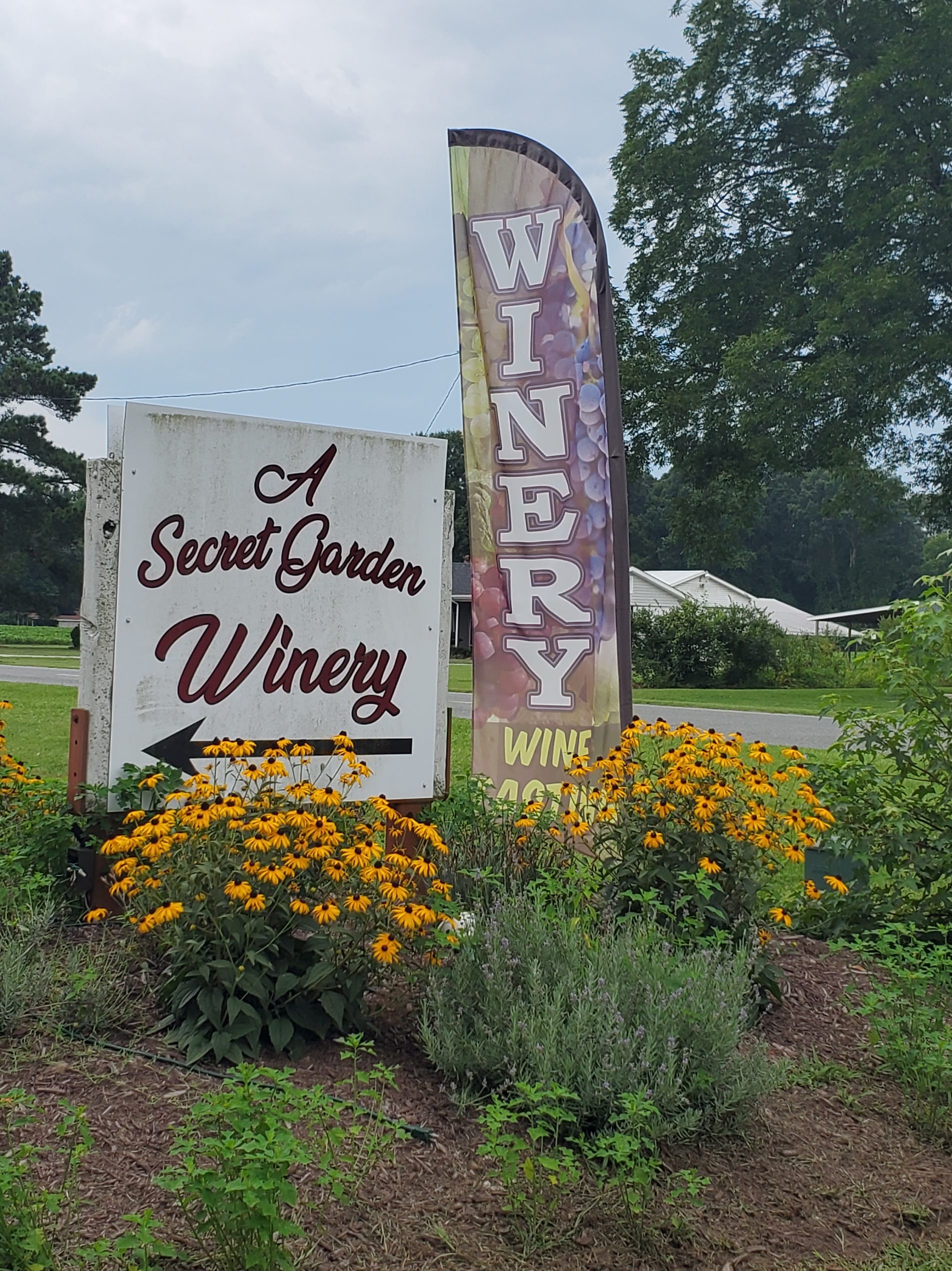
A Secret Garden Winery
Stop by the only winery in the county, A Secret Garden Winery (1008 Airport Rd NE) for a taste of traditional North Carolina varietals, such as muscadine. Their wines are all chemical free and exactly as they would have been made hundreds of years ago!

Goldsboro

Around 1787, when Wayne County was formed, a town named Waynesborough grew around the county’s courthouse. More and more citizens relocated from Waynesborough to this growing village, named eventually “Goldsborough’s Junction” after Major Matthew T. Goldsborough, an Assistant Chief Engineer with the railroad line. Later this was shortened simply to Goldsborough. In 1847, the town was incorporated and became the new Wayne County seat. Local legend has it the Goldsborough supporters put moonshine in the town’s well to encourage people to vote for Goldsborough.

In the following decades, Goldsborough’s growth continued in part by new railroad connections to Charlotte and Beaufort. By 1861, the town’s population was estimated to be 1,500. It was the trading center of a rural area that started with yeoman farmers. By this time, it had been developed as large cotton plantations dependent on the labor of enslaved African Americans, as the invention of the cotton gin had enabled profitable cultivation of short-staple cotton in the up-counties.

Because of its importance as railroad junction, Goldsborough played a significant role in the Civil War, both for stationing Confederate troops and for transporting their supplies. The town also provided hospitals for soldiers wounded in nearby battles.

In December 1862, the Battle of Goldsborough Bridge was waged, in which both sides fought for possession of the strategically significant Wilmington and Weldon Railroad Bridge. Union General John Foster arrived with his troops on December 17, aiming to destroy this bridge in order to put an end to the vital supply chain from the port of Wilmington. He succeeded on that same day, his troops overpowering the small number of defending Confederate soldiers and burning down the bridge. On their way back to New Bern, Foster’s men were attacked again by Confederate troops, but they survived with fewer casualties than the enemy. The important bridge at Goldsborough was rebuilt in a matter of weeks.

Goldsborough was the scene of another Union offensive in 1865, during Union General Sherman’s Carolinas Campaign. After the battles of Bentonville and Wyse Fork, Sherman’s forces met with the armies of Schofield, their troops taking over the city in March. During the following three weeks, Goldsborough was occupied by over 100,000 Union soldiers. After the war was over, some of these troops continued to stay in the city.

In 1869, the spelling of the city was officially changed to Goldsboro. Wayne County was part of North Carolina’s 2nd congressional district following the Civil War, when it was known as the “Black Second”, for its majority-black population. This district elected four Republican African Americans to Congress in the 19th century, three of them after the Reconstruction era. The attorney George Henry White was the last to serve, being elected in 1894 and serving two terms.

During World War II the North Carolina Congressional delegation was successful in gaining the present-day Seymour Johnson Air Force Base, which opened on the outskirts of Goldsboro in April 1942 as a U.S. Army Air Forces installation named Seymour Johnson Field. From this point on, the city’s population and businesses increased as a result of the federal defense installation. The base’s name was changed to Seymour Johnson AFB in 1947 following the establishment of the U.S. Air Force as an independent service.

The city is also home to Goldsboro Milling Company, the 10th largest producer of hogs in the U.S., and also a major producer of turkeys.

Andy Griffith, actor, lived in Goldsboro, teaching English, drama, and music at Goldsboro High School. Doris Jackson, née Doris Coley, founding member of the Shirelles, also lived in Goldsboro.

Wayne County Museum
The Wayne County Museum (116 N William St.) resides in a Jeffersonian revival-style building, constructed in 1927 by the Goldsboro’s Women’s Club, an uncommon occurrence of the day (for women to own property). The women offered the building to the USO during World War II. Opened since 1988, the museum holds numerous exhibits and holds several special exhibits throughout the year. The museum is part of the North Carolina Civil War Trails and also houses the original 1916 Lady in the Park Statue from Henry Park. (See below.)

Herman Park
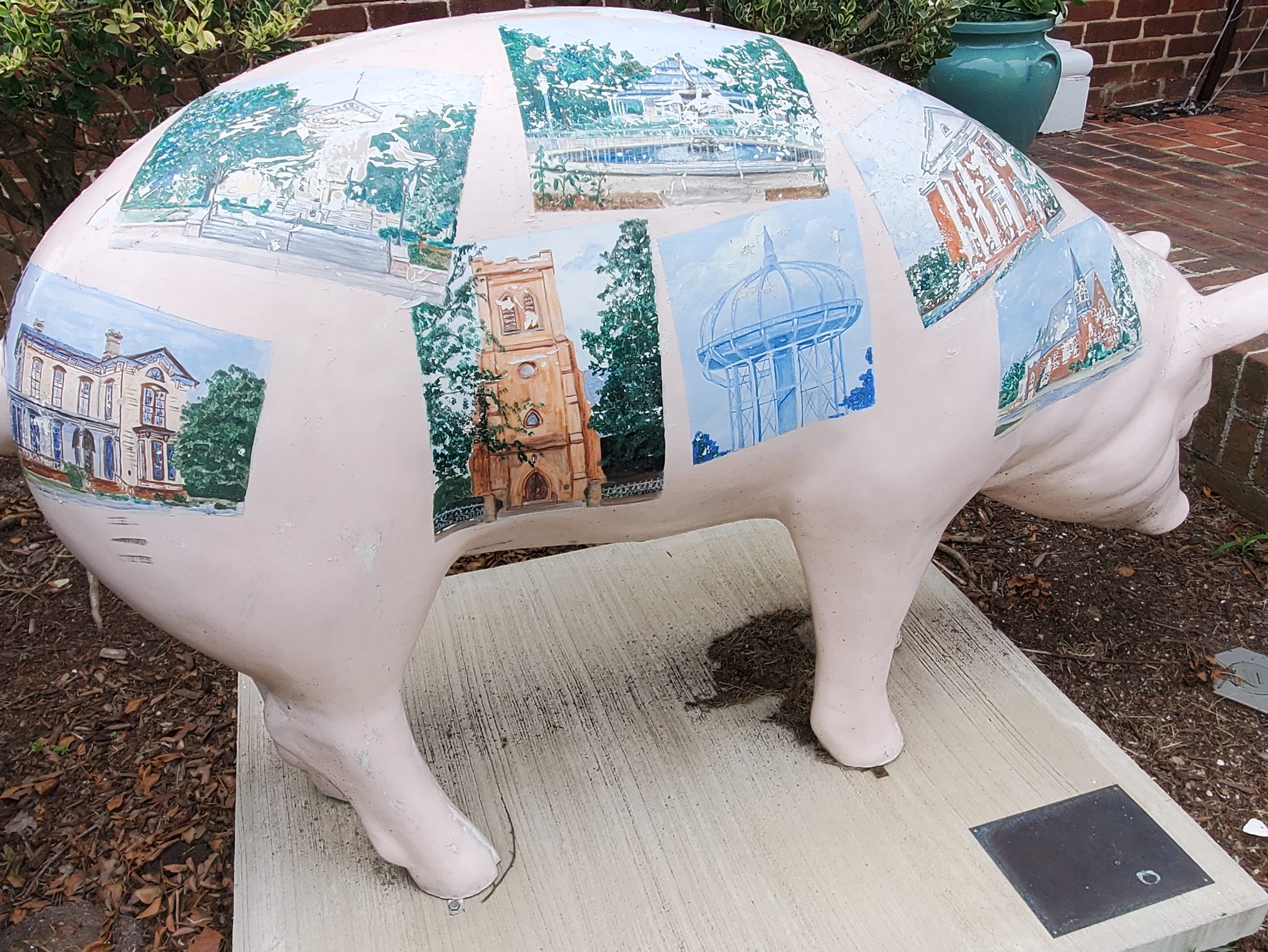
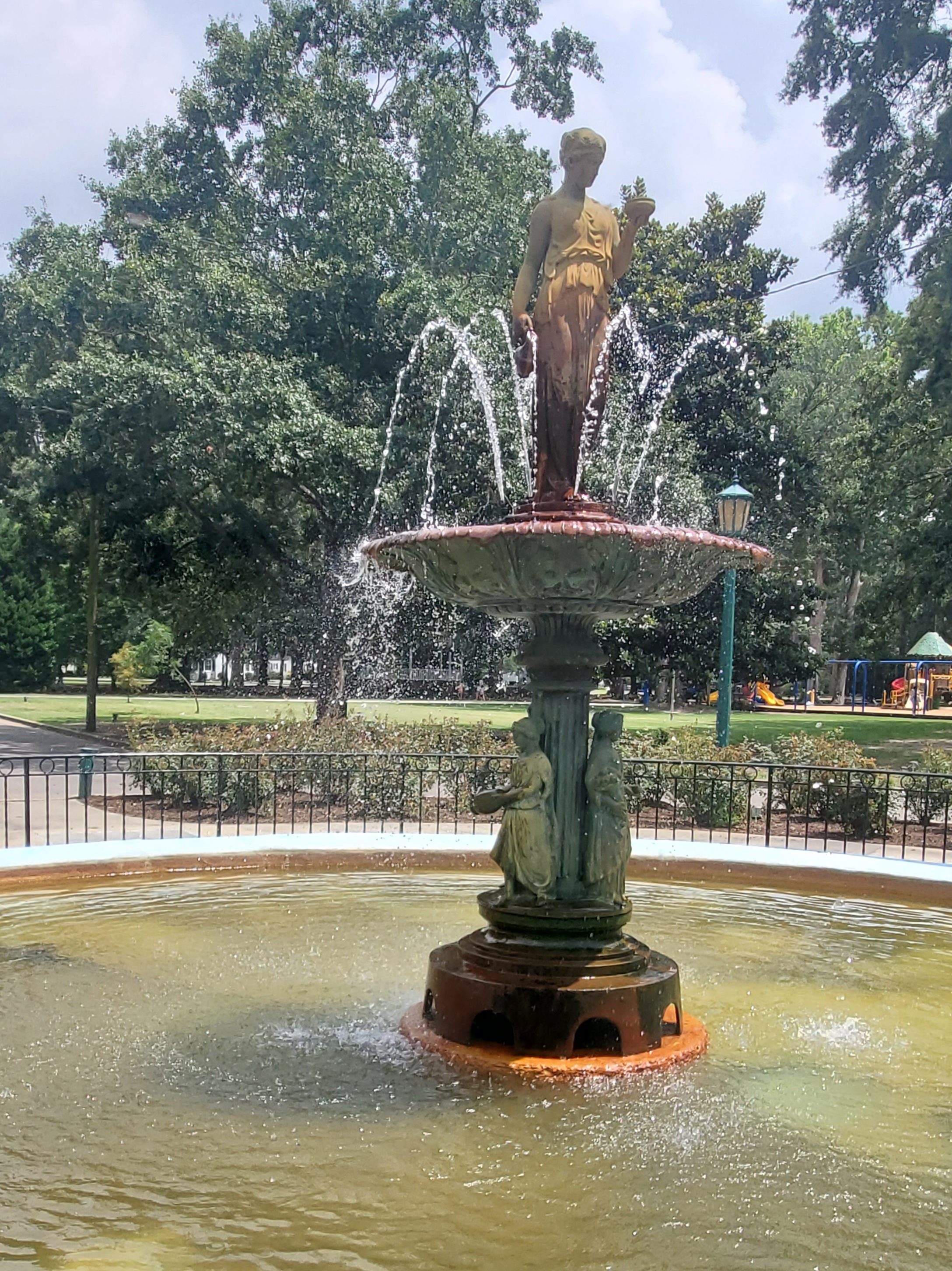
Herman Park (900 Park Ave.) is Goldsboro’s oldest park. It includes a recreational center, miniature train (in operation since 1955), tennis courts, picnic shelters, a turn-of-the-century park house, gazebo, goldfish pond, fountain (sculpted by a Danish artist in 1916), and children’s playground. The kids can spend a few hours playing or you can walk the park–and get tickets for the train ride. It’s really peaceful and a pretty location to enjoy–even on a hot day.

Waynesborough Historical Village
Step into the 19th century at the Waynesborough Historical Village (801 US Hwy 117 S), a reconstructed “village” located near the original site of the town of Waynesborough. It is home to several historical Wayne County buildings ranging from various periods of time. These buildings include a family home, a medical office, a one-room school, a law office, a gerneral store, and a Quaker Meeting House.

In the 1980s, the Old Waynesborough Commission was formed to create, operate, and maintain a village near the original site to represent Waynesborough. This group solicits buildings dating from the antebellum period to the early 1900s. These structures were moved to the park, renovated, and opened to visitors as a project of living history. None of the buildings are original to the town of Waynesborough, but each is representative of a period in Wayne County history. In addition to the tranquil historical village, the Commission also operates a Visitors Center and over 4.5 miles of hiking and nature trails.

Seven Springs

Though there’s really not anything to see here, there is some interesting history regarding Seven Springs. The town was incorporated as Whitehall in 1855, named in homage to the 1741 home of planter William Whitefield. In December 1862, during the American Civil War, a battle was fought near the town. In 1881, the community was reincorporated as White Hall. That year, a hotel and resort opened to bring customers to seven mineral springs in the town’s vicinity, but the resort closed in 1944. In 1951, the town was renamed Seven Springs. Seven Springs’ population peaked in 1960 with 207 residents. In 1999, the Neuse River flooded during Hurricane Floyd, causing major flooding in the area. Half of the town’s population left the area. Then after Hurricane Matthew in 2016 and Hurricane Florence in 2018, the town suffered further population decline. By 2020, the town had only 55 residents, and many of the businesses on the main street have been abandoned.

Cliffs of Neuse State Park
Located in Wayne County 15 miles southeast of Goldsboro, Cliffs of the Neuse State Park (240 Park Entrance Rd.) sits on 90-foot bluffs overlooking the Neuse River–and about 600 yards wide. Layers of sand, clay, seashells, shale, and gravel create a spectrum of colors on the face of the cliff. However don’t expect to get a very good view of the cliffs as you’ll be standing at the top of the cliffs, rather than across from them. From the parking lot, the overlook is directly in front of you. Toward the right is a short path with a small overlook area.

The cliffs were formed millions of years ago when a fault in the earth’s crust shifted. The Neuse River follows this fault line. Completing the landscape are longleaf pine restoration areas and creeks that were once used to make moonshine and cornmeal. An 11-acre lake complements the river in providing opportunities for water recreation. The park, which has a very helpful staff and park ranger, covers 751 acres along the southern banks of the Neuse River. It has a swimming area, several hiking trails, fishing areas, a nature museum, and picnic areas. Organized groups can also canoe on the river or get a guided tour (with reservations). (Beware of the big black ants–they can be aggressive and they bite!)

Mt. Olive

Mount Olive was formed as a village before the Civil War, it was occupied by Union soldiers in December 1862 and incorporated as a town in 1870.

The wolrd-famous Mt. Olive Pickle Company, established in 1926, is located on the corner of Cucumber and Vine streets–and a gift shop with pickle swag open to the public during the week is located at 1 Cucumber Blvd–within the plant gate. (You can drive through and park in the interior parking lot. Just tell them you’re going to the gift shop.)

The North Carolina Pickle Festival is held the last full weekend of April each year. The annual celebration is put on by both the community of Mount Olive and the Mt. Olive Pickle Company. On New Year’s Eve, the Mt. Olive Pickle Company celebrates in unusual fashion by dropping a three-foot pickle down a flagpole into a pickle tank. However, instead of midnight local time, the drop takes place at 7 pm. The event first took place on New Year’s Eve 1999.

Next stop… Sampson County!

Journey through Lenoir County

Lenoir county was formed in 1791 from the southern part of Dobbs County and was named for William Lenoir (1751-1839), an officer in the American Revolutionary War who took part in the Battle of Kings Mountain. The area hosts a BBQ Fest on the Neuse in May each year, including a car/truck show. You can also take a foodie tour on the Eastern NC BBQ Trail (Four of the trail’s 13 stops are in Lenoir County.) and several breweries, including Mother Earth Brewing (311 N. Herritage St. in Kinston).

More opportunities include events, location, and local food stops on the African American Music Trails of North Carolina–with many stops in Lenoir County and surrounding counties–as well as the Blue Ridge Music Trail, the Kinston Area Railroad Modelers Association (KARMA) and the Kinston Community for the Arts Public Art Trail.

If you’re a Civil War buff, then Lenoir County is a must see for you. And even if you’re not, there’s plenty to discover in this county for people with nearly any interest… public art, sculpture, history, museums, food, breweries, downtown walking, wall murals, and much more. Kinston saw its share of bloody battles during the Civil War. In 1862, 2,400 Confederates troops and 12,000 Union troops faced off at a site known as Harriet’s Chapel. Lenoir County was the site of two major Civil War battles: The First Battle of Kinston and The Battle of Wyse Fork, not to mention the significant history of the CSS Neuse ironclad (much more to come on that). For Civil War enthusiasts and historians, you’ll want to stop at the Kinston Battlefield Park memorial site (corner of Meadowbrook and Harriet’s Dr.) as well as the Chapel Site (Hwy 258 South, 1/4 mile from the Visitor and Information Center — P.S. The staff is really helpful there!) and Starr’s Battery & Breastworks (on a trail taken from the Chapel). Other high-interest spots are the Maplewood Cemetery (mass grave of 44 unknown Confederate soldiers), the Graave of the Unknown Union Soldier, and the Cultural Heritage Museum, which honors more than 200,000 black soldiers and 7,000 white officers who fought with the Union. In addition, the Battle of Kinston History and Driving Tour includes 14 local sites. (Begin at the Visitor and Information Center.) Enthusiasts can continue their journey of discovery on the North Carolina Civil War Trails.

La Grange

La Grange was incorporated in 1869 and named for the French estate of the Marquis de Lafayette, the Château de la Grange-Bléneau. The Garden Spot Festival is a yearly event held in September. In La Grange, you’ll find the La Grange Arts Center, which holds local art exhibits, craft shows, and classes for both adults and children as well as special events. The Center is housed in the town’s first brick building. Numerous pieces of art are also available for purchase.

Deep Run

The village of Deep Run was incorporated in 1925 through 1928. At one time, the town was called Red Town, due to the number of houses with red tin roofs.

Pink Hill

The town of Pink Hill was incorporated in 1915. You’ll find the Wilbur A. Tyndall Tractor Museum (N.C. Highway 11) has a collection of John Deere, Massey, and other tractors from various years in addition to area farm memorabilia from the area.

Kinston

Kinston was the big surprise in this county–unexpectedly large. You can spend the entire day in this city walking the streets, seeing the sights, stopping in museums, shopping, dining, and exploring public art as well as the beautiful, historical architecture, and much more. Kinston even has a Lions Water Adventure Park, Down East Wood Ducks baseball park, and a drag racing strip!

In 2009, Kinston won the All-America City Award–the second time in 21 years the city has won the title. Harmony Hall, the oldest building in Kinston, was owned by North Carolina’s first governor, Richard Caswell.

At the time of English settlement, the area was inhabited by the Neusiok people. Preceding the historic tribe, indigenous peoples of a variety of cultures had lived in the area for thousands of years. Before the English colonists established the city, they called the area “Atkins Bank”, referring to a bluff once owned by Robert Atkins just above the Neuse River. Atkins Bank was the site of farms, a tobacco warehouse, and a Church of England mission.

Kinston was created by an act of the North Carolina General Assembly in December 1762 as “Kingston”, in honor of King George III, who had recently ascended to the throne. After victory in the American Revolution, the citizens renamed the city “Kinston” in 1784 to show the population’s disavowal of royalty. In 1833, Kinston briefly became “Caswell”, in honor of Governor Caswell, but the name Kinston was restored the following year.

Commissioners appointed to design the town began to accept “subscriptions” for numbered lots. To keep a lot, subscribers were required to build brick homes of specific dimensions within three years or lose their rights to the property. The town was laid out with border streets named East, North, and South, with the western border the Neuse River. The two principal roads within these borders were named for King George and Queen Charlotte. They remain King Street and Queen Street to this day. Other streets were named in honor of Governor Arthur Dobbs (later renamed Independent Street) and the commissioners.

In December 1791, an act was passed in the General Assembly to abolish Dobbs County and form Lenoir and Glasgow Counties. At that time, Kinston was designated the county seat for Lenoir County. Kinston was incorporated as a town through an act of the legislature in January 1849.

During the onset of the Civil War, Camp Campbell and Camp Johnston were established nearby as training camps, and a bakery on Queen Street was converted to produce hardtack in large quantities. The city also housed a factory for the production of shoes for the military. The Battle of Kinston took place in and around the city on December 14, 1862.

From February 5 to February 22, 1864, 22 deserters were executed by hanging in the city. The court martial and subsequent hangings were carried out by the 54th Regiment, North Carolina Troops, Confederate States Army. Fifteen of these men were from Jones County and had all started their service in the 8th Battalion North Carolina Partisan Rangers.

The Battle of Wyse Fork, also known as the Battle of Southwest Creek (March 7–10, 1865), took place very near the city. At this later battle, the Confederate ram Neuse was scuttled to avoid capture by Union troops. Remnants of the ship have been salvaged, and were on display at Richard Caswell Park on West Vernon Avenue. A climate-controlled museum has been built on downtown Queen Street, and has moved the hulk there to prevent further deterioration of the original ship’s remains. A full-scale replica vessel (Ram Neuse II) has been constructed near the original’s resting place (known as the “Cat’s Hole”) beside the bank of the Neuse River on Heritage Street in Kinston. Union Army forces occupied the city following the battle and United States troops were assigned to the area through the Reconstruction era.

During the late 19th century, an expansion into new areas of industry occurred, most notably the production of horse-drawn carriages. Kinston also became a major tobacco- and cotton-trading center. By the start of the 20th century, more than 5 million pounds of tobacco were being sold annually in Kinston’s warehouses.

During the 20th century, new industries were founded, including lumber and cotton, as North Carolina businessmen invested in processing their own crops. Professional sports were introduced in the form of a minor league baseball team. Later growth came from a DuPont plant for the manufacture of polyester fibers, and manufacturing plants for pharmaceuticals. Growth finally slowed following the 1960s, with the shift in textile production overseas. Efforts to reinvigorate the economy through various means have had limited success.

Kinston was heavily impacted by flooding in 1996 and 1999. Hurricane Fran struck the North Carolina coast on September 5, 1996, and brought 16 inches of rain to the area, causing the Neuse River to flood portions of the city. On September 16, 1999, Hurricane Floyd struck the area, bringing 17 inches of rain. It caused what locals have called the “Flood of the Century.”

The Cultural Heritage Museum, built in 2000 on South Queen Street as a new economic development catalyst for Kinston and the surrounding areas of eastern North Carolina, was created to recognize the contributions of African Americans in numerous fields. It pays tribute to the more than 200,000 Black soldiers and 7,000 White officers of the United States Colored Troops who fought with the Union forces in the Civil War. It also honors Black military veterans from all wars, Carl Long and the Negro Baseball League players, local heroes, and Africa and Black history in general.

Kinston is home to several notable restaurants. The Chef & the Farmer, recipient of a James Beard Award, started by Vivian Howard and Ben Knight, is located in downtown Kinston. The PBS series A Chef’s Life focuses on the restaurant, owners, and local farmers from whom it sources, such as Brothers Farm.

The city holds annual festivities, including the Sand in the Streets concert series held at Pearson Park, the Annual BBQ Festival on the Neuse River, and the Festival on the Neuse.

Kinston’s Grainger Stadium is home to the Down East Wood Ducks, a Class A Minor League Baseball team in the North Division of the Carolina League that began play in 2017. It was previously home to the Kinston Indians minor league baseball team, as well as youth and college level baseball tournaments. The town first hosted professional baseball in 1908. The Kinston Drag Strip hosts a variety of motor-sports events throughout the year.

In 2012, Woodmen of the World constructed the Woodmen of the World Community Center and Lions Water Adventure Park, a 53,000-sq. ft, facility that offers a cardio and strength-training center, an Olympic-sized swimming pool, several corporate reception areas, and conference rooms, as well as a quarter-mile elevated track and several sporting courts.

In 1956, Kinston was the site of a rare, perfect game of billiards, as Willie Mosconi sank 150 balls in a row in one inning against Jimmy Moore. In 2018, ESPN called Kinston “America’s Basketball Heaven.” According to the ESPN article, one in 52.7 players on Kinston High School’s varsity team makes the NBA.

The city of Kinston will celebrate Never Give Up Day on August 18th, 2023. Never Give Up Day is a day honoring the qualities of determination and the power of individuals who simply refuse to give in to life’s challenges. More than 80 cities across the US proclaim Never Give Up Day.

Community Council for the Arts

The Community Council for the Arts is a nonprofit organization that is dedicated to helping residents experience the joy, promise and the pursuit of artistic excellence. You’ll discover the 2-story Arts Center (400 N. Queen St.) filled with exhibits by many local and regional artists, plus workign artist studios, classes and programs, and more. Admission is free.

CSS Neuse II
Kinston is home to the CSS Neuse II (118 N Herritage St), which is listed on the National Register of Historic Places. Its remains are on display in the CSS Neuse Civil War Interpretive Center but a full-size replica is on display in the center of downtown. In its first foray into action, the Neuse ran aground in the Neuse River on April 22, 1864, and was stuck until mid-May when the waters of the Neuse river rose and dislodged the vessel. The replica vessel itself is a museum, and you can walk its exterior and interior, which includes some historic displays and information. An exterior deck allows you to view the vessel from above. It is the worlds only full-size replica of a Confederate ironclad gunboat. Construction began on the site in 2002, and the vessel/museum was opened in 2009 with docents on site.

CSS Neuse Museum
Once your visit the CSS Neuse II, walk a few blocks over to 100 N Queen St and visit the CSS Neuse Civil War Interpretive Center. Displays focus on the building, operation, destruction, and recovery of the CSS Neuse. The museum contains the remains of the original ironclad.

African American Music Trail

During its tobacco days, Kinston was a hotbed of music, and musicians traveled from all over to play in the tobacco warehouses. One of those singers, James Brown, traveled with his band members from Kinston. It is said they brought “a Kinston sound” to Brown’s music.

Kinston Music Park

Located near the Neuse River, you can stroll through the Kinston Music Park, read lyrics and quotes, and admire colorful music-inspired mosaics. You can also enjoy the park’s sculpture Intersections, which has images of famous jazz, soul, gospel, and rhythm and blues musicians from Kinston and nearby communities.

The Flue
In the heart of downtown, you’ll find a large public art sculpture called The Flue (400 N. Queen St.) — seven tall concrete tobacco barn facades. Built on a lot that once housed Brooks Tobacco Warehouse, the installation has a commanding presence. Each structure stands 28 feet tall and 16 feet wide, casting shadows over an empty field. The sculptures were created by an earth casting technique by Raleigh artist Thomas Sayre. Sayre also has earth casting public art sculptures on Greensboro’s Downtown Greenway and throughout the state and country.

Caswell No. 1 Fire Station Museum

The Caswell No. 1 Fire Station Museum is Kinston’s oldest brick structure and the city’s original fire station (118 S. Queen St.) and features fire hydrants from the 1800s to 1960 and 19th-century fire equipment. You’ll also discover a fire truck that was on the scene during Kinston’s devastating fire of 1895 that destroyed nearly all downtown homes and businesses. The building is on the National Register of Historic Places.

Neuseway Nature Center
The Neuseway Nature Center (401 W. Caswell St.) features wooded nature trails, a children’s playground, and a planetarium.

Tick Bite

Tick Bite is an unincorporated community on the Contentnea Creek. Tick Bite was decimated by Hurricane Floyd in 1999. The Contentnea Creek surged to levels that had not been seen in 500 years, setting a new “500 year flood plain” for the area.

Next stop… Wayne County!

Journey through Greene County

Tourism-wise, there’s not a whole lot that creates interest in Greene County, but there is some interesting history here.

Greene County was named in honor of Nathanael Greene, one of General Washington’s right-hand men, as was the Piedmont city of Greensboro, NC. As part of a land grant by King Charles II of England in 1663, the area was first settled around 1710 by immigrants from Maryland, Virginia, and within North Carolina. The original inhabitants of the area, the Tuscarora Indians, fought with these immigrants and on March 20–23, 1713, a fighting force of South Carolinians and Yamasee Indians, under Colonel Murice Moore, defeated the Tuscarora, under the leadership of Chief Hancock. This was the final major battle of the Tuscarora War at Fort Neoheroka near where Snow Hill is located today.

A portion of western North Carolina was also named Greene County after Nathanael Greene. However, that area was ceded to the federal government and became part of the Southwest Territory (1790–1796) and then the State of Tennessee after 1796.

Hookerton

Formally established in 1817, Hookerton is the oldest incorporated town in Greene County. Hookerton is home to one of more than 750 Civil War sites in North Carolina, Virginia, and Maryland.  A Civil War Trails marker is located on Main street (Hwy 123). Bridges in Hookerton and nearby over the Contentnea Creek and Little Contentnea Creek were important to the movement of troops and supplies in this area. Potter set fire to the Hookertown Bridge after crossing it on his way back to New Bern July 21. This small town was also headquarters for Confederate Gen. James Pettigrew after his attempt to recapture New Bern failed in April 1863.

Snow Hill

The county seat, Snow Hill, which was chartered in 1828, is the largest town and major commercial center in the county. The town of Snow Hill draws its name from the historic white sandy banks of nearby Contentnea Creek. Snow Hill hosts numerous tennis tournaments during the year and is home to the Green Ridge Racquet Club. Many junior and adult players travel to Snow Hill to play in the USTA (United States Tennis Association) sanctioned tournaments.

Snow Hill was originally a major trading depot on Contentnea Creek. There are several theories for the origination of the town’s name. One theory is that the town derived its name from the Contentnea Creek on whose banks Native Americans camped and called them “snowy white,” which was translated into “snowy hills.” The snowy white reference is likely to the white sands along the creek.

Snow Hill may be the smallest town in the United States to ever field a professional baseball team. From 1937-40, the Snow Hill Billies played in the Class D Coastal Plain League and won the league pennant in 1937. Future New York Yankees Aaron Robinson and Al Gettel began their careers with the Billies.

In April 2011, a tornado struck the town and caused massive damage.

Greene County Museum

In Snow Hill, you’ll find the Greene County Museum, a community gathering place for both adults and children, with exhibits featuring local history, quilting, childrens’ art as well as rotating exhibits featuring photography, memorabilia, local artists, and more. The museum also hosts cultural events, speakers throughout the year as well as outdoor events in the courtyard.

Jason

First named Aloc, meaning “leave alone” by the Tuscarora Indian tribe, the town of Jason was once a prospering town with a furniture store, post office, and general store. One could buy groceries, post a letter, purchase alcohol, and be placed in jail–all in the same building! There was also a cotton mill on the northern side of town, which was one of the first in Greene County.

Coming soon… Lenoir County!
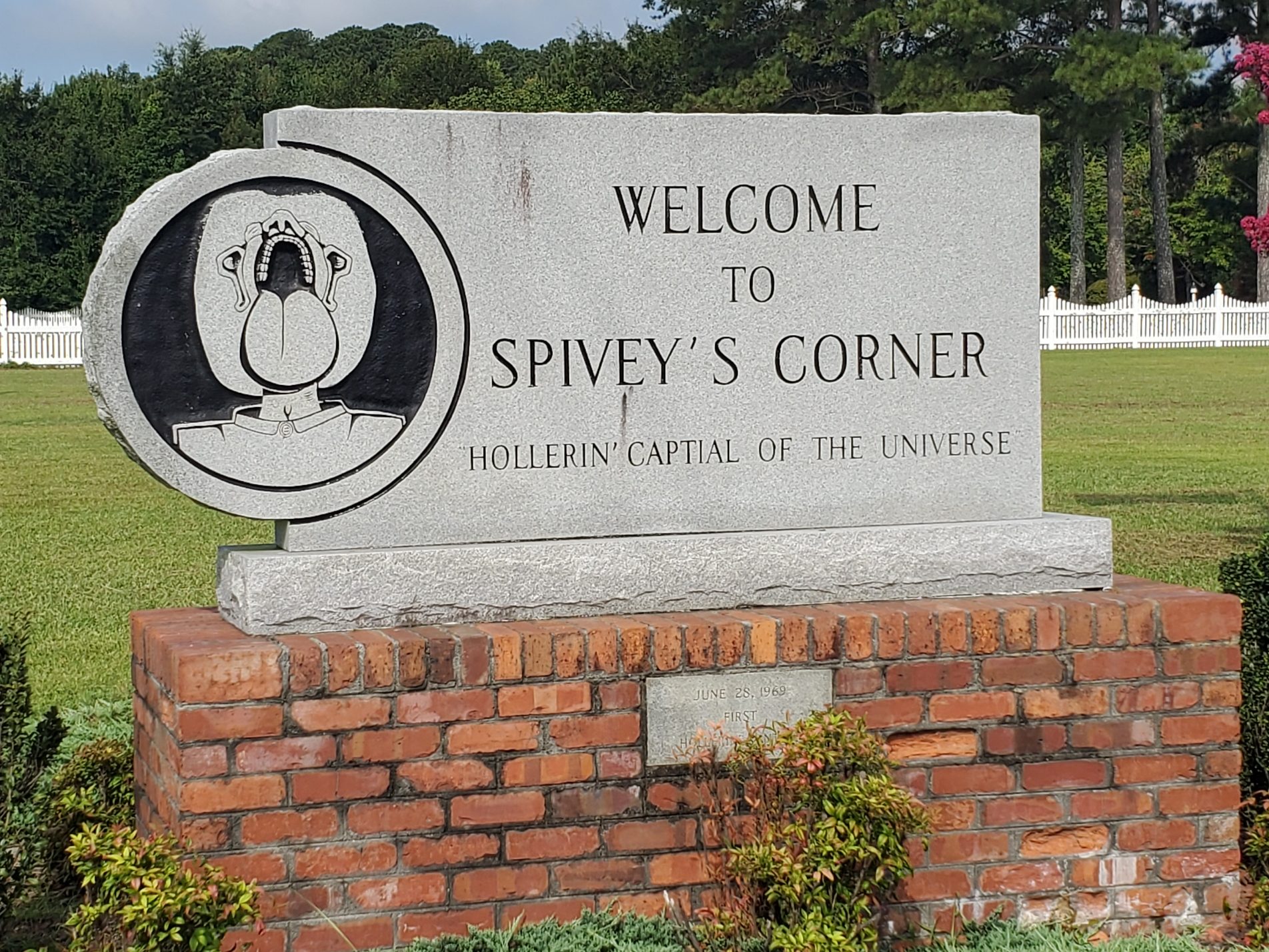
Journey through Warren County

Warren County

Once one of the wealthiest counties in the state from 1840 to 1860 as the center of tobacco and cotton plantations, education, and later textile mills, Warren County is now one of the poorest counties in North Carolina. It was made famous for a landfill scandal and a birthplace of the environmental justice movement.

The county was established in 1779 from the northern half of Bute County. It was named for Joseph Warren of Massachusetts, a physician and general in the American Revolutionary War who was killed at the Battle of Bunker Hill in Boston, MA. The county seat was designated at Warrenton later that year. In 1786, part of Granville County was moved to Warren. In 1881, parts of Warren County, Franklin County and Granville County were combined to form Vance County. Warren also had one of the largest free black populations in antebellum NC, and today has a higher black population than any other ethnicity.

In 1978, a transformer manufacturer contracted a trucking company to illegally dump polychlorinated biphenyls (PCBs) alongside roads in North Carolina. The state of North Carolina assumed responsibility for cleaning up the pollution, and in December 1978, the state government purchased land in the Warren County community of Afton to establish a landfill to dispose of the chemical waste. Local residents began organizing to protest the planned disposal site, arguing better disposal options existed and that a hazardous waste facility would undercut the county’s ability to attracted new industry. National civil rights organizations and politicians became involved, and about 500 protestors were arrested in September 1982 for attempting to obstruct the construction of the disposal site. While the demonstrations did not halt the creation of the landfill, the site was eventually detoxified, and a significant amount of historic records attribute the start of the modern environmental justice movement to the protests in Warren County.

Soul City

Soul City, a “planned community” development, was first proposed in 1969 by Floyd McKissick, a civil rights leader and director of the Congress of Racial Equality. Soul City was intended to be a new town built from the ground up and open to all races, but placed emphasis on providing opportunities for minorities and the poor. It was also designed to be a means of reversing out-migration of minorities and the poor to urban areas; the opportunities Soul City provided, such as jobs, education, housing, training, and other social services would help lessen the migration.

The city was planned to contain three villages housing 18,000 people by 1989. Soul City was projected to have 24,000 jobs and 44,000 inhabitants by 2004. It was intended to include industry and retail development for jobs, as well as residential housing and services. The plan was for residents to work, get schooling, shop, receive health care, and worship in town. Soul City was the first new town to be organized by African-American businesses. McKissick envisioned Soul City as a community where all races could live in harmony.

The town was funded by the Department of Housing and Urban Development (HUD). Soul City was one of 13 model city projects under the Urban Growth and New Community Development Act. It was located on 5,000 acres in Warren County near Manson-Axtell Road and Soul City Boulevard in Norlina.

It has not been successful in attracting business and industry, and has not developed as much housing as intended. Today, only an eerie monument sign remains.

Ridgeway

Ridgeway is a small community in Warren County that hosts the Ridgeway Cantaloupe Festival each year in July.

Ridgeway Opry House
The Ridgeway Opry House is still a casual entertainment venue along 704 US Highway 1 South.

Norlina

Norlina was first called the “Ridgeway Junction” in 1837. As a railroad passed through this area, many citizens started to sell wood and water to the railroad. Eventually this began to expand, and in the 1860s the name changed to the “Woodyard”. By the 1870s, the area had grown in business, and was referred to as the “Junction.” The Seaboard & Raleigh Railroad had just been formed, and the “Junction” was now thriving with its business. A small community was formed, including two hardware stores, a horse-drawn taxi service, and smithing shops. By 1900, John Williams established the Seaboard Air Line Railway and it grew to over 4,680 miles. This small group of people had turned the railway stop into a real town. In 1913, the name Norlina was coined, being a portmanteau of the beginning of “North” and the ending of “Carolina.”

Seven Springs Farm and Vineyard

Located near Ridgeway (332 Axtell Ridgeway Rd), Seven Springs Farm and Vineyard (opened in 2017) is a small, family-owned and operated farm and vineyard.  The family-owned property has seven naturally created springs that have been in the family since about 1990.

Warrenton

Founded in 1779, Warrenton is the county seat of Warren County. It became one of the wealthiest towns in the state from 1840 to 1860, being a trading center of an area of rich tobacco and cotton plantations. Interestingly, more than 90 percent (more than 200) of its buildings are listed in the National Register of Historic Places and its National Historic District encompasses nearly half the town’s area. William Christmas platted and surveyed the streets and lots and public squares, and he established 100 lots of one-half acre each, convenient streets and squares, and a common area for the use of the town.

The area was originally developed as tobacco and cotton plantations and Warrenton served as a regional center for trade and entertainment. In the 1850s, the town became a busy center of commerce when the railroad was built to improve shipping of the commodities of the rich tobacco and cotton fields to markets.

The town holds many community events including a Christmas Parade in December, a Fright Night in October, a SpringFest, Run Warrenton (a 5K Road Race), and a Harvest Market in October.

Visitors can take a self-guided Walking Tour of the town. Several establishments have community maps available, and you may also find a map in the large outdoor display case to the left of the Hardward Café (see above image).

While in Warrenton, stop by for a bite of lunch at the Hardware Café, an old hardware store that has been reimagined as a café. Then visit Locorum, a black-owned vodka and moonshine distillery.

Next stop… Greene County!

Journey through Union County

Union County was formed in 1842 from parts of Anson County and Mecklenburg County. Its name was a compromise between the Whigs, who wanted to name the new county for Henry Clay, and the Democrats, who wanted to name it for Andrew Jackson. The Helms, Starnes, McRorie, and Belk families were prominent in the town as well as in Monroe and Charlotte.

For the first half or more of the twentieth century, cotton was the “king” crop for farmers.  Two cotton gins operated 24 hours a day during harvest season. Country stores throughout the community served as popular gathering places as well as sources for gas, various sundries, and penny candies.

The county also as a ghost town called Gibraltar, but we were unable to find it.

Fairview

Fairview is located in the foothills of the Uwharrie Mountains. Tyler Knob is the highest point at 849 feet at its peak, sitting on the Fairview-Unionville town line. The Rocky River runs through Fairview along the higher foothills of the Uwharrie Mountains. An area in the southwest quadrant near Crooked Creek called Red Field, may have served as a Native American encampment site as evidenced by an abundance of arrowheads.

Unionville

The town of Unionville was originally chartered by the North Carolina General Assembly in 1911. Unionville is known for its community spirit. For more than 70 years, the annual Unionville Barbeque, held at Unionville Elementary school, has served as one of the largest fundraisers for a school in the state of North Carolina. Other community events held annually include an annual 4th of July parade, Christmas parade and tree lighting ceremony, and community concerts (Concerts in the Park) held on the grounds of the community center.

The Unionville Town Seal was created by Mr. Eric Hinson of Unionville Elementary School with the assistance and input of a team of students: Greg Felker, Michael Herman, Abigail Jones, and Janine Sanchez.

New Salem

New Salem is the home of Polk Mountain, which is the southernmost high peak of the Uwharrie Mountains at 861 feet (262 m). New Salem is also the site of Eastview Speedway, located on NC 205.

Marshville

Marshville is known as the birthplace of country music singer Randy Travis. Marshville is also the site of the Randy Travis Festival, an annual street fair and carnival that takes place every fall. Parts of the 1985 Oscar-nominated movie ‘The Color Purple’ were filmed in Marshville. The movie was directed by Steven Spielberg and its cast included Oprah Winfrey and Whoopi Goldberg.

In June 2012 the Marshville Museum And Cultural Center was opened with exhibits on the history of Marshville, the surrounding area, and its residents. Marshville is also the site of the Boll Weevil Festival, an annual street fair and carnival that takes place each fall. Marshville is said to be infamous for the highest water bills in the county, though we are unable to corrobarate this.

On the day of our trip (May 20, 2023), the town of Marshville was celebrating their first ever town festival!
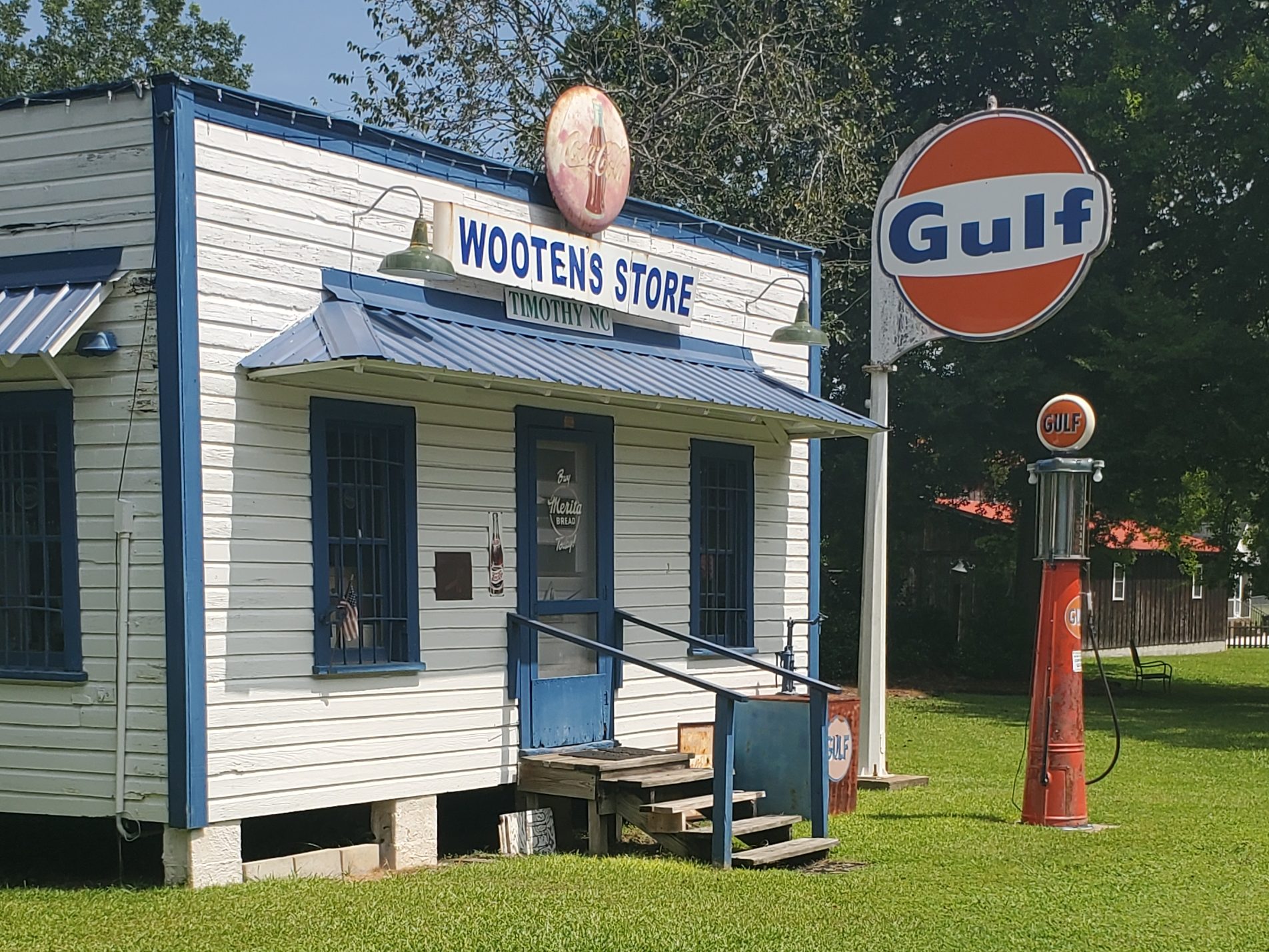
Marshville Museum and Cultural Center
Stop by the Marshville Museum and Cultural Center (201 Main St) for some local history. Kids can have a scavenger hunt at the museum and turn their sheet in for a prize.


Wingate

In Wingate, you will find the Jesse Helms Center (3910 US Hwy 74 East) as well as Wingate University (211 East Wilson St), including The Batte Center (403 N Camden Rd). Take a drive through campus or stay for a performance.

Monroe

Monroe was founded as a planned settlement. In 1843, the first Board of County Commissioners, appointed by the General Assembly, selected an area in the center of the county as the county seat, and Monroe was incorporated that year. The town was named for James Monroe, America’s fifth president. It became a trading center for the agricultural areas of the Piedmont region, which cultivated tobacco. Monroe was home to the Starlite Speedway in the 1960s to 1970s. On May 13, 1966, the 1/2 mile dirt track hosted NASCAR’s ‘Independent 250.’

Monroe, the county seat of Union County, also became a focal point during the Civil Rights Movement. In 1958, local NAACP Chapter President Robert F. Williams defended a nine-year-old African-American boy who had been kissed by a white girl in an incident known as the Kissing Case. A second African-American boy, aged seven, was also convicted and sentenced to live in a juvenile reformatory until he was 21 for simply witnessing the act. The former First Lady, Eleanor Roosevelt, talked to the North Carolina governor to urge restraint, and the case became internationally embarrassing for the United States. After three months, the governor pardoned the boys.

During the 1960s, the city had a population estimated at 12,000; the press reported an estimated 7,500 members of the Ku Klux Klan gathering in the city, many coming from South Carolina (only 14 miles from the state border).

The Jesse Helms family was prominent among the white community during these years. Jesse Helms Sr. served as Police and Fire Chief of Monroe for many years. Jesse Helms, Jr. was born and grew up in the town, where whites were Democrats in his youth. He became a politician and was elected to five terms (1973–2003) as a U.S. Senator from North Carolina, switching to the Republican Party as it attracted conservative whites. He mustered support in the South, and played a key role in helping Ronald Reagan to be elected as President of the United States. Through that period, he was also a prominent (and often controversial) national leader of the Religious Right wing of the Republican Party. The Jesse Helms Center is in neighboring Wingate, North Carolina.

Monroe has a wonderful, walkable downtown area with shops and restaurants. Locals recommend Main Street Bistro, Southern Roots Bar & Grill, and the Oasis among other restaurants. Visit the Dowd Center Theatre and the Monroe Science Center (for kids). We also recommend stoping by Bela Nature, a gardening and gifts boutique. Each November, the town hosts the Warbirds Over Monroe Air Show.

Treehouse Vineyards
The lovely Treehouse Vineyards (301 Bay St) has three treehouses on the property: two for overnight stays and designated for just a date night. Only one treehouse is visible from the parking lot, while the other two stay well hidden. These treehouses stay booked, so get your reservation in as soon as possible!

Dowd Center Theatre

Monroe Science Center
318 E Franklin Street

JAARS

The town of Jaars, capitalized as JAARS on some maps, is a census-designated place (CDP) in Union County. The population was 597 at the 2010 census. The region’s name comes from the JAARS Center (7405 Jaars Rd, Waxhaw), a non-profit organization that that leads the effort in worldwide Bible translation. The group has translated the Bible into countless languages around the world, including for indigenous tribes. It’s a fascinating place to visit, including the JAARS Museum, the Museum of the Alphabet (6409 Davis Rd, Waxhaw), and the Mexico Cardenas Museum (6403 Davis Rd, Waxhaw). The Night at the Alphabet Museum is a monthly event.

Waxhaw

This town is a must-see and is high on our list of places in North Carolina to return to! With it’s proximity to the Charlotte area, Waxhaw center has become a bustling place for antiques, fine dining, culture, and more.

The original inhabitants of the Waxhaw region were a Native American people group known as the Wysacky or Waxhaws. The area was first settled by colonists in the mid-eighteenth century. Most settlers were of German and Scots-Irish origin. Settlers became subsistence farmers and were known for being independent. Andrew Jackson, who later would become the seventh President of the United States, was born nearby in 1767, prior to the American Revolution. There is some disagreement as to which of the Carolinas was his birthplace because of the proximity of the border between the two. However, there are historical marker signs around Waxhaw, North Carolina describing Andrew Jackson’s early connection to the area. His relationship to the area also is documented at the Museum of the Waxhaws. Andrew Jackson State Park is minutes from downtown Waxhaw, which has a memorial and other information about Andrew Jackson

The arrival of the railroad in 1888 created access to the markets in Atlanta and helped the town reach prosperity. The railroad tracks were laid through the center of town to show the importance of the railroad system to the community. Beginning in the late nineteenth century, the community began to develop cotton mill factories for manufacturing textiles. The railroad helped increase access for the products of this industry. Cotton manufacturing was important to the region through the 1940s. Postwar changes in the economy, with shifts of the textile industry to jobs in other areas of the country and out of the country.

Waxhaw has done an amazing job of creating vibrant shopping and dining district with a large variety of storefronts, a brewery, plus architecturally significant houses are made easily accessible on both sides of the train track that runs directly through the center of town. Its Small Town Main Street committee is working on an integrated approach to developing and marketing the historic center of town. Stores on both sides of the tracks as well as green areas and convenient parking are connected by a footbridge over the railway tracks. We recommend stopping by the Funki Monki Home Furnishings shop for decor and gifts as well as Waxhaw Candles and several antique shops too. At the right time of day, you can stand atop the bridge as the train runs underneath!

Also stop by the Museum of the Waxhaws (8215 Waxhaw Highway), the Waxhaw’s Farmers’ Market (27283 Waxhaw Parkway) and take a Waxhaw Historical Walking Tour too!

Military Wall of Honor
100 N. Block of Main St

Waxhaw Events

  • Spring Kaleidoscope Fest: Kaleidoscope Fest is held each year in downtown Waxhaw in the Spring and celebrates all things art from the fine arts, musical and performing arts, culinary arts, martial arts and more.
  • Jammin’ by the Tracks: Kick the summer off right with some great tunes downtown by the tracks on the First Friday night of the month May – September.
  • Independence Day Celebration: Waxhaw’s Independence Day Parade takes place on Main Street in Waxhaw beginning at 10 a.m. and is attended by over 10,000 people.
  • Autumn Treasures: Second Week of October – There is something for everyone during Autumn Treasures. This event features the Kansas City Barbeque Society sanctioned “Grill’n & Chill’n’” BBQ cook-off. In addition, the town offers live entertainment and booths with various arts and crafts. A kid zone and array of concessions are enjoyed by participants as well.
  • Holiday Festival of Lights: The holiday season begins the first Saturday in December when downtown is lit up with lights adorning downtown trees, buildings, park and streetscapes. Musical entertainment, carriage rides, a visit with Santa Claus and more are sure to put you in the festive mood.
  • Christmas Parade: The Waxhaw Christmas Parade is a little slice of Americana. School marching bands, hundreds of parade entries, and a visit by Jolly Old St. Nick bring Christmas spirit to all who visit.

Mineral Springs

Brooklandwood (6103 Waxhaw Hwy) is a large 260+ acre farm and estate within the Town of Mineral Springs and an adjoining 44+ acres outside of the town for a total of 305 acres. Brooklandwood is the site of the Queens Cup Steeplechase, one of steeplechase horse racing’s major annual events. The day consists of 5-6 jump races, and is held the last Saturday of every April. The schedule of events also features a Jack Russell Terrier judging contest. 12,000-18,000 people descend on Mineral Springs from all parts of the country but primarily within the seven county region of Charlotte, to take part in this day-long event of races and other activities.

Wesley Chapel

Wesley Chapel was officially incorporated as a village of Union County in 1998. The village of Wesley Chapel’s existence can be traced back to the establishment of Wesley Chapel United Methodist Church, one of many United Methodist churches to be named after Methodism founder John Wesley’s chapel in London. The Wesley Chapel church was founded in 1832 on the remains of an abandoned campground outside nearby Mineral Springs known as McWhorter Campground.

The village was originally known as Price’s Mill, named after the family of Joseph Price and his son James Newton Price. The Price family began as farmers but acquired a significant portion of the land of Wesley Chapel and contributed to much of the village’s early development.

Marvin

Marvin was founded on July 1, 1994. The area known as Marvin today was settled and inhabited by elements of the Waxhaw Indian tribe, who lived near the present day border between North Carolina and South Carolina. The Waxhaw gained their name from the type of waxy reed which grew near the swamps of the Waxhaw forests. In 1700, John Lawson, Surveyor-General of the Colony of North Carolina made first contact with the Waxhaw Indians, and the native land of Marvin. He noted that “the land was being so fertile that no labor of man in one or two ages could make it poor.” Lawsons thoughts about the land were confirmed 300 years later with numerous farms scattered around the Marvin area, giving its semi-rural suburban atmosphere. In 1741, an epidemic of smallpox was introduced into the community, and many of the Indians were killed or were forced to abandon the area. Settlers began to exploit the fertile land to grow craps such as soy and tobacco.

Old Steel Creek road was used as a transport of slaved cotton, which was destroyed by General Cornwallis during the American Revolutionary war, and currently is the site of Highway 521.

Weddington

The areas of Weddington and Indian Trail, both located on the western edge of Union County near Mecklenberg County, lie just on the outskirts of Charlotte. The drive through these areas is quite beautiful as you weave through many high-end and gated communities. Undoubtedly, many who work in the neighboring Charlotte metro call this area home.

Indian Trail

Every Fourth of July the town holds an annual parade, which is one of the biggest parades in the Charlotte area.

Founded on March 12, 1861, the town holds a history of traders traveling along the “Indian Trail,” which ran from Petersburg, Virginia, to the Waxhaw Indians and gold mining areas. Indian Trail was first a farming community; however, German and Scot-Irish and Irish settlers began to move into the area due to its geographical location. In 1874, the Seaboard Coast Line Railroad was built between the cities Charlotte and Monroe. The railroad, which runs through the town, brought prosperity to the area. Indian Trail was incorporated as a town in 1907, with established city limits based upon a one-half mile radius from the intersection of Indian Trail Road and the Seaboard Railroad.

Stallings

Stallings was incorporated as a town in 1975, but its history dates back to the early 1900s when Matthew Thomas Stallings, a prominent farmer and merchant who lived near Harrisburg, moved to Union County and bought 200 acres of land on the Mecklenburg County line northwest of Indian Trail.

From the turn of the century until the Great Depression of the 1930s, Indian Trail and Stallings were trading centers for cotton farmers as far away as Wesley Chapel to the south and Stewart’s Mill to the north. In 1910, the Seaboard Railway built a depot and furnished passenger service—as well as, freight service for several years. The depot gave the town’s residents and merchants easy access to suppliers. With the Depression, the trains stopped running and the depots in Stallings and Indian Trail were both closed. The depot in Stallings had closed earlier because the train could not get up steam fast enough to climb the grade into Matthews, if it stopped in Stallings.

Giant Bradford watermelons grew well in the sandy soil and were sold in Charlotte by the truckloads or shipped to New York by rail. When the Depression came, blight killed the watermelons, boll weevils feasted on the cotton, and the Depression made peasants of everyone. After the Depression, a new four-lane highway, U.S. 74, was built and passed through Stallings from Monroe to Charlotte. Growth and population grew quickly in the 1960s and early 1970s. The town was incorporated on June 24, 1975.

Lake Park

The Village of Lake Park is a hybrid “Traditional Neighborhood Development” or TND and conventional planning.  The guidelines are focused on practical uses of open areas and placing buildings and spaces in a manner that invites people to spend more time outdoors.  The movement has also been called “neo-traditionalism,” the “village concept,” and the “New Urbanism.”

In 1994, the Village of Lake Park received its charter for the State of North Carolina.  By 1996, development had begun on Lake Charles and NorthGate, providing a mixture of homesites a well as the creation of Lake Park’s north entry.  In 1997, the bronze sculpture of a child flying a kite was dedicated, and in 1998 a 35-foot granite obelisk anchoring Howard Circle was dedicated.  The development of Ashley Hall followed NorthGate as the first two development plans in North Carolina to include a traffic circle at the intersection of two main streets.  Howard Circle is named in honor of Lake Park’s first Mayor, Scott Howard.  It included a time capsule that will be opened in 2023.

Next stop… Warren County!