
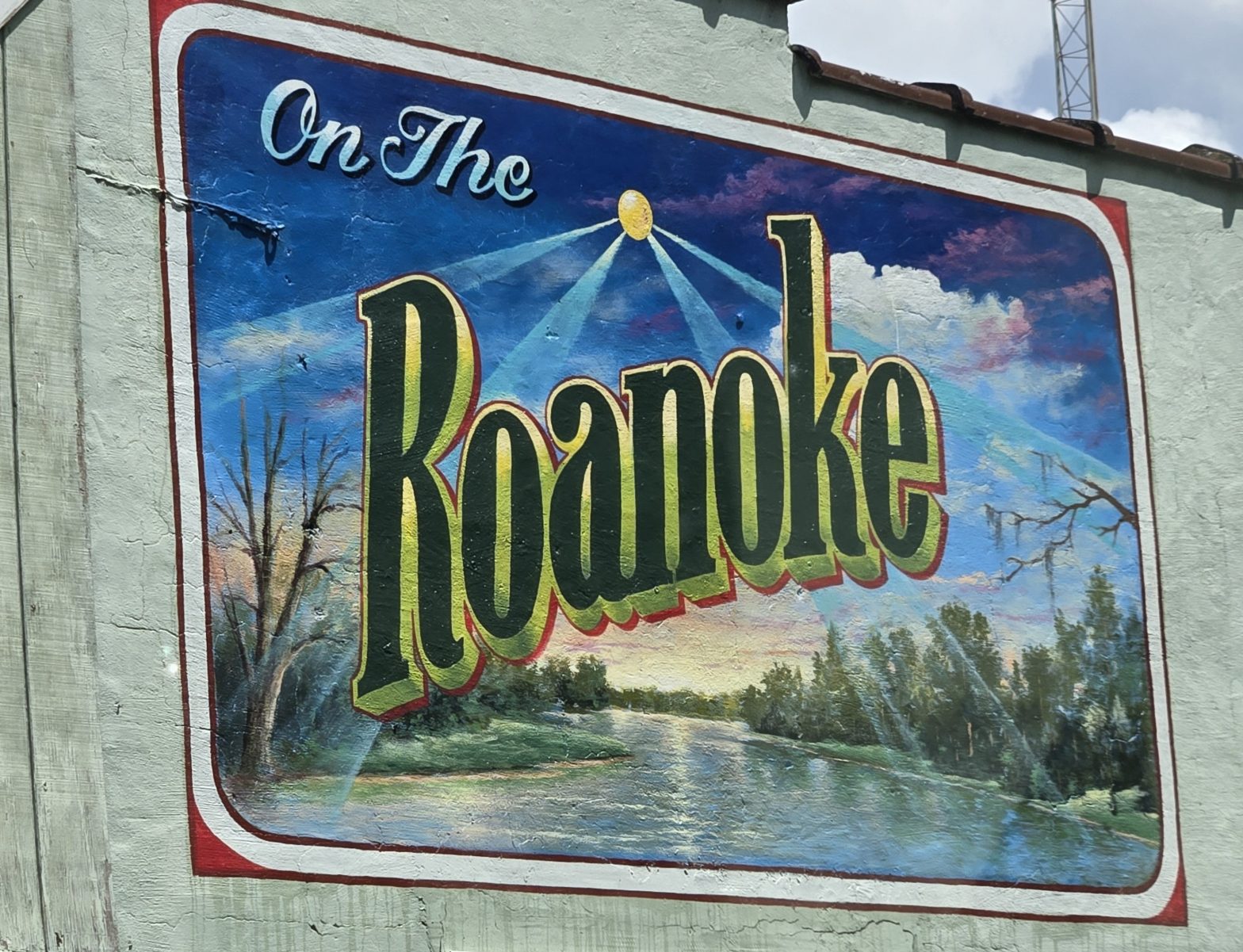
Named for Josiah Martin, the last royal governor of North Carolina (1771–75), Martin County was formed in 1774 from the southeastern part of Halifax County and the western part of Tyrrell County.
Wilber Hardee, the founder of Hardee’s is from Martin County.
Parmele
The town was settled in 1890 when the Wilmington and Weldon Railroad was built through the area to provide transportation from nearby lumber mills. It was named for local lumber mill owner E. A. Parmele. Following the construction of the Albemarle and Raleigh Railroad, the population rapidly grew, and the community was incorporated as a town in 1893 by the North Carolina General Assembly. A fire burned through much of the town on April 1, 1904, destroying many businesses and leading to the decline of nearby lumber mills. In 1909, William C. Chance founded the Higgs Industrial School for African Americans (also known as the Parmele Industrial Institute) which, at its peak, occupied a six-building campus and merged with the town’s public school. The school was closed following a fire at its main building in 1954.

Robersonville
Robersonville, incorporated in 1872, is located in North Carolina’s Inner Banks region. Once an affluent eastern North Carolina community, it is noted for its abundance of historic mansions and estates, due in large in part to families obtaining wealth from the tobacco industry and then later manufacturing.
The earliest known residents of the Robersonville area were the Tuscarora and Morotock Native American people. According to various deeds, family bibles, wills, and church records, European settlers arrived many years before the Revolutionary War. One of the earliest known churches of the area was Flat Swamp Primitive Baptist Church, founded in 1776. Among the early settlers of this area was the family of Henry Robason, who is said to have been born in 1710 in England. Eventually the family name became “Roberson,” and the family tree grew throughout the region. Before the Civil War, George O. Roberson and his father, William, owned a store originally located on the northwest corner of what are now Railroad and Roberson streets. The local militia trained at this store during the Civil War.
When the town was incorporated February 16, 1872, it became the first town in Martin County not located on the Roanoke River; thus, it wasn’t dependent on the river for communication with other settlements. Instead, the railroad was the main artery of communication and trade. The town was named after Henry, William, and George Roberson. Of the three brothers, Henry D. Roberson is considered to be the “Father of Robersonville.”
In the late 1800s, the Jewish Agricultural Society helped many Jewish families relocate from Russia to the United States. While most of these families settled in the Northeast, a few were relocated to eastern North Carolina due to its agrarian-based economy and abundance of affordable land. Most notably the Margolis, Smith (Schmidt), and Bernstein families came to the Robersonville area in the early 1900s and took to farming in addition to owning department stores and shops. In 1902, Adath Shalom (Congregation of Peace) was established. The first synagogue was built in 1907 and existed until it caught fire in the late 1940s. Afterward, most families attended religious services in nearby Rocky Mount, 34 miles (55 km) to the west. The handful of Jewish families who resided in Robersonville and nearby Williamston either died or relocated to larger cities, with the Margolis family being one of the last to leave in the 1990s.
Everetts
Incorporated in February 1891, Everetts was named for a family of first settlers and was a thriving trading center situated along the railroad between Robersonville and Williamston. It began more than 20 years earlier as a small rural cross roads named for its principal landowner, Simon Peter Everett. In 1869, he deeded some of his land to the Williamston and Tarboro Railroad Company for the construction of the railroad.
After October 1882, when the Seaboard and Raleigh Railroad, the successor to the Williamston and Tarboro, finally completed the rail line, the Everetts community began to develop as a market for agricultural products such as cotton, corn, grapes, potatoes and eventually peanuts. It grew into a trading center for much of Cross Roads and Poplar Point townships for farm and household supplies. The railroad, with its mail, passenger, and freight services and telegraph line, was the lifeline of the community. Today, visitors can see the landmark J.T. Barnhill Building along US Business 64/13, which still serves as a general store and has a painted billboard on its outside wall.
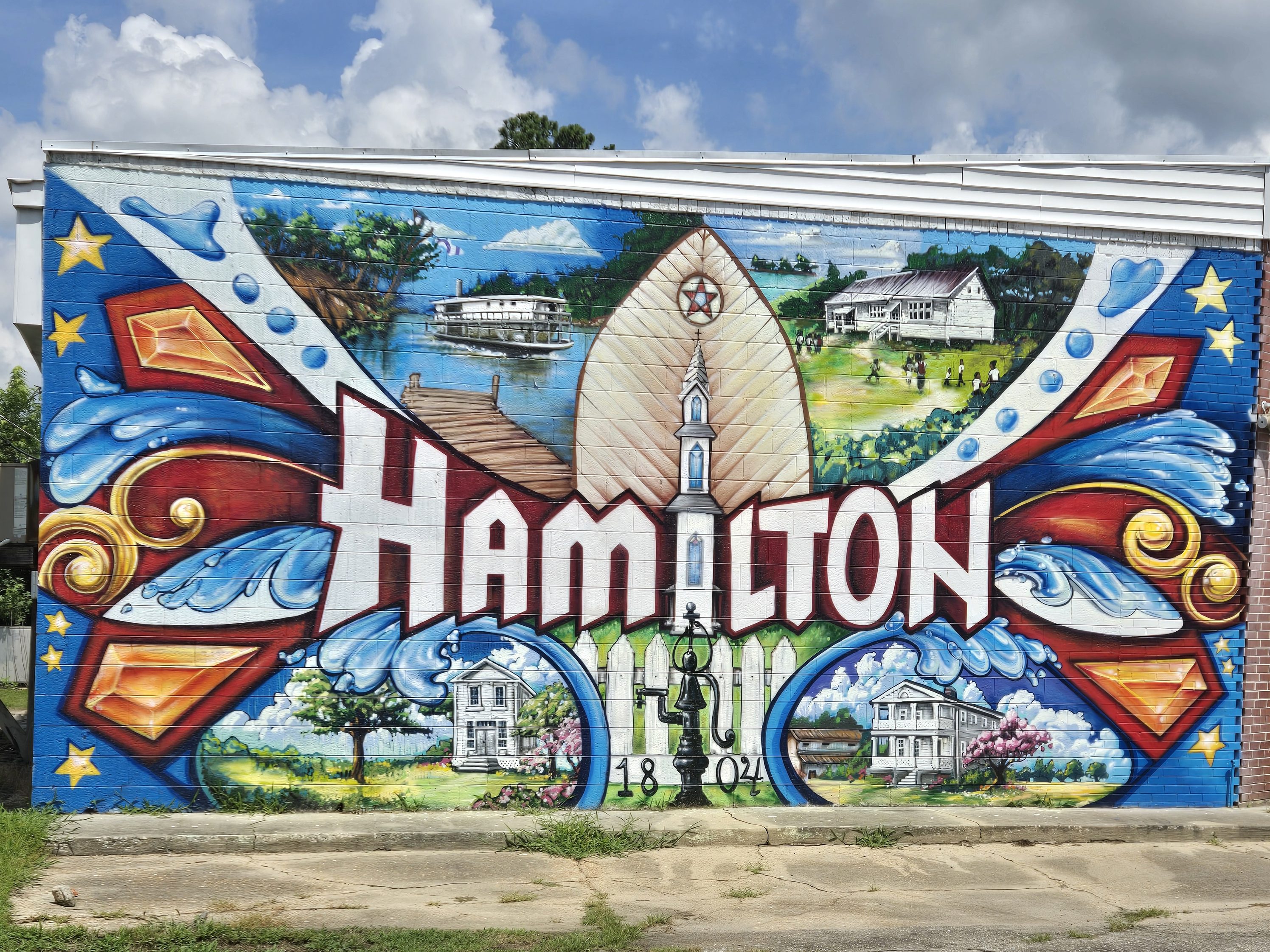
Hamilton
The town was founded in 1804 at the highest point of navigation on the Roanoke River.
According to local historians, the most significant historical event of early Hamilton was the battle and fall of Fort Branch during the American Civil War, when Union vessels and troops came upriver from Plymouth in an attempt to reach Weldon to cut off supplies to General Robert E. Lee. The fort, located two miles southeast of Hamilton along the Roanoke River, protected Weldon until the day after General Lee surrendered at Appomattox Court House, whereupon the railroad line over the Weldon bridge had no more military significance. Afterward, the fort was abandoned and the cannons were dumped into the Roanoke by departing Confederate troops.
In 1887, the town saw construction of its first railroad, the Hamilton Railroad & Lumber Company, also known as Hitch’s Railroad. This was a short line that served the lumber industry in the area, but later expanded operations. In the 1910s, a Rosenwald school was constructed in Hamilton to serve the local black community. Alternating dates of construction are reported, with the earliest being 1914. The school operated until 1960.
Hamilton, once a thriving, beautiful Victorian port town with many of its homes listed in the National Historic Registry, has been in decline in recent years, losing more than half its population since 1980.
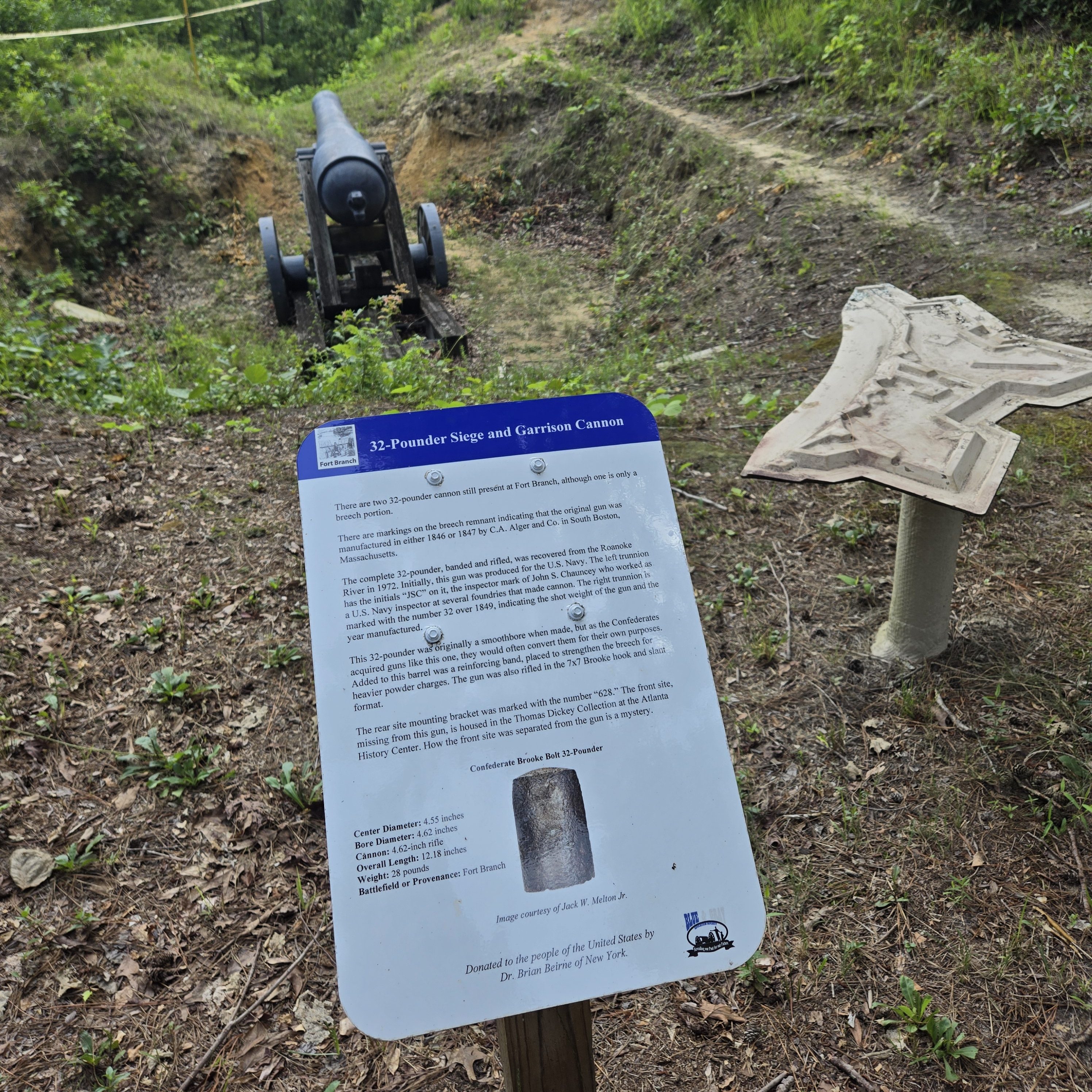
Fort Branch Civil War Site
Located just past Hamilton, The Fort Branch Civil War Site (2883 Fort Branch Rd.), is worth a visit and self-guided tour.
In July 1972, a group of men from Alabama began pulling cannons from the river. In an effort to keep the cannons in Martin County, the group was accused of violating North Carolina’s antiquities laws. The courts officially decided that the cannons belong to the state under the North Carolina Department of Archives and History. The department decided to permanently loan the artifact to Fort Branch.
Another important site in Hamilton is the Rosenwald School, a black school funded by Julius Rosenwald, president of Sears, Roebuck and Co. During segregation, white schools had approximately five times the funding of the former. The Rosenwald Fund sought to provide support for these underprivileged schools.

Williamston
Founded in 1779 and named after Williams William, a local military commander during the American Revolution, Williamston is the county seat of Martin County.
Williamston was a focus of activity in the Civil Rights Movement. Beginning in June 1963, civil rights activists led by Golden Frinks protested at City Hall for 29 consecutive days. The Ku Klux Klan was very active in this part of the state during this time, including a well-documented rally in Williamston on October 5, 1963, attended by mostly local residents but with several carloads of attendees traveling over 150 miles to attend.

Moratoc Park
Moratoc Park (102 River Dr.) is a lovely 18-acre riverside park, located beside the Roanoke River. The park features a river overlook and a newly constructed riverside walkway. The park also features a river overlook, fishing pier and canoe/kayak launch, and the Moratoc building, a rustic conference building overlooking the scenic Roanoke River. Moratoc Park is the site of the original wharf of Williamston, where goods were shipped in and out.
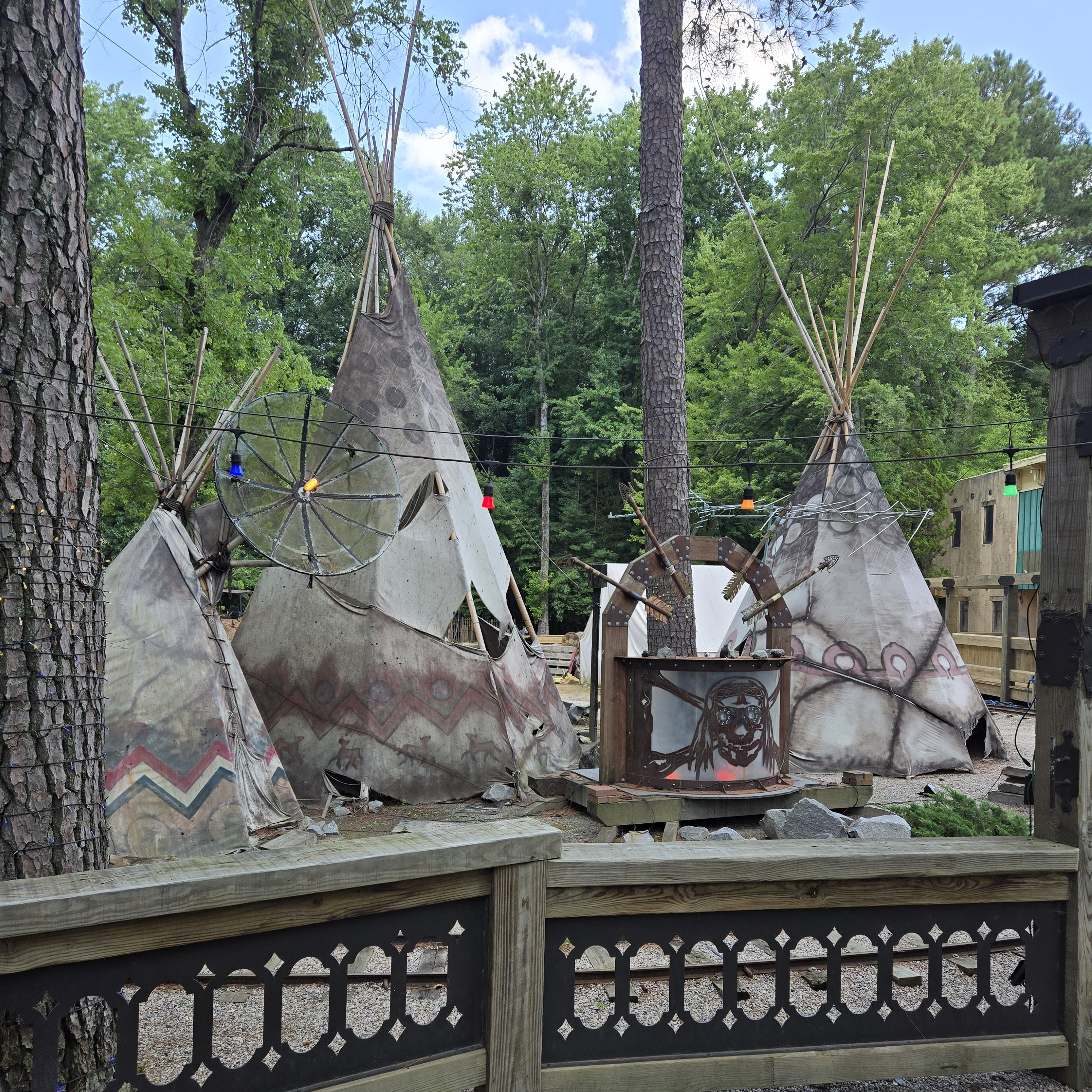
Deadwood Restaurant and Theme Park
Located south of Williamston and near the town of Bear Grass (2302 Eds Grocery Rd.), the Deadwood Restaurant and Theme Park is a family-owned and operated Western Theme Park featuring scenic train rides, miniature golf, arcades, playground, roller coaster, carousel, picnic areas, ice cream and coffee shop, a full-service restaurant, and a large indoor area that features a dinner theater, a haunted house for Halloween, and a banquet hall for private parties. Outside of peak hours, you can enter the park to walk through.

Bear Grass
The town of Bear Grass, located in the southern part of Martin County, was named for a type of yucca (Yucca flaccida) that grows less than two feet in height and is found abundantly in the region. The community’s development was hindered by it not being located along a navigable stream or on either of the railroad lines traversing Martin County. A post office was established in 1885, although it was closed less than two years later.
Records are limited, complicated by the fact that Bear Grass businesses were listed in directories with Williamston addresses because that was the nearest post office. But by the turn of the century, the community consisted of several legal distilleries, cotton gins, sawmills, grist mills and blacksmith shops. Reuben H. Rogerson’s two-story steam-powered sawmill and cotton gin was one of the area’s largest before being destroyed by fire in November 1908.
The first decade of the 20th century witnessed considerable growth in the community. After several meetings in early 1909, the town’s merchants drew up a charter, and on February 16, 1909, the North Carolina General Assembly granted a charter to the town of Bear Grass.
An unusual physical feature of the town is that, when incorporated, the boundary was a circle with a radius of 500 yards from a white oak “near a well at the stores of Rogers Brothers and Cowing Brothers.” These limits remain today, making Bear Grass one of the few towns in the state laid out in this manner.
Local artist Henry C. Cowen created two statues that enliven the Bear Grass School campus. The “rampant bear” statue standing in front of the school was sculpted in 1981. The statue of George Washington in front of the Yucca House (formerly the Bear Grass School teacherage) was commissioned by the Bear Grass Ruritan Club in honor of the country’s constitutional bicentennial in 1987. Cowen also produced several war memorial soldiers located on the corner of Green Street and Ayers Avenue.
Beginning in 2014, Bear Grass hosts the annual Chicken Mull Festival. Chicken mull is a local comfort food consisting of parboiled chicken, broth, crushed soda crackers, chopped boiled eggs and seasoning. The festival is held each year in the fall.
Next stop… Bertie County!
 Portable NC