
Discover Burlington at the heart of Alamance County!
The need of the North Carolina Railroad in the 1850s to locate land where they could build, repair and do maintenance on its track was the genesis of Burlington, North Carolina. The company selected a piece of land slightly west of present-day Graham. On January 29, 1856, the last spikes were driven into the final tie of the North Carolina Railroad project, uniting the cities of Goldsboro and Charlotte by rail. The next day, the first locomotive passed along the new route. When the iron horse arrived in Alamance County, locals referred to it as “the eighth wonder of the world”.
Not long after this historic opening, the railroad realized a pressing need for repair shops. With Alamance County’s position along the new line, it became the logical choice for the shops’ location. After several debates concerning where the shops would be located, Gen. Benjamin Trollinger, a progressive Alamance County manufacturer, made an offer that settled the matter. Gen. Trollinger owned land just northwest of Graham, and he convinced several other prominent citizens owning adjacent lots to join him and sell their property to the railroad. 57 buildings were constructed between 1855 and 1859, including structures for engine and machine shops, carpentry, blacksmithing, houses for workers and railway officials, and company headquarters. For a brief period, railroad directors changed the name of official name of “Company Shops” to “Vance” (1863–1864), the village returned to the “Company Shops” moniker in July 1864.
During the Civil War, Company Shops remained a small village without many public utilities or services, such as churches and schools. It was only in 1863 that company stockholders approved city street layouts and the sale of private property in the village, although properties used for commercial purposes still had to be leased by the company and couldn’t be bought. In 1866, the village was officially incorporated as “Company Shops.”
Through a series of leases and mergers, the railroad was leased to Richmond & Danville Railroad (1871), working as part of the Pennsylvania Railroad, and in 1893, the North Carolina Railroad was folded into the Southern Railway system. With the railroad shops no longer operated there, the citizens of Company Shops decided a new name was needed. In February 1887, a contest was held to decide a name, and one person submitted the name “Burlington” after seeing it on a passing train. An appointed committee for the town selected the name, and the name was officially changed through North Carolina State Legislature.
Around the turn of the century, Edwin M. Holt established small textile operations along the Haw River and Great Alamance Creek. In 1908, Edwin M. Holt built the first cotton mill in the South. From the establishment of this single factory, Alamance County grew to eventually operate 30 cotton mills and 10 to 15 yarn manufacturing plants employing 15,000 people. Eventually, the early textile venture of Edwin M. Holt became known all over the world as Burlington Industries. Throughout this period, Burlington became a prosperous and vibrant small city filled with schools, churches, newspapers, telegraph and telephone lines, roads and a streetcar line.
During a century-and-a-half of economic change, Burlington grew, adapted, and prospered. Originally the center of commerce for Company Shops, the downtown area still serves as the heart of today’s community with financial services, government services, an expanded library, small shops, eateries and a restored theater. Downtown has also returned to its status as a major employment center, becoming the home to Laboratory Corporation of America (LabCorp), one of the world’s largest biomedical testing firms and Burlington/Alamance County’s largest employer.

Dentzel Carousel at Burlington City Park
One of Burlington’s prized destinations is the carousel at Burlington City Park (1388 S Main St.). The grounds consist of many outdoor activities and play spaces, walking paths, a mini train ride, and, or course, the beautiful indoor, 3-row carousel. This carousel has been restored and well cared for over the years and the building’s doors open to the outdoors during temperate days, while being heated and air conditioned inside when needed. The carousel operates during select hours on weekends.
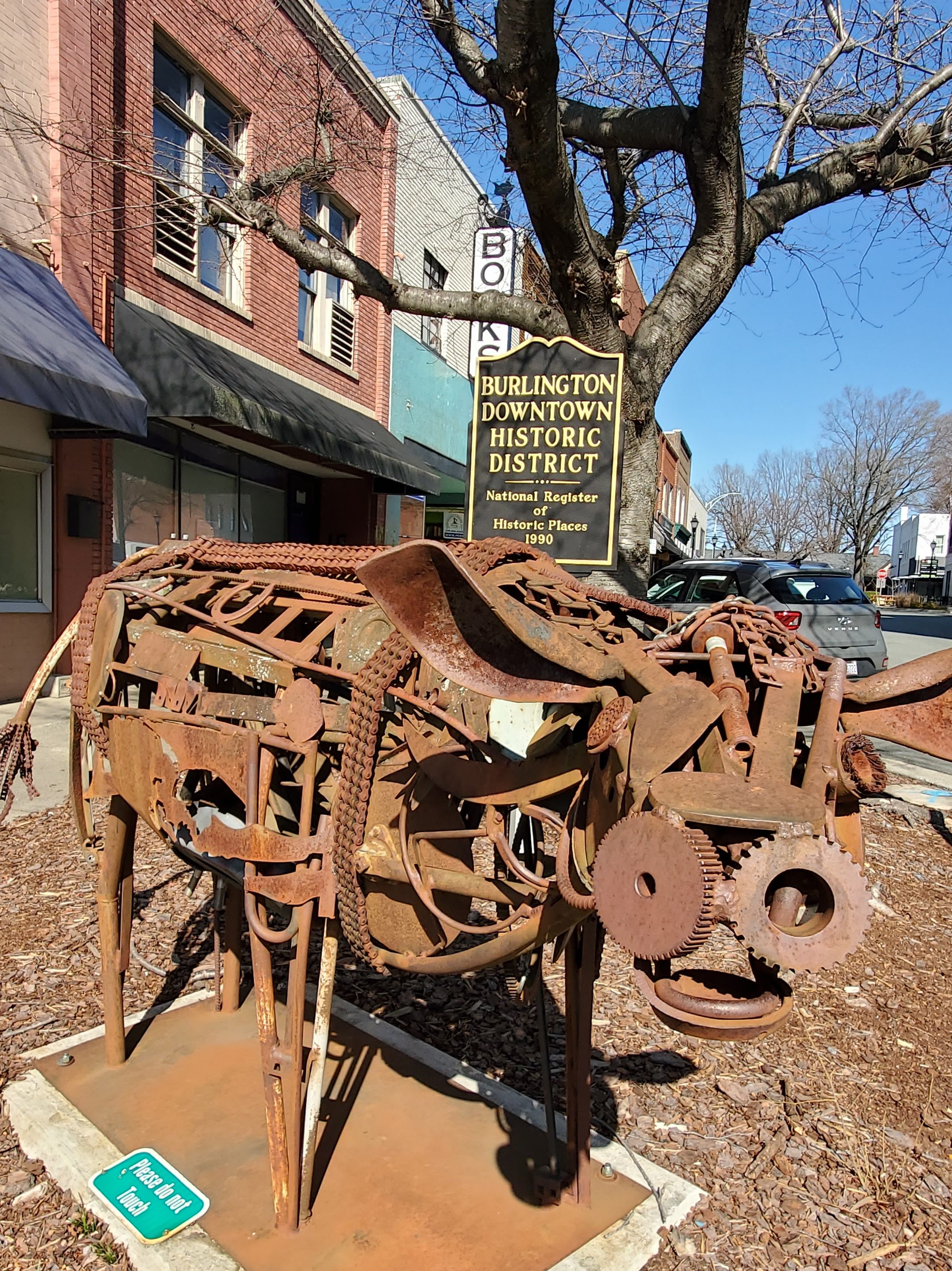
Burlington Historic District
While in downtown, be sure to meander through the historic district, which includes a variety of shops, a bookstore (Persnickety Books), ice cream shop, the 1928 Paramount Theater (128 East Front St.) and public art. Adjacent to the shopping areas is the old rail station complete with a few rail cars on display and statuary on the grounds. Stop by Zack’s Hot Dogs (201 W Davis St.) for some local fare too!
BONUS: While in downtown Burlington, you can head out on a scavenger hunt for various murals, including “Dance It Out,” the “Burlington Mural,” “Justice & Equality,” “Locks of Love: Heart of Downtown Burlington,” and “Between Us,” plus public art installations at Alamance Arts, New Leaf Society, and more.
Next stop… Northampton County!
 Portable NC