
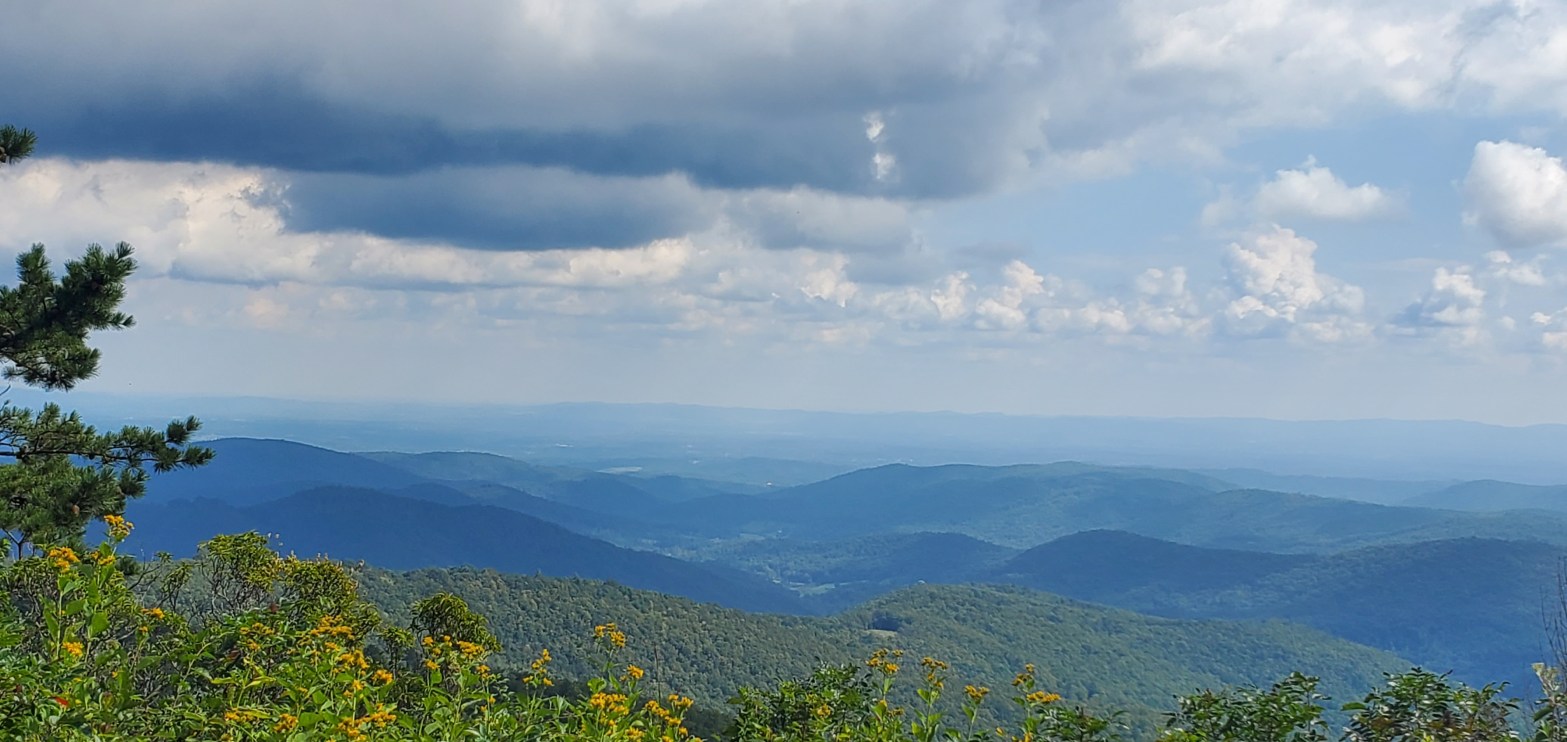
The fifth smallest county in North Carolina, Alleghany County was formed from parts of Ashe County in 1859 by an act of the North Carolina General Assembly. The county received its name from the Allegewi Indian word “oolikhanna” (beautiful stream). In 1825, Bower’s Store became Alleghany’s county seat.
The earliest inhabitants of the area eventually comprising Alleghany County were Cherokee and Shawnee Native Americans. By the late 1700s, these people had been displaced by English, German, and Scotch-Irish settlers. The county was formed in 1859 from the eastern part of Ashe County. A group of commissioners selected a site near the center of the county to build a courthouse and established the county seat of Sparta. The county was expanded through annexations at the expense of its neighbors from 1869 and 1903, and a portion was moved to Wilkes County in 1909.
The construction of the Blue Ridge Parkway in the 1930s led to increased tourism and growth in Alleghany County. In 1936, the regional Blue Ridge Electric Membership Corporation was founded with the support of the Rural Electrification Act, leading to the eventual expansion of electric utility service in Alleghany. In 1944, the county’s first major manufacturer—D&P Pipe Works—opened after relocating from Chicago to Sparta to be closer to supplies of local mountain laurel roots which were used during World War II in the production of wooden tobacco pipes. Due to unreliable electricity, the company relied on its own generator for power, but utility service improved after the war.
Alleghany County’s economy grew in the 30 years following World War II with the expansion of manufacturing, aided by the improved electricity service and company’s desire to locate their facilities in areas with lower land costs, fewer regulations, and less competitive wages. Service-oriented businesses cropped up along U.S. Route 21 to accommodate travelers driving north out of the state. Use of the highway decreased after Interstate 77 was completed in 1975. D&P Pipe Works, later renamed Dr. Grabow, peaked with about 350 employees before health concerns regarding tobacco smoking led to a decline in demand for pipes in the late 20th century. Between 2000 and 2005, the county lost 60 percent of its manufacturing jobs.
The county is located entirely within the Appalachian Mountains region of western North Carolina. Most of the county is located atop a rolling plateau that ranges from 2,500 to 3,000 feet (760 to 910 m) above sea level. The southern border of the county drops abruptly nearly 1,500 feet (460 m) to the Foothills region of North Carolina. The plateau is crossed by numerous hills and mountains, and the highest point in the county is Peach Bottom Mountain/Catherine Knob at 4,175 feet (1,273 m) above sea level. The major rivers of Alleghany County are the New River and the Little River; the latter flows through the town of Sparta, the county seat.
Alleghany County is one of several North Carolina counties which produces a significant amount of Christmas trees, with an estimated 1.2 million such trees from the county being sold in 2022. You’ll see Christmas tree farms throughout the county, including on hill and mountainsides. Alleghany also produces the most pumpkins among the counties in the state, so pumpkin fields abound hear — and you’ll see many trucks loaded up with pumpkins from September onward — as they make their way to porches across the state.
Alleghany County’s Barn Quilt Trail features 98 barn quilts spread across the county. An arts community is centered in Sparta. The NC Mountain Arts Adventure is held each year in October, featuring 12 studios throughout two weekends across the county.
Roaring Gap
Roaring Gap was established in 1890 as a summer resort by Elkin, North Carolina industrialist Alexander Chatham, one of the founders of the Chatham Manufacturing Company. The community derives its name from the noise the wind makes when rushing through the mountains located there. Roaring Gap has 3 golf and country clubs.
Stone Mountain State Park
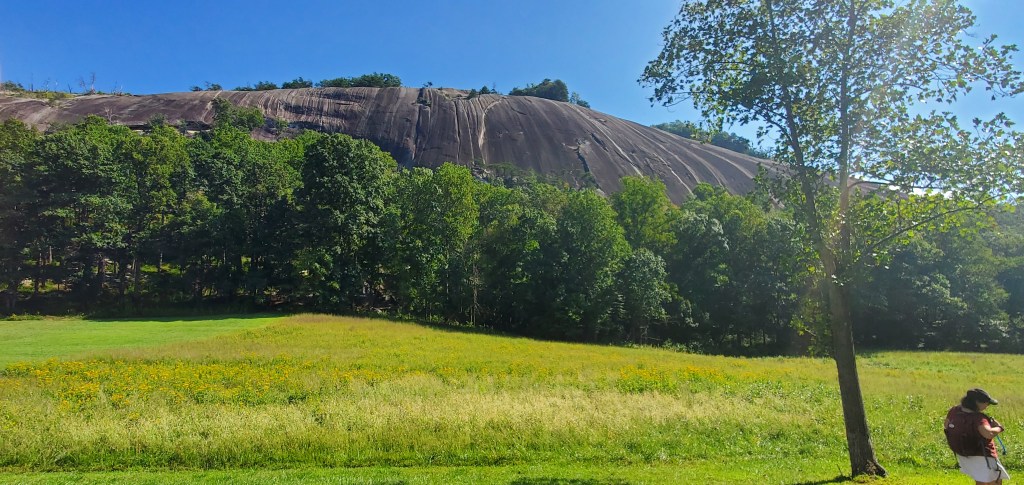
The centerpiece of the park is Stone Mountain (accessed via Frank Parkway in Roaring Gap), a dome of exposed granite (specifically a quartz diorite to granodiorite) of Devonian age, which has intruded into the gneiss of the Precambrian Alligator Back Formation. It rises sharply over 600 feet (183 m) above the surrounding terrain. The mountain, which has an elevation of 2,305 feet (706 m) above sea level, is known for its barren sides and distinctive brown-gray color, and can be seen for miles. The mountain offers some of the best rock climbing in North Carolina, and the park’s creeks and streams feature excellent brook trout fishing. Because the mountain is the best example of a monadnock in massive granite in North Carolina it was designated a National Natural Landmark in May 1974. The park visitor center features the Mountain Culture Exhibit, including mountain settler life and artifacts and natural history, including trout, butterflies, and moths.
The mid-19th century Hutchinson Homestead sits at the foot of Stone Mountain and includes a log cabin, barn, blacksmith shop, corncrib, meat house, and original furnishings. The Homestead is open Thursday through Sunday from March – October. The grounds can be visited year round.
The Stone Mountain viewing area can be accessed easily from the Lower Trailhead parking area. You can also access through the Upper Trailhead Parking. From both directions, you can hike the Stone Mountain Loop Trail, which features a beautiful waterfall, and view the dome from below or hike to the see the vista from atop the dome. The loop is listed as strenuous. However, this blogger (who is not a frequent hiker) found the trail to be easier–except going up the stairs on the way back. If you’ve hiked all the way out to the hanging rock, I would rate this trail easier (other than the stairs).
Sparta
Sparta is the county seat of Alleghany County. James H. Parks, an early businessman whose store stood near the present location of the ABC store, was one of three men who donated land for the county seat in 1866. Parks is credited with suggesting the name “Sparta”, after the Greek city-state.
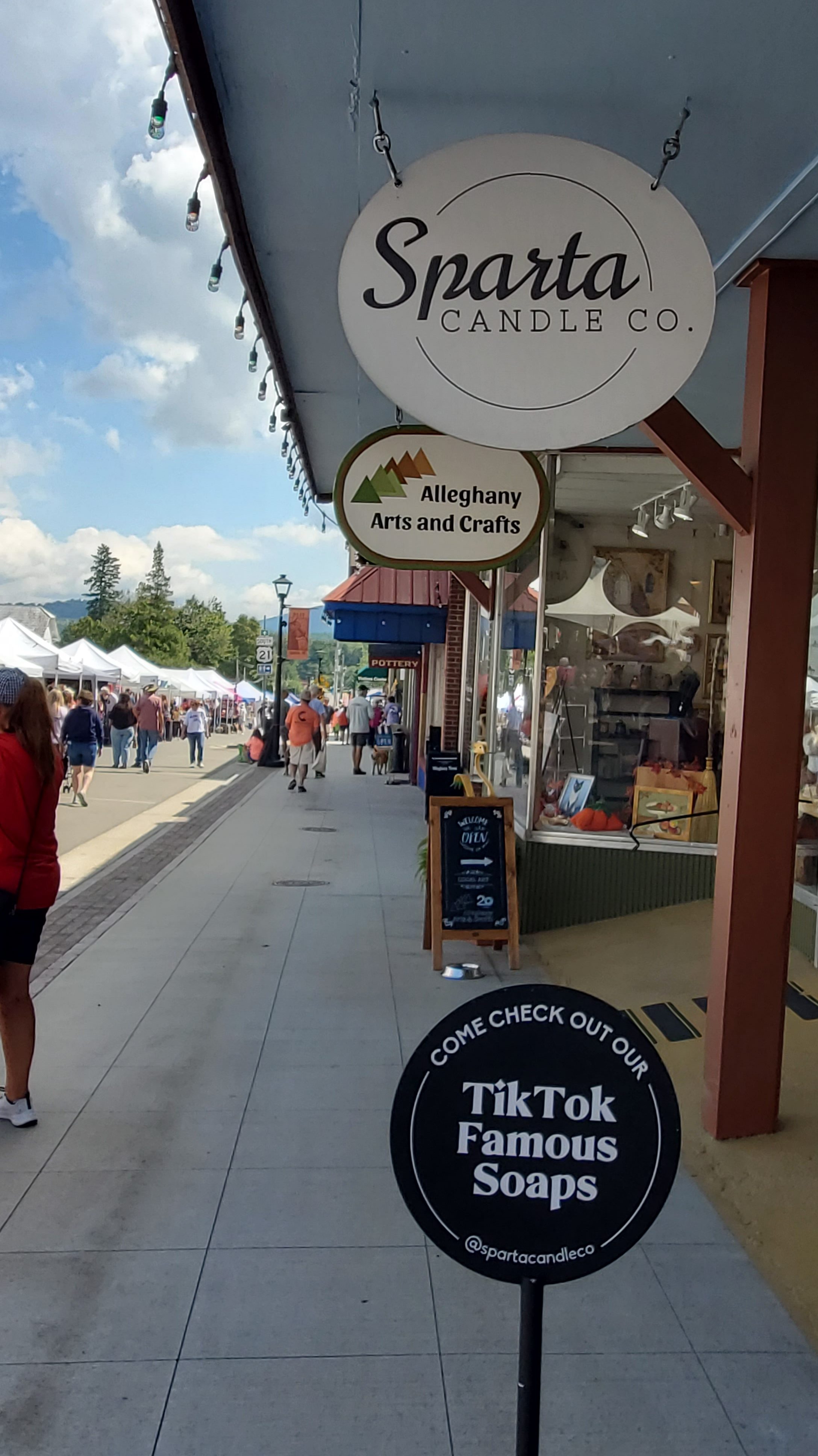
When passing through the city, which is surrounded by additional peaks, you still get an on-top-of-the-world feeling with vistas all around. Stop by the many shops, including Sparta Candle Co., as well as the Visitors Center with information about the area, plus view exceptional photography of the county’s most iconic scenes and Blue Ridge Mountains overlooks.
The town of Sparta hosts a “Music on Main” series of weekly public concerts for local musicians from June through September every year as well as the annual Mountain Heritage Festival held in downtown Sparta (on Main St.) in mid-September. Stop by for crafts, vendors, food, music, and more!
On August 9, 2020, the town was the epicenter of a moderate earthquake that was felt as far as Georgia and into the Piedmont area of North Carolina. The earthquake, which registered as a 5.1 on the Richter magnitude scale, was the largest earthquake to occur in North Carolina in over 100 years.
Doughton Park
Doughton Park is a landscape of mountains, open meadows and pioneer cabins, hiking trails and a place to view wildlife and get a feel for the lives of those who lived here long ago. Originally known as the Bluffs, this area came by its present name in honor of Congressman Robert L. Doughton, a long-time advocate and supporter of the Parkway. The 7,000-acre park is one of the best places along the motor road to view white-tailed deer, raccoons, red and grey foxes, and bobcats, as well as spectacular shows of flame azalea and rhododendron in the late spring.
Alleghany Historical Museum
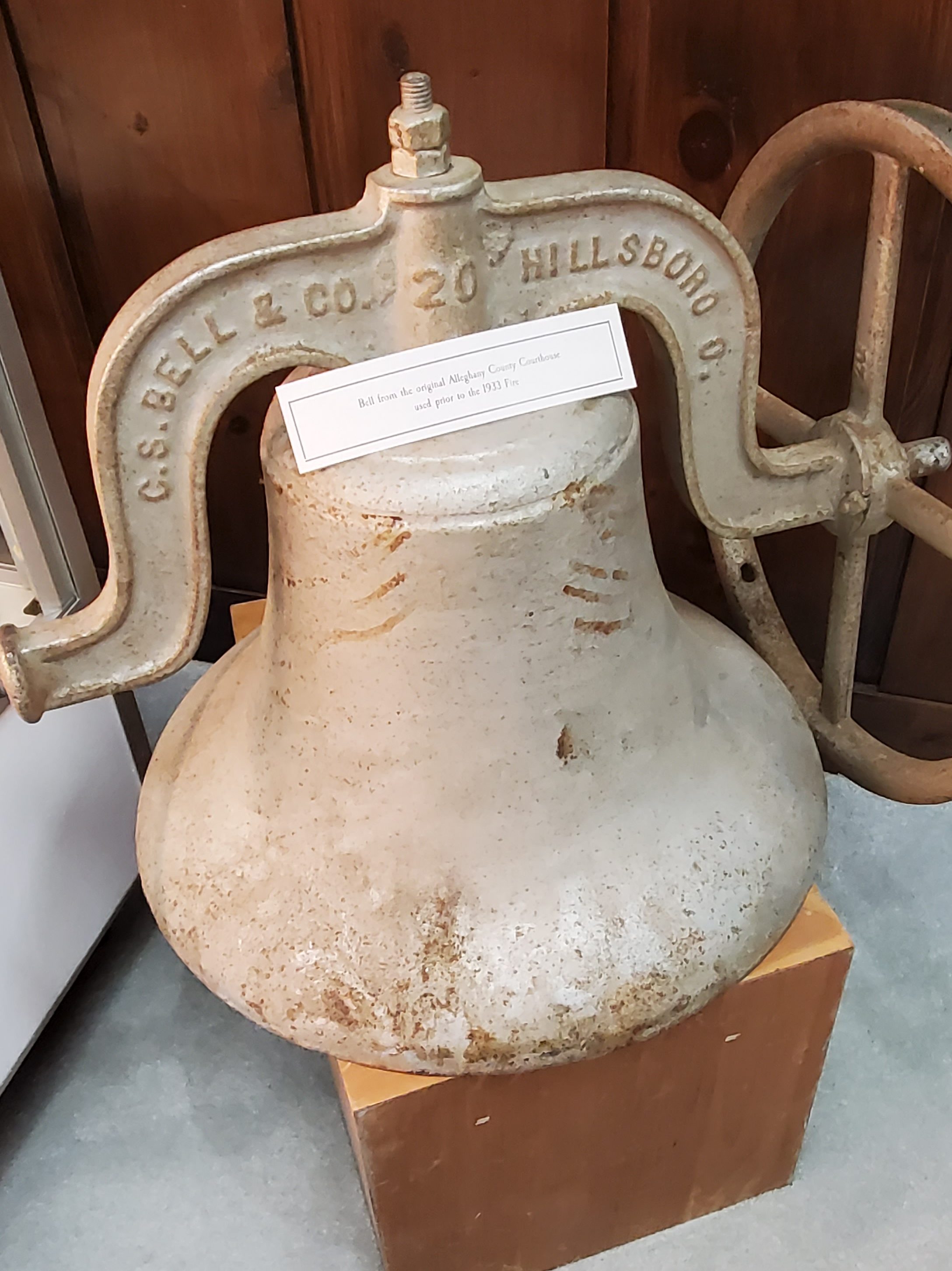
While in Sparta, stop by the Alleghany Historical Museum (45 N Main St.) and learn about the area’s history, including farming and schooling as well as typical life. View relics from the past, including a schoolhouse desk, tobacco farming tools, historic bibles, and a large thimble collection.
Freeborne’s Restaurant and Lodge is an iconic biker’s gathering spot located at 14300 NC-18 South.
Laurel Springs
Thistle Meadow Winery
Visit the Alleghany County’s only winery (102 Thistle Meadow), just 12 miles southwest of Sparta. Located in the heart of the Blue Ridge Mountains, the winery offers tastings of wines made from grapes grown around the world. The winery is dog friendly.
P.S. NC’s Hugging Tree is located on Bluff Mountain Trail in Laurel Springs.
Next stop… Johnston County!
 Portable NC